Product Overview of the Hydroman® 150TJQ22-50H6B
When your sump fills with sand, silt, leaves and small debris, an ordinary clean-water pump will not last long. The Hydroman® 150TJQ22-50H6B is an electric trash pump built for that kind of work. It sits below the liquid surface and pushes dirty water out through a large-bore discharge. It needs no priming, no fuel and no suction hose to keep airtight.
This page covers what the pump is, where it earns its keep, and how to check that it fits your site before you place an order.
The 150TJQ22-50H6B is an electric submersible trash pump. The motor and the hydraulic end form one sealed unit that you lower directly into the sump, pit or basin. Because the pump sits in the liquid, you skip the usual suction-side headaches of a surface-mounted pump: air leaks, priming time, and lift limits (a surface pump cannot lift water more than about 7–8 m at sea level in practice, however powerful it is). A submersible trash water pump simply has water around it already.
If you are comparing an electric trash pump against an engine-driven one, the difference shows up every day on site. An electric unit makes no exhaust, uses no diesel, and is far quieter. That matters in tunnels, deep excavations, enclosed plant rooms and any site with noise or emission limits. Running cost is lower too, since a motor converts around 90% or more of its electrical input into shaft power, while a small diesel engine typically converts only 30–40% of its fuel energy.
The “trash” in the name refers to the impeller. Clean-water impellers have narrow passages that jam on grit and fibre. A trash pump uses a wide-passage, open-style impeller and generous clearances so solids pass through rather than lodge in the pump. Wear parts take the abuse of sand and abrasive particles, and you can replace them rather than scrapping the pump.
Hydroman® will confirm the exact discharge size, motor rating, impeller design and wetted materials for your configuration in the datasheet that comes with your quote.
Key Features of the Hydroman® Electric Trash Pump
Because the motor is sealed and cooled by the liquid around it, you get a compact, self-contained unit. Submersible motors in this class are normally built to IP68, meaning dust-tight and rated for continuous immersion, and typically use Class F insulation (rated to 155 °C) with built-in thermal protection. You lower it in on a chain or lifting eye, connect the discharge, connect the cable, and it is ready to go. There is nothing to prime and no engine to service on a Monday morning.
Solids are why you are here, so look closely at them. Trash pumps in the 6-inch class commonly pass solids in the range of about 50–75 mm, but the figure depends on the specific impeller. What the pump can pass is one question. What it can pass without wearing out in six months is another, and it depends on how hard, how sharp and how plentiful the particles are. Light silt and leaves are easy on a pump. Angular quartz sand or crushed rock is a different story. Tell us your particle size and concentration, and we will match the impeller and materials to them.
For a submersible, the mechanical seal is the part that decides longevity. Industrial pumps in this class usually pair a tandem or double mechanical seal, often with silicon carbide faces, with an oil chamber between the pump and motor so that grit has to get past two barriers before it reaches the windings. Pump casings and impellers are commonly cast iron or ductile iron for general drainage. For abrasive duties, high-chrome white iron with a hardness of roughly 550–650 HB lasts several times longer than standard grey iron, while stainless options suit mildly corrosive liquids.
Like any centrifugal trash pump, this pump’s output depends on where it works on its curve. As the discharge head rises, flow falls. Add long pipe runs, bends, valves and height, and the pump operates further up its curve, delivering less water than the headline flow figure. Solids add an extra penalty, because slurry is denser and more viscous than clean water, which drops efficiency slightly and raises power draw. Size the pump for the duty point, not the maximum flow on the brochure.
Cable length, control panel, starting method (direct-on-line, star-delta or soft starter), material grade and wear-part upgrades can all be discussed during quotation. If you need a particular configuration, tell us up front rather than assuming it is standard.
Technical Specifications of the 150TJQ22-50H6B Electric Trash Pump
Buyers and engineers need hard numbers, so the table below sets out the parameters that define this pump. Because Hydroman® configures pumps to suit the electrical supply and the duty, we supply the confirmed values for your exact build in the official datasheet and performance curve.
| Parameter | Information |
| Brand | Hydroman® |
| Model | 150TJQ22-50H6B |
| Pump type | Electric submersible trash pump |
| Installation | Fully submerged |
| Discharge size | 150 mm |
| Motor power | 22 kW |
| Rated flow / rated head | 200 m³/h; 15 m |
| Maximum solid particle size | 56 mm |
| Impeller type / wetted materials | Closed type; options depend on medium |
| Power supply / cable length | Specified to your site voltage, frequency and installation depth |
The model prefix “150” is commonly read as a 150 mm (6-inch) class discharge in this pump family. If your project needs an electric trash pump 6 inch class, ask us to confirm the outlet against the drawing before you finalise your piping.
A quick reality check on what “6-inch” means for flow. A 150 mm bore has a cross-section of about 0.0177 m². At the commonly recommended pipeline velocity of 1.5–3 m/s for dirty water, that works out to roughly 95–190 m³/h (about 420–840 US gpm) through the discharge line. Engineers keep slurry-type duties toward the upper half of that range so solids stay in suspension rather than settling in the pipe. Go much slower and sand builds up on the pipe floor, and go much faster and friction losses and wear climb quickly.

Applications of the 150TJQ22-50H6B Electric Trash Pump
Mine sumps collect water mixed with fines, drill cuttings and sand. These pumps clear it from pits and sump areas without stopping to unblock suction lines. In abrasive ground, material choice matters more than horsepower. A high-chrome impeller costs more upfront and often lowers the cost per operating hour.
Process plants, workshops and processing yards generate wastewater with scale, sludge and small debris. A trash pump handles that coarse content where a standard sump pump clogs. Check the liquid’s chemistry and temperature first. Most submersible motors are designed for liquids up to roughly 40 °C unless specially built.

Submersible Trash Pump Project
Foundation pits, trenches and basements fill after every storm, and the water is rarely clean. It carries silt and clay, and sometimes gravel and sticks. Pumps here get moved often, so a compact electric unit that you can lower into any sump and relocate with a crane or tripod is convenient. Matching the pump to the worst-case solids, not the average, avoids a clogged pump in the middle of a flood.
For factory sumps, drainage basins and general submersible transfer pump duties where the liquid carries more debris than a sewage or clean-water pump should handle, this is a sensible choice. It also fits as a standby unit: set it in the pit, wire it to a level control, and leave it ready.

Installation, Operation and Maintenance
Hang the pump from its lifting chain or rest it on a base, and keep it out of soft mud, because a pump sucking sediment from the sump floor wears prematurely. Keep the liquid level above the minimum operating level in the manual, and secure the discharge pipe so that its weight is not carried by the pump. Support the cable so that it never takes the pump’s weight, and avoid sharp bends in it.
Have a qualified electrician make the connections. A proper installation includes earthing, overload protection, residual-current protection and, for unattended operation, level control. If you need a submersible trash pump with float switch, ask us when you inquire so the correct control option is quoted. A float switch is not something to assume is included.
Pump life is largely decided by routine checks. Inspect the impeller and wear plate for thinning, check the oil chamber for water contamination (a milky colour is the sign that a seal is failing), test cable insulation, and tighten fasteners. Intervals depend on the medium: a pump on clean drainage may go many months between checks, while one in abrasive sand slurry deserves a look every few weeks at first, until you learn its wear rate.

Why Choose Hydroman® Electric Submersible Trash Pumps?
Hydroman® pumps are built for industrial users who care about uptime and whole-life cost. We start with your duty (flow, head, liquid, solids, power supply) and recommend a pump and configuration that fits it, rather than pushing a standard model. Our team can help you check your operating data, discuss material and electrical options, and prepare a quotation based on quantity, destination and delivery terms. We also stay realistic about what a pump can do. We would rather tell you that a slurry pump suits your duty better than sell you a trash pump that wears out early.
How to Select the Right Electric Trash Pump
Choosing a pump from a price list is the fastest route to the wrong pump. Work through these five checks.
Total dynamic head is the sum of three things: the vertical lift from the water surface to the discharge point, the friction loss in the pipe and fittings, and the velocity head at the outlet. Friction loss often surprises people. A long run of 150 mm pipe at 2 m/s loses roughly 1–2 m of head per 100 m, and every elbow and check valve adds more. Pump power can then be estimated:
Hydraulic power (kW) = Flow (m³/s) × Head (m) × 9.81 × liquid density (t/m³)
For example, moving 130 m³/h (0.036 m³/s) against 20 m total head requires about 7.1 kW of hydraulic power. At an overall pump efficiency of 55% (typical for trash pump geometry, which gives up some efficiency for solids passage), the motor must supply around 13 kW at the shaft. That is why motor ratings in this class run well above the hydraulic figure.
Pipe diameter, impeller passage and particle size all have to agree. The largest solid you expect should be smaller than the pump’s rated passage, and it also has to move through your hose or pipe and any valves downstream. A pump that passes a 60 mm lump into a 50 mm valve has only moved the blockage.
Match materials to what is actually in the water:
| Condition | Typical material direction |
| Clean-ish drainage, light silt | Cast or ductile iron |
| Sand, gravel, quarry fines | High-chrome or hardened alloy wear parts |
| Mildly corrosive or acidic water | Stainless steel or coated components |
| Hot or chemical liquids | Special seals and motor, confirm with us |
Verify voltage, frequency (50 or 60 Hz), number of phases and cable length against your site. On the single phase submersible pump question: in practice, single-phase supply is generally limited to small pumps, usually under about 2–3 kW. A 6-inch-class trash pump needs far more power than that, so expect a three-phase supply. Also plan overload protection, earth-leakage protection and a properly rated control panel.
When you compare electric trash pumps for sale, look past the unit price. Ask for the performance curve, the solids passage, the seal type, the wetted materials and the availability of spare parts. On abrasive duty the purchase price is often a minor part of lifetime cost, with wear parts, downtime and energy making up most of it. If someone claims to offer the best electric trash pump, ask what duty point they are measuring and whether you can see the curve.
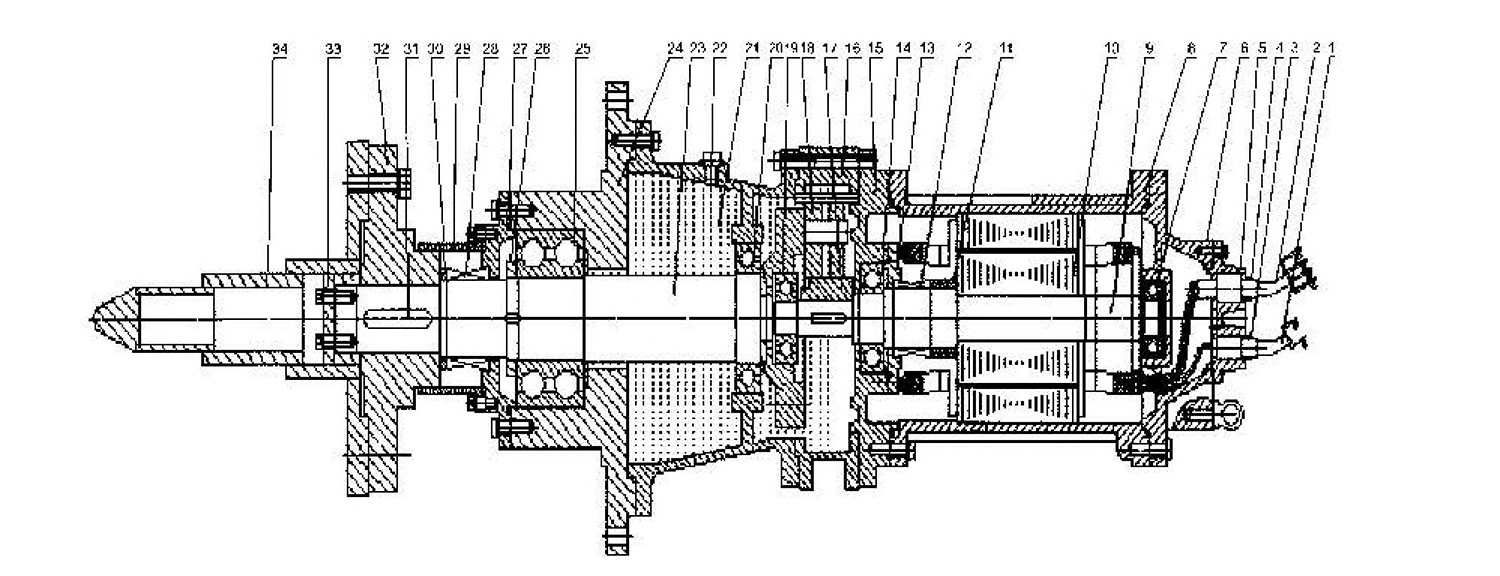
| Serial No. | Name | Serial No. | Name | Serial No. | Name |
| 1 | Control cable | 2 | Power cable | 3 | Control cable gland |
| 4 | Power cable gland | 5 | Cable seat | 6 | Upper end cover of the motor |
| 7 | Bearing | 8 | Stator | 9 | Rotor axle |
| 10 | Rotor | 11 | Mechanical seal pad | 12 | Mechanical seal |
| 13 | Gland | 14 | Bearing | 15 | End cover |
| 16 | Pin wheel housing | 17 | Bearing | 18 | Cycloid gear |
| 19 | Bearing | 20 | Bearing | 21 | Engine oil |
| 22 | Oil plug | 23 | Main shaft | 24 | Bearing body |
| 25 | Bearing | 26 | Round nut | 27 | Bearing body gland |
| 28 | Mechanical seal | 29 | Sheatding | 30 | Mechanical seal pressure pad |
| 31 | Key | 32 | Coupling flange | 33 | Axle head pressure plate |
| 34 | Stirring head |
Not every dirty-water job needs a trash pump, and not every trash pump suits every job. Here is how the main types compare.
| Pump type | Best suited to | What to watch |
| Electric submersible trash pump | Dirty water with sand, silt, small debris | Solids size, abrasion, wear parts |
| Submersible slurry pump | Highly abrasive, dense slurry | Higher cost, built for wear rather than free passage |
| Submersible sewage pump | Domestic and municipal sewage, fibres | Not designed for heavy sand or abrasive solids |
| Electric semi trash pump | Water with finer solids | Narrower passages than a full trash pump |
| Vertical trash pump | Deep, narrow sumps with a pump mounted above | Needs a bearing column and more headroom |
A submersible trash slurry pump sits between the two worlds: it handles more abrasive, denser material than a standard trash pump, at the price of heavier wear parts. If your sump carries more than a modest amount of sand, ask us whether a trash pump or a slurry-duty build is the better fit.
A word on terms: you may also see “submerged trash pump” or “immersion trash pump” in catalogues. They describe the same idea, a pump working while immersed in the liquid. And note that a trash pump is by nature a single stage trash pump in most designs, because staging adds passages that would catch solids. We will confirm the configuration for your exact build.
It moves water that contains solids, such as sand, silt, mud, leaves and small debris, from sumps, pits, excavations and basins. Typical uses include mining and quarry dewatering, construction drainage, industrial wastewater and general electric waste pump duties.
The “150” in the model points to a 150 mm (6-inch) class discharge, and we confirm the exact outlet size on the datasheet and drawing that accompany your quote. Verify it against your pipework before ordering.
Yes, within limits. Sludge and fine sand are normal trash pump territory. Heavy, coarse or very angular sand wears impellers quickly, so you may want hardened materials or a slurry-duty design. Tell us the particle size and concentration so we can recommend the right build.
A trash pump is designed to pass solids freely with minimal clogging, mostly in water-dominated liquids. A slurry pump is designed to survive highly abrasive, high-solids mixtures, with thicker wear parts and a more rugged hydraulic design. Trash pumps favour free passage, and slurry pumps favour wear life.
A float switch is not assumed to be part of the standard pump. Level control options depend on the configuration you order, so tell us if you need automatic start and stop when you request a quote.
Pumps of this size are normally three-phase. Please send us your site voltage, frequency and phase, and we will confirm what can be supplied.
Send us the flow rate and head you need, the liquid and its solids content, particle size, power supply, quantity and delivery destination. The more we know about your site, the more accurate your quote will be.
Get a Quote for Your Electric Trash Pump
Tell us about your pumping conditions: required flow rate, total head, solids content and power supply. Our team will help you evaluate a suitable pumping solution for the Hydroman® 150TJQ22-50H6B and reply with a recommendation and quotation.
 Sara Liang
 +86 189 3110 6396 (Whatsapp/Wechat)
 Inquiry@tobeepump.com
Please provide your information: Name · Business Email · Company · Country · Required Flow Rate · Total Head · Pumped Medium · Particle Size · Power Supply · Quantity · Additional Requirements
Related Pumps

Tobee is specialized in providing solutions for slurry pump, vertical sump pumps, gravel pump, dredging pumps, froth pump, seawater pumps, fire pumps, slurry pump parts and OEM pump parts for your harsh projects.
Top Navigation
Top Navigation
Contact Information
+86 180 3203 4573
+86 311 8722 1317
No. 266, Tianshan St, High-tech Zone, Shijiazhuang City 050000, China.