Electric Centrifugal Trash Pump Description
When you're standing at the edge of a flooded excavation, a silt-choked sump, or a construction pit full of gravel and sludge, the last thing you want is a pump that seizes up the moment it meets something bigger than clear water. That's the exact problem the Hydroman® TBZ411 submersible trash pump was built to solve. It's an electric submersible trash pump engineered to keep moving water loaded with solids, debris, mud, and stringy waste — the kind of water that would jam a standard clean-water pump within minutes.
If you've been running a KBZ411 and looking for a drop-in upgrade, you're in the right place. The TBZ411 is designed as a full replacement for the KBZ411, matching its footprint and connection sizing while giving you the option to step up in flow, head, or solids handling depending on how you configure it.
Below, you'll find everything you need to know about how the TBZ411 works, where it fits on your job site, how it stacks up against a standard submersible water pump, and how to size one correctly before you buy.
What Makes the TBZ411 a "Trash Pump" and Not Just Another Submersible Pump
There's a real, practical difference between a submersible water pump and a submersible trash pump — it's not just marketing language. A clean-water pump uses tight impeller clearances and small internal passages to maximize efficiency on clear liquid. Feed it water with sand, wood chips, small stones, or rags, and those tight clearances turn into a clog risk almost immediately.
The TBZ411 is built the other way around. It's a submersible centrifugal trash pump, meaning it uses an open or semi-open, non-clogging impeller with wider internal passages specifically so solids can pass through the volute instead of jamming it. That's the core distinction behind the "submersible pump vs trash pump" question people search for — it comes down to impeller geometry and passage size, not just horsepower.
Submersible electric motor. The motor sits fully submerged in the pumped liquid or in an oil-filled, hermetically sealed chamber, driving the impeller directly with no belts or external seals exposed to the debris stream.
Centrifugal pumping action. As the impeller spins, it flings liquid outward into the volute, converting rotational energy into flow and head — pushing water (and whatever's mixed into it) up through the discharge pipe.
Non-clogging solids passage. Wider vane spacing and a vortex-style flow path let solids ride through the pump body rather than getting trapped against the impeller face, which is what separates a submersible dirty water trash pump from a standard sump pump.
Heavy-duty cast iron construction. The pump body, motor housing, and impeller on the TBZ411 are cast iron — the same material choice you'll find across the majority of commercial-grade submersible trash pumps, because it holds up against abrasive slurry and repeated solids impact far longer than aluminum or plastic housings.
Handles genuinely dirty water. This is where the TBZ411 earns its place as a submersible trash water pump rather than a general submersible dirty water trash pump with a marketing label slapped on. Sand, gravel, sludge, leaves, small stones, and fibrous debris all pass through without stalling the impeller.
Direct submersible installation. You don't need a dry-pit station or a separate priming system. Lower the TBZ411 into a sump, collection tank, excavation pit, or flooded basement and it starts moving liquid as soon as it's covered.
Optional float switch control. A submersible trash pump with float switch turns the TBZ411 into a genuinely hands-off system — it starts automatically when the liquid level rises and shuts off once the pit is drawn down, which matters a lot for unattended dewatering overnight or on a job site where nobody wants to babysit a pump.
Continuous-duty motor protection. Thermal overload protection and IP68-rated sealing mean the motor is designed to run for extended cycles in submerged, high-humidity, and high-solids conditions rather than short bursts.
Hydroman® TBZ411 Submersible Trash Pump

TBZ411 Specifications
Actual output figures for any electric submersible trash pump depend on the motor size, voltage, and discharge configuration you order — and we'll always confirm exact numbers against the current TBZ411 datasheet before you place an order. To give you a realistic frame of reference, here's how the TBZ411 platform typically compares against the performance range seen across 3–4 inch electric submersible trash pumps in the industry today:
| Parameter | TBZ411 (typical configuration) | Industry range for 3–4" electric submersible trash pumps |
| Pump Type | Submersible centrifugal trash pump | Centrifugal / vortex |
| Drive Type | Electric, direct-coupled | Electric or engine-driven |
| Discharge Size | 4 in (100 mm) | 2 in – 6 in |
| Motor Power | 11 kW (15 HP) | 0.5 HP – 35 HP |
| Flow Rate | Up to approx. 84 m³/h (369 GPM) | 70 – 1,600+ GPM |
| Total Head | Up to approx. 48.5 m (159 ft) | 25 ft – 105 ft |
| Max Solid Size | Up to 11.5 mm spherical | 1 in – 4 in |
| Motor Protection | IP68, thermal overload | IP68 typical for submersible class |
| Impeller | Cast iron, non-clogging vortex/semi-open | Cast iron, stainless, or hard-iron |
| Cable | Submersible-rated, oil- and abrasion-resistant | 20 ft – 33 ft standard |
| Housing Material | Cast iron | Cast iron, aluminum, or stainless |
| Float Switch | Optional tethered float, automatic on/off | Optional on most electric models |
Ask your Hydroman® sales contact for the confirmed performance curve for the exact TBZ411 model code you're considering — output varies with voltage (single-phase or three-phase), frequency (50 Hz or 60 Hz), and discharge configuration.
| Capability | TBZ411 Trash Pump | Standard Submersible Water Pump |
| Clean water | Yes | Yes |
| Water with sediment or silt | Yes | Limited, clog-prone |
| Solid particles (up to ~2 in) | Designed for it | Not designed for it |
| Construction site debris | Suitable | Usually not suitable |
| Continuous heavy-duty dewatering | Yes | Depends on model |
| Industrial slurry or wastewater | Yes | Depends on model |
If your water source is genuinely clean — a clear well, a rainwater tank with no sediment — a standard submersible pump is more efficient and often cheaper to run. The moment solids, grit, or debris enter the picture, that efficiency gap flips, and a submersible slurry trash pump or centrifugal trash pump like the TBZ411 becomes the pump that actually finishes the job instead of tripping on overload every twenty minutes.

Where the TBZ411 Goes to Work
You'll find this class of pump doing the unglamorous but essential work across a handful of recurring situations. On a construction site, it's pulling groundwater and rainwater out of foundation excavations and shoring pits where the water is mixed with clay, sand, and construction debris. In municipal drainage, it handles stormwater collection points and combined-sewer overflow areas where solids content is unpredictable. Industrial plants rely on it for process wastewater, cooling basin cleanout, and general factory floor drainage where the discharge stream is never truly clean.
When a storm hits and a basement or parking structure floods fast, this is also the category of pump crews reach for — a submersible electric trash pump that can go straight into standing water loaded with mud and debris without a dry-run or priming delay. And day to day, it's the standard choice for sumps, catch basins, lift stations, and holding tanks where water collects with sediment over time.

How to Size a Submersible Trash Pump Correctly
Getting the sizing right up front saves you from buying twice. Work through it in this order:
Start with your required flow rate — how many gallons or cubic meters need to move per hour to keep pace with inflow, not just to empty a static volume once. Then calculate total dynamic head, which stacks vertical lift, discharge pipe length, friction losses through that pipe, every elbow and valve in the line, and any back-pressure at the outlet. Underestimating head is the single most common reason a pump "doesn't perform to spec" on site — the pump wasn't wrong, the head calculation was short.
From there, check the maximum solid size in your actual water source against the pump's rated solids passage, and confirm the discharge size lines up with your existing hose or pipe rather than forcing a reducer that throttles your flow. Last, confirm your power supply — voltage, phase, and available amperage — before the pump ships, since a 3-phase 480V unit does you no good on a single-phase 230V job site.

Installing the TBZ411
Before lowering the pump, check the cable, discharge coupling, and impeller housing for shipping damage, and confirm the liquid level in the pit will stay within the pump's rated submergence range — running dry, even briefly, is the fastest way to burn out a submersible motor. Position the pump on stable, level ground within the sump so the intake screen isn't sitting directly against loose debris that can starve the impeller.
On the discharge side, match the hose or pipe diameter to the pump's discharge port and keep the run as short and straight as practical — every extra elbow adds friction loss you'll feel in reduced flow. Electrical connections should go through a qualified electrician, with ground-fault protection and any required overload relay sized to the motor's actual running amperage, not just the nameplate horsepower.

Keeping a Trash Pump Running Long-Term
A trash pump earns its keep by staying in service through repeated cycles, and that comes down to a short maintenance routine rather than any single big fix. Rinse debris out of the intake and volute after each use before sediment has a chance to dry and harden in place. Pull the impeller periodically to check for wear, chips, or partial clogging that can throw off balance and stress the motor bearings. Inspect the power cable jacket and cord entry for nicks or softening, since that's the most common failure point on a submersible unit exposed to abrasive water. Watch running current against the motor's rated amperage — a steady climb over time usually means impeller wear or a partial blockage building up. And if the pump is going into storage for an extended period, clean it fully, drain any residual liquid, and store it upright in a dry space per the manufacturer's guidance.

Why Contractors and Plants Choose Hydroman®
Hydroman® has built its reputation on submersible pumping equipment engineered for the applications other manufacturers try to avoid — high-solids slurry, abrasive dirty water, and continuous-duty industrial cycles where downtime isn't an option. The TBZ411 carries that same design philosophy: cast iron construction sized for abrasion resistance, a non-clogging impeller geometry proven across the broader Hydroman® trash and sewage pump range, and motor protection rated for the kind of environments where a cheaper pump would already be back in the shop.
Configuration flexibility is part of the package too. Depending on your project, Hydroman® can adjust discharge size, motor voltage and phase, cable length, and control options — including the float switch setup — so the unit that ships matches your site conditions rather than a generic catalog spec. For contractors managing multiple job sites, industrial buyers standardizing a plant-wide pump fleet, municipal project engineers, and equipment distributors looking for a reliable line to carry, that flexibility plus OEM/ODM support is what keeps the TBZ411 in the spec sheet project after project.
Hydroman® TBZ411 Submersible Trash Pump Material of Construction
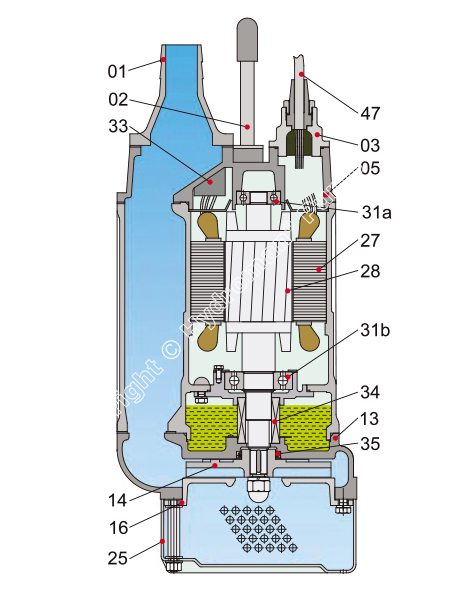 |
Item No. | Part name | Material | Item No. | Part name | Material | |
| 01 | Hose coupling | Cast iron | 28 | Rotor | Shaft: AISI420SS | ||
| 02 | Handle | Rubber & steel | 31a | Bearing | Ball bearing | ||
| 05 | Upper cover | Cast iron | 31b | Bearing | Ball bearing | ||
| 11 | Motor body | Cast iron | 33 | Motor protector | — | ||
| 13 | Pump body | Cast iron | 34 | Mechanical seal | Sic-Sic/Carbon-Sic (≤2.2kW) Sic-Sic/Sic-Sic (≥3.7kW) |
||
| 14 | Impeller | High chrome alloy | 35 | Oil seal | — | ||
| 16 | Inlet plate | Ductile iron | 47 | Cable | — | ||
| 25 | Strainer | Steel | |||||
| 27 | Stator | — |
 |
|
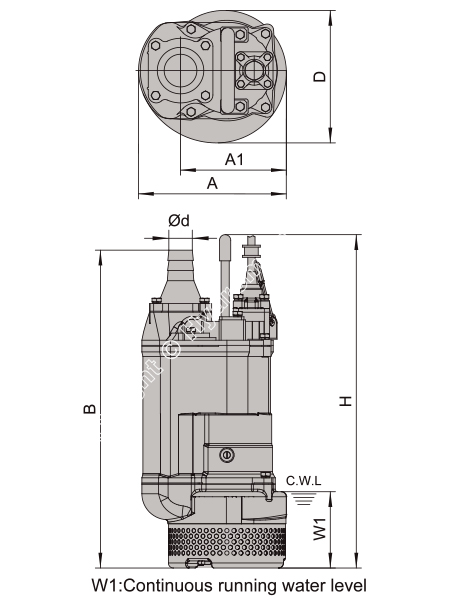
| Model (50/60Hz) | TBZ411 |
| d (mm) | 100 |
| A (mm) | 373 |
| A1 (mm) | 255 |
| B (mm) | 807 |
| D (mm) | 350 |
| H (mm) | 695 |
| W1 (mm) | 190 |
| N.W (Kg) | 136 |
| G.W (Kg) | 148 |
| Packing dimension(mm) | 885x415x435 |
What is a submersible trash pump? It's a fully submersible pump built with a non-clogging impeller and wider internal passages specifically so it can move water containing solids, debris, and sediment — the kind of liquid that would clog a standard clean-water submersible pump.
What can the TBZ411 actually handle? Dirty water, suspended sediment, small stones, construction debris, and fibrous material, with solids passage sized according to the specific configuration — always confirm the maximum solid size against the current TBZ411 datasheet for your exact model.
Is the TBZ411 an electric submersible trash pump? Yes. It's direct electric drive with the motor sealed and submerged, available in the voltage and phase configuration your site power supply requires.
Can it handle dirty water and slurry-heavy applications? Yes — that's the core use case. It's built as a submersible dirty water trash pump and holds up in slurry-adjacent conditions where a standard water pump would clog or overheat.
What's the difference between a trash pump and a sewage pump? Both handle solids-laden liquid, but a trash pump is generally optimized for larger, harder debris (stones, construction waste, mixed sediment), while a sewage pump's impeller and passage design lean toward softer organic solids and fibrous waste typical of wastewater. The overlap is real, which is why sizing against your actual water source matters more than the label on the box.
How do I choose the right one? Work through flow rate, total head, maximum solid size, discharge diameter, and available power supply — in that order — before comparing models or prices.
Can the TBZ411 be used for construction dewatering? Yes, it's a common fit for excavation pits, foundation dewatering, and shoring areas where groundwater comes mixed with soil and debris.
How often does a submersible trash pump need maintenance? For continuous or daily use, plan on inspecting the impeller and cable monthly at minimum, with a full clean-out after every job that involves heavy sediment or debris. Pumps in lighter, occasional service can go longer between checks, but a quick rinse after each use is good practice regardless.
Looking for the Best Submersible Trash Pump for Your Project?
Whether you're comparing submersible trash pumps for sale, replacing an aging KBZ411, or specifying equipment for a new municipal or industrial project, our team can walk you through the right TBZ411 configuration — discharge size, motor rating, float switch setup, and cable length — and give you a straight submersible trash pump price based on your actual application, not a generic catalog number.
Get in touch with Hydroman® for full technical specifications, pump selection assistance, project-based recommendations, OEM requirements, bulk quotation, and delivery information.
Related Pumps

Tobee is specialized in providing solutions for slurry pump, vertical sump pumps, gravel pump, dredging pumps, froth pump, seawater pumps, fire pumps, slurry pump parts and OEM pump parts for your harsh projects.
Top Navigation
Top Navigation
Contact Information
+86 180 3203 4573
+86 311 8722 1317
No. 266, Tianshan St, High-tech Zone, Shijiazhuang City 050000, China.