TBZ43.7 Submersible Wastewater Pump
When you're moving sewage, effluent, or dirty process water day after day, you need a pump that just keeps working — no babysitting, no surprise clogs, no repeat callbacks to the same wet well. That's exactly what the Hydroman® TBZ43.7 submersible wastewater pump is built for. It's a 3.7 kW (5 HP) electric-driven submersible centrifugal pump designed to sit fully submerged in your collection tank, sump, or treatment basin and quietly move wastewater to wherever it needs to go — treatment stage, discharge point, or the next process step in your line.
You'll find the TBZ43.7 doing this kind of work at municipal lift stations, on industrial drainage systems, and inside wastewater treatment plants where reliable, unattended operation matters more than anything else on the spec sheet. If you're comparing submersible wastewater pumps for a project right now, this page walks you through what the TBZ43.7 actually does, how it performs, and where it fits — so you can size it correctly the first time.
The TBZ43.7 belongs to Hydroman®'s TBZ series of submersible drainage and sewage pumps — a lineup that runs from a compact 1.5 kW unit right up to 15 kW heavy-duty models. The 43.7 sits comfortably in the middle: strong enough for real wastewater loads with suspended solids, but still compact enough to drop into a standard sump or collection pit without a crane.
At its core, it's a centrifugal pump — a semi-open impeller spins inside a cast iron volute, and that spinning motion is what turns electrical energy into flow and pressure. Because the whole unit is designed to run fully submerged, there's no need to build a separate dry pump house, and there's no suction lift to fight against, since the pump sits directly in the liquid it's moving.
You'll notice this pump handles more than just clear water. It's rated for wastewater, sewage, effluent, drainage water, and dirty water carrying suspended solids — the kind of everyday reality in a treatment plant or industrial drain line, not just the "ideal fluid" numbers you sometimes see on a spec sheet.
Key Features That Matter on the Job
A 3.7 kW / 5 HP motor sized for real duty. This is the sweet spot for small-to-mid-sized wastewater transfer — big enough to move meaningful volume, small enough to run economically on a standard power supply without needing special electrical infrastructure.
A submersible centrifugal design that skips the guesswork. Because the impeller and motor are one submerged unit, there's nothing to prime, no suction piping to leak, and no cavitation risk from a long dry-side suction run.
Genuine wastewater and sewage handling capability. The semi-open impeller is cast from high-chrome alloy and paired with a ductile iron wear plate — a combination chosen specifically so the pump can pass solids and abrasive particles without wearing out in a season.
Construction built for continuous underwater duty. The pump body and motor housing are rigid cast iron, the mechanical seal is rated to withstand 0.5 MPa, and the motor housing routes the discharge channel around the stator for effective cooling — which is what lets this pump run continuously, submerged, without overheating.
A layout that's easy to install and just as easy to service. The top-mounted outlet saves space in tight wet wells, and the whole unit is portable enough to move between sites without special rigging. You won't need a dedicated pump house — the TBZ43.7 installs straight into your sewage pit, collection sump, or treatment basin.
Hydroman® TBZ43.7 Submersible Wastewater Pump

TBZ43.7 Technical Specifications
Here's the real performance data for the TBZ43.7, taken from Hydroman®'s TBZ series test curve. Use it to check the pump against your actual flow and head requirement before you order.
| Parameter | TBZ43.7 |
| Pump Type | Submersible Wastewater / Sewage Pump |
| Model | TBZ43.7 |
| Motor Power | 3.7 kW / 5 HP |
| Rated Current (400V) | 7.7 A |
| Outlet Diameter | 100 mm (4") |
| Rated Capacity | 60 m³/h (1 m³/min) |
| Rated Head | 11.5 m |
| Maximum Capacity | 90 m³/h (1.5 m³/min) |
| Maximum Head | 18.5 m |
| Impeller Passage | 8.5 mm |
| Frequency | 50 Hz / 60 Hz |
| Maximum Immersion Depth | 25 m |
| Liquid Temperature | 0–40 °C |
| Liquid pH Range | 6.5–8.5 |
| Insulation Class | F |
| Protection Class | IP68 |
| Cable Length | 10 m |
| Pump Body / Motor Housing | Rigid Cast Iron |
| Impeller | High-Chrome Alloy, Semi-Open |
| Wear Plate | Ductile Iron |
| Mechanical Seal Rating | 0.5 MPa |
A quick note on how to read this: rated capacity and head give you the pump's efficient operating point, while maximum capacity and head show what it can do at the low-head end of the curve. If your discharge line has a lot of lift or long horizontal runs, size against the rated point rather than the maximum — that's where the pump runs most efficiently and lasts longest.
If you've never specified a submersible pump before, the working principle is simpler than it sounds.
The pump sits fully submerged in wastewater — that's the "submersible" part, and it's what lets it self-prime and avoid suction-side problems altogether. Once powered up, the electric motor spins the impeller inside the volute casing. As the impeller turns, centrifugal force throws the liquid outward, converting rotational energy into velocity and pressure. That pressurized flow is then pushed out through the top-mounted discharge outlet and into your pipeline, carrying the wastewater from your collection tank, sump, or treatment basin on to the next stage — whether that's a downstream treatment process, a lift station, or final discharge.
Because the whole assembly runs underwater, there's no priming step, no suction lift limitations, and — with the TBZ43.7's cooling design — no risk of the motor overheating even during long, continuous runs.

Where the TBZ43.7 Gets Put to Work
Wastewater treatment plants. This is the pump's home turf — moving wastewater between stages, running collection tanks, handling sewage lift duties, and transferring effluent through the treatment train.
Municipal sewage systems. Cities and utilities use pumps in this class for collection and conveyance across sewage networks, particularly where a compact, submersible unit is easier to maintain than a large dry-pit station.
Industrial wastewater lines. Manufacturing and processing facilities rely on submersible wastewater pumps to move the water generated during production — provided the fluid characteristics fall within the pump's rated range (more on that below).
Commercial and building drainage. Basements, underground facilities, and commercial sites that need dependable sewage removal use the same platform, often in a duty/standby pair for redundancy.
Sump pits and wastewater collection tanks. Anywhere wastewater needs to be gathered and lifted out — construction sites, holding tanks, general collection sumps — the TBZ43.7's portable, drop-in design makes it a practical fit.

What Wastewater Can the TBZ43.7 Handle?
The TBZ43.7 is rated for sewage, wastewater, dirty water, effluent, drainage water, and liquids carrying suspended solids up to its 8.5 mm impeller passage. That passage size tells you this pump is built for general wastewater with fine-to-moderate solids content — not for heavy sludge, large debris, or stringy fibrous material, which call for a different impeller design in the TBZ lineup or a dedicated grinder pump.

Why Engineers and Buyers Choose the Hydroman® TBZ43.7
It's built to run, not just to start. The rigid cast iron construction, high-chrome alloy impeller, and mechanical seal rated to 0.5 MPa aren't marketing details — they're what let this pump run continuously in abrasive wastewater without the impeller wearing thin after a few months.
Direct submersible installation saves you money on infrastructure. No dry-pit pump house, no complex suction piping — you drop the pump into your existing tank or sump and connect the discharge line.
It's engineered specifically for wastewater duty, not repurposed from a clean-water line, which shows up in the impeller passage, the seal rating, and the cooling design.
Maintenance stays manageable. Routine inspection covers the impeller, cable, seal, and bearings — nothing exotic, and the portable design means it's straightforward to pull for service when it's time.
It fits real B2B wastewater projects, from municipal contracts and industrial wastewater systems to sewage treatment plant upgrades, drainage projects, and OEM equipment integration where a manufacturer needs a proven pump platform to build around.

Installing a Submersible Wastewater Pump
Installation follows a logical sequence, and getting each step right up front saves you a service call later.
Start by checking the pump and discharge pipeline before anything goes in the ground or the tank — confirm the outlet size matches your pipework and that nothing was damaged in transit. Position the pump on stable footing at the bottom of the sump or wet well, using a guide rail system if your installation calls for one. Connect the discharge pipeline securely, since a loose or poorly supported joint is one of the more common causes of early failure.
Have the electrical connection done by a qualified electrician, following the motor nameplate data and your local electrical code — this isn't a place to improvise. Before you put the pump into full service, verify the rotation direction and confirm the motor protection device is set correctly. Finally, run the pump under real or simulated flow conditions to confirm it's hitting the head and capacity you expect.

Keeping the TBZ43.7 Running Long-Term
A submersible wastewater pump earns its keep through consistent upkeep, not heroics. Build a simple inspection routine that checks the pump body, impeller, power cable, mechanical seal, bearings, and discharge connection on a regular schedule — the interval depends on your duty cycle and fluid characteristics, but quarterly is a reasonable starting point for continuous municipal or industrial service.
Never let the pump run dry. Submersible pumps depend on the surrounding liquid for cooling, so operating below the manufacturer's minimum liquid level — even briefly — shortens motor life fast. Keep an eye on solids and debris buildup around the pump inlet, since accumulated material is the most common cause of gradual performance loss. And periodically check that the motor's overload and leakage protection devices are functioning as designed, so they actually trip when they're supposed to.

TBZ43.7 Submersible Wastewater Pump Price
We're not going to give you one number here, because it wouldn't be accurate — and a number that isn't accurate isn't actually useful to you. Pricing for a submersible wastewater pump like the TBZ43.7 depends on your specific configuration: the exact motor and impeller selection, discharge size, cable length, materials, optional accessories like auto-coupling systems or control panels, order quantity, and shipping destination.
What we can tell you is that the TBZ43.7 is priced as a mid-power, general-duty wastewater pump — positioned between light-duty drainage units and the larger 7.5 kW-and-up heavy sewage pumps in the range. If you're comparing submersible wastewater pumps for sale and want a number you can actually build a budget around, send us your flow, head, and fluid details and we'll quote the configuration that fits.
Why Source Your Submersible Wastewater Pump from Hydroman®
Hydroman® has been manufacturing submersible and slurry pumps for industrial, municipal, and mining applications for decades, and that experience shows up in details you won't find on a spec sheet — the wear-plate material choice, the seal design, the cooling channel routing. As a manufacturer rather than a reseller, we can offer OEM and customized configurations, application-based pump selection support from our own engineers, genuine spare parts backing for the life of the pump, and export and project supply capability for buyers sourcing at scale. If you're evaluating submersible wastewater pump manufacturers for an upcoming project, that combination of manufacturing depth and direct technical support is usually what separates a pump that lasts from one that doesn't.
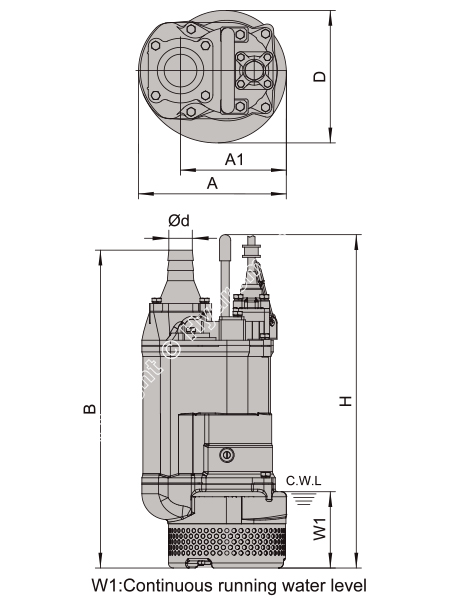 |
|
| Model (50/60Hz) | TBZ43.7 |
| d (mm) | 100 |
| A (mm) | 283 |
| A1 (mm) | 208 |
| B (mm) | 642 |
| D (mm) | 252 |
| H (mm) | 629 |
| W1 (mm) | 150 |
| N.W (Kg) | 63 |
| G.W (Kg) | 68 |
| Packing dimension(mm) | 710x320x295 |
What is a submersible wastewater pump? It's a centrifugal pump built to run fully submerged in the liquid it's moving — wastewater, sewage, or dirty water — using a sealed motor and pump assembly rather than a separate dry-mounted unit with suction piping.
What is a 5 HP submersible wastewater pump used for? A 5 HP (3.7 kW) unit like the TBZ43.7 is sized for small-to-mid wastewater transfer: municipal lift stations, treatment plant transfer duty, industrial drainage, and commercial building sewage removal, typically in the 60–90 m³/h flow range.
How does a submersible water pump work? The motor spins an impeller inside the pump casing while the whole unit sits submerged in the liquid. The spinning impeller uses centrifugal force to accelerate the liquid outward and push it through the discharge outlet and into the pipeline.
Can the TBZ43.7 pump handle sewage? Yes. It's rated for wastewater, sewage, dirty water, and liquid carrying suspended solids up to 8.5 mm — the level of solids content typical of municipal sewage and general industrial wastewater.
Can this pump be used in a sewage treatment plant? Yes, the TBZ43.7 is commonly used for wastewater transfer between treatment stages, collection tank duty, and effluent transfer within treatment plant operations.
What's the difference between a wastewater pump and a sewage pump? In practice the terms overlap heavily. "Wastewater pump" is often used more broadly for general dirty-water transfer, while "sewage pump" sometimes implies a design built for higher solids content or fibrous material. The TBZ43.7 handles both use cases within its 8.5 mm solids rating.
How do I choose the right submersible wastewater pump? Start with your required flow and head, then check your fluid's solids size, temperature, and pH against the pump's rated envelope. From there, installation depth and duty cycle (continuous vs. intermittent) will confirm whether a standard TBZ model fits or whether you need a larger motor or a corrosion-resistant build.
How much does a submersible wastewater pump cost? It depends on motor size, materials, discharge configuration, and accessories — there isn't a single fixed price. Send us your application details and we'll provide a specific quote for your configuration.
Can Hydroman® customize the TBZ43.7 pump? Yes. We offer OEM and customized configurations, including alternative materials, cable lengths, discharge fittings, and control accessories, to match specific project or equipment integration requirements.
If the TBZ43.7 isn't quite the right fit for your flow, head, or fluid characteristics, these related lines from the same series and family are worth a look:
Get a Quote for the Hydroman® TBZ43.7
Need a 5 HP submersible wastewater pump for a real project, not just a spec comparison? Send us your required flow rate, required head, liquid type, solids size, installation depth, and quantity, and our engineers will confirm the right TBZ configuration — or point you toward a better-fitting model in the series — before you commit to an order.
Contact Hydroman® for a project quote
 +86 189 3110 6396 (Whatsapp/Wechat)
 Inquiry@tobeepump.com
Related Pumps

Tobee is specialized in providing solutions for slurry pump, vertical sump pumps, gravel pump, dredging pumps, froth pump, seawater pumps, fire pumps, slurry pump parts and OEM pump parts for your harsh projects.
Top Navigation
Top Navigation
Contact Information
+86 180 3203 4573
+86 311 8722 1317
No. 266, Tianshan St, High-tech Zone, Shijiazhuang City 050000, China.