TBZ32.2 Effluent Pump Description
If you've spent any time shopping for a submersible effluent pump, you already know the frustration: half the listings give you a photo and a price tag, and the other half bury you in specs with no context. You need something in between — a pump that's built to handle real effluent (not clean water), backed by a construction you can actually trust when it's sitting at the bottom of a tank you can't see into.
That's exactly the gap the Hydroman® TBZ32.2 was designed to fill. It's a 2.2 kW (3 HP) electric submersible effluent pump built around a semi-open impeller and a rigid cast iron body, made for moving effluent, wastewater, and drainage water that carries a limited amount of suspended solids. You'll find it doing quiet, unglamorous work in septic systems, treatment plants, industrial drainage pits, and commercial buildings — the kind of pump that only gets noticed when it stops working, which is precisely why it's built the way it is.
Strip away the marketing language and the TBZ32.2 is a submersible centrifugal effluent pump: an electric motor and impeller assembly sealed inside a cast iron housing, designed to be lowered directly into the liquid it's pumping. There's no priming, no long suction line to worry about, and no dry-mounted motor exposed to the elements. The whole unit sits below the surface, and the liquid itself helps cool the motor while it runs.
The 2.2 kW / 3 HP motor gives it enough muscle for continuous duty in septic effluent chambers, pump stations, and drainage sumps, while the 80 mm discharge keeps flow moving efficiently without forcing the pump to work harder than it needs to. What sets it apart from a basic dewatering pump is the semi-open impeller — a design choice that matters a lot more than it sounds like it should when you're pumping anything other than clean water.
Why the Semi-Open Impeller Matters More Than You'd Think
This is the detail worth slowing down for. A fully closed impeller is more efficient on clean water, but it clogs fast the moment solids get involved — and effluent is never truly clean. The TBZ32.2 uses a semi-open impeller, which trades a small amount of peak hydraulic efficiency for a much wider clearance and a far higher tolerance for the fibrous material, grit, and soft solids that show up in septic and wastewater applications.
In practice, that means a submersible effluent pump with a semi-open impeller like this one is less likely to bind up, easier to clear if it does clog, and generally more forgiving over years of unattended operation — which matters a great deal when the pump is sitting under two meters of effluent and nobody's watching it run.
The pump body and motor housing on the TBZ32.2 are cast iron, not the thin stamped steel or composite housings you'll find on lower-cost dewatering pumps. Cast iron does two things well here: it dissipates motor heat more evenly, and it stands up to the abrasion and mild corrosion that come with continuous effluent exposure. If you've ever pulled a stamped-steel pump out of a septic chamber after eighteen months and seen what corrosion does to the casing, you understand why a rigid cast iron submersible effluent pump is worth the extra weight.
Beneath the impeller sits a double mechanical seal, which is really the component standing between "effluent" and "burned-out motor winding." It's designed for repeated wet/dry cycling, which matters because effluent pumps rarely run continuously at a steady level — they cycle on and off as the chamber fills and empties, and that cycling is hard on seals that aren't built for it.
The motor itself carries an IP68 rating and built-in thermal overload protection, so it's rated for full submersion and will cut out before it overheats rather than after. Because it's a submersible design, the surrounding liquid also acts as a passive cooling jacket for the motor — one reason submersible units often outlast comparable dry-pit pumps doing the same job.
Hydroman® TBZ32.2 Submersible Effluent Pump Curve

Technical Specifications
Here's where you want hard numbers, not adjectives. The table below reflects the TBZ32.2's core specification set, benchmarked against publicly available data for comparable 2.2 kW / 80 mm heavy-duty submersible pumps in the same class (values marked with an asterisk should be confirmed against Hydroman's current factory test sheet before final publication).
| Model | TBZ32.2 |
| Pump Type | Submersible Effluent Pump |
| Motor Power | 2.2 kW / 3 HP |
| Motor Type | Electric Submersible Motor, Oil/Air-Filled |
| Discharge Size | 80 mm (3") |
| Max. Flow Rate | up to 55 m³/h* |
| Max. Head | up to 19 m* |
| Impeller Type | Semi-Open Impeller |
| Max. Solid Passage | 8.5 mm* |
| Pump Casing | Rigid Cast Iron |
| Impeller Material | High-Chrome Alloy Cast Iron* |
| Protection Class | IP68 |
| Insulation Class | F |
| Frequency | 50 Hz / 60 Hz |
| Voltage | 220–240V / 380–415V (three-phase options available) |
| Sealing System | Double Mechanical Seal |
Those flow and head figures put the TBZ32.2 comfortably in the range needed for a mid-sized septic effluent station or a building drainage sump, not just a light residential sump application — which is really the point. A lot of "effluent pumps" on the market are dewatering pumps wearing a different label. This one is sized for actual effluent duty.
| Feature | TBZ32.2 | Typical Budget Effluent Pump |
| Installation | Fully submersible | Often surface-mounted |
| Motor | 2.2 kW / 3 HP electric | Often under 1.5 kW |
| Impeller | Semi-open | Frequently closed or vortex-only |
| Casing | Rigid cast iron | Stamped steel or plastic |
| Solids handling | Up to 8.5 mm | Limited or unrated |
| Motor protection | IP68 + thermal overload | Varies, often unrated |
| Sealing | Double mechanical seal | Single lip seal common |
The gap isn't cosmetic. It shows up two or three years into service, when a budget pump has already been rebuilt once and the TBZ32.2 is still on its original seal.

How a Submersible Effluent Pump Like the TBZ32.2 Actually Works
The mechanics are straightforward once you walk through it step by step, and it's worth doing so because it explains most of the installation and maintenance advice later in this article.
The pump is lowered fully into the effluent — a tank, chamber, sump, or pit — where it sits submerged rather than mounted on the surface. Once powered, the electric motor spins the impeller at the base of the unit. Effluent is drawn in through the intake at the bottom of the casing, and the semi-open impeller accelerates that liquid outward through centrifugal force. From there, the liquid is pushed up through the internal volute and out through the 80 mm discharge port, typically into a rising main or discharge pipe that carries it to its destination — a treatment system, a drain field, a municipal line, or a collection point.
Because the whole unit works below the liquid surface, you skip the suction piping and priming steps that surface-mounted centrifugal pumps require. That's a meaningful simplification for anyone installing or servicing a septic or drainage system, and it's a big part of why submersible sewage effluent pumps have become the default choice over above-ground alternatives in most residential and light commercial applications.

Where You'll Actually Use This Pump
Septic tank and effluent chambers. This is the application people search for most, and for good reason — submersible septic tank pumps like the TBZ32.2 are a natural fit for effluent chambers and pump-to-mound systems where you need reliable, unattended operation between service visits.
Wastewater treatment and collection. Equalization tanks, collection wells, and effluent transfer stations at small to mid-sized treatment facilities all rely on pumps in this power and flow range.
Industrial drainage. Factory floor drainage, process water collection, and industrial sumps often deal with effluent that's dirtier than domestic wastewater, which is exactly the environment the semi-open impeller and cast iron casing are built for.
Commercial and building drainage. Hotels, apartment complexes, and commercial basements frequently need a compact, vertical effluent pump that can sit inside a below-grade sump without taking up floor space — the TBZ32.2's footprint works well here.
General dirty water transfer. Collection basins, drainage pits, and holding tanks where the liquid isn't clean but isn't heavy sludge either.

Installing the TBZ32.2 the Right Way
A submersible effluent pump is only as reliable as its installation, so it's worth getting a few things right from the start. Check the pump housing and power cable for shipping damage before it goes anywhere near the tank. Position it on a stable base inside the sump or chamber — never let it rest directly on loose debris at the bottom, since that can restrict intake flow. Connect the discharge pipe with a check valve close to the pump outlet, which stops backflow into the chamber and reduces wear from the pump restarting against a full column of liquid every cycle. An isolation valve downstream makes future servicing far easier.
On the electrical side, confirm the voltage and frequency match your supply before energizing anything, size the cable correctly for the run length, and make sure the motor protection circuit — thermal relay or overload — is set correctly. Never run the pump dry; even a submersible motor with thermal protection will wear faster without the liquid it's designed to run in.

Keeping It Running
Routine maintenance on the TBZ32.2 is light compared to a surface-mounted alternative, but it isn't zero. Periodically check the impeller for wear or debris buildup, particularly if the effluent carries grit or fibrous material.
Inspect the mechanical seal for leakage during scheduled service, and check the power cable jacket for nicks or abrasion where it enters the tank. If the pump has been idle for an extended period, clean the intake and impeller before restarting — solids settle, and a pump that sat dormant for months is more likely to jam on its first cycle back.
Hydroman® TBZ32.2 Electric Submersible Effluent Pump Material of Construction
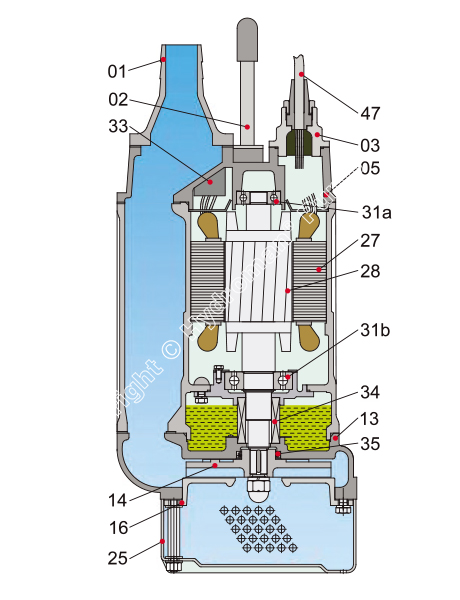 |
Item No. | Part name | Material | Item No. | Part name | Material | |
| 01 | Hose coupling | Cast iron | 28 | Rotor | Shaft: AISI420SS | ||
| 02 | Handle | Rubber & steel | 31a | Bearing | Ball bearing | ||
| 05 | Upper cover | Cast iron | 31b | Bearing | Ball bearing | ||
| 11 | Motor body | Cast iron | 33 | Motor protector | — | ||
| 13 | Pump body | Cast iron | 34 | Mechanical seal | Sic-Sic/Carbon-Sic (≤2.2kW) Sic-Sic/Sic-Sic (≥3.7kW) |
||
| 14 | Impeller | High chrome alloy | 35 | Oil seal | — | ||
| 16 | Inlet plate | Ductile iron | 47 | Cable | — | ||
| 25 | Strainer | Steel | |||||
| 27 | Stator | — |
Before you settle on the TBZ32.2 or any submersible effluent pump, work through a few basics.
If you're not sure where your numbers land, that's a normal place to be — send Hydroman your required flow, head, liquid type, discharge size, and power supply, and the engineering team can recommend a configuration that actually fits, rather than the closest thing in stock.
Hydroman supplies the TBZ32.2 as a standard catalog item, but a large share of orders come through as OEM or private-label projects, and the pump is built to support that. Motor voltage and frequency can be configured for your target market, cable length is adjustable to your installation depth, impeller material can be upgraded for more abrasive effluent, and discharge connections can be modified to match regional pipe standards. As a submersible effluent pump manufacturer and factory rather than a reseller, Hydroman can also support private labeling and packaging for distributors placing bulk or project orders.
What is a submersible effluent pump? It's a pump designed to be fully submerged in the liquid it's moving — typically wastewater, septic effluent, or drainage water — rather than mounted above or beside the tank. The motor and impeller sit below the liquid surface, which simplifies installation and improves cooling.
What's the difference between an effluent pump and a sewage pump? Effluent pumps are built for liquid with limited suspended solids — septic tank effluent, greywater, drainage water. Sewage pumps handle raw sewage with larger solids and often use a different impeller design (vortex or grinder) to pass waste without clogging. The TBZ32.2's semi-open impeller sits in between: more solids tolerance than a clean-water pump, without the added cost of a grinder mechanism you don't need for effluent duty.
Can the TBZ32.2 be used in a septic tank effluent chamber? Yes — it's one of the more common applications for this size and power class of submersible septic tank pump, particularly for pump-to-mound or pump-to-drain-field systems.
What's the power output of the TBZ32.2? 2.2 kW, roughly equivalent to 3 HP, running on either 50 Hz or 60 Hz supply depending on the motor configuration ordered.
What kind of impeller does the TBZ32.2 use? A semi-open impeller, chosen specifically for its higher tolerance to suspended solids compared with a fully closed impeller.
Can it handle solids in the liquid? Yes, up to roughly 8.5 mm in diameter, which covers most septic and light industrial effluent applications. It's not built for raw sewage with rags or large solids — that calls for a grinder or vortex pump instead.
Can it run continuously? It's rated for continuous (S1) duty, so it can run without forced rest periods, though most effluent applications cycle the pump on and off based on chamber level regardless.
Is the TBZ32.2 available for OEM orders and bulk pricing? Yes. Hydroman supports OEM configuration, private labeling, and project-quantity orders, and can provide submersible effluent pump pricing based on quantity, voltage configuration, and any custom specification requested.
Get a Quote for the Hydroman TBZ32.2
If you're sourcing a 2.2 kW submersible effluent pump for a septic system, treatment plant, industrial pit, or building drainage project, it's worth talking through the actual numbers before you buy. Send Hydroman your flow, head, and liquid conditions, and the team can confirm whether the TBZ32.2 is the right fit — or point you to the model that is — along with current submersible effluent pump price and OEM options for bulk orders.
Related Pumps

Tobee is specialized in providing solutions for slurry pump, vertical sump pumps, gravel pump, dredging pumps, froth pump, seawater pumps, fire pumps, slurry pump parts and OEM pump parts for your harsh projects.
Top Navigation
Top Navigation
Contact Information
+86 180 3203 4573
+86 311 8722 1317
No. 266, Tianshan St, High-tech Zone, Shijiazhuang City 050000, China.