Sand Pump Description
Heavy-duty submersible sand pump with agitator for sand, slurry, and sediment transfer
If you're moving sand, mineral slurry, or settled sediment on a jobsite, you already know that a standard water pump won't survive long. Abrasive solids cut through impellers, chew up wear plates, and turn a routine pumping job into a parts-replacement cycle. The Hydroman® 200TBS422 was built around that problem.
It's a heavy-duty electric submersible sand pump with an integrated agitator, engineered to sit directly in the sand, slurry, or mud you're pumping and keep working through high-concentration, continuous-duty conditions that would stall a general-purpose pump within days. The agitator at the base breaks up settled solids before they reach the impeller eye, so you're not relying on the suction alone to lift compacted material off the bottom of a pit or pond. Combined with a high chrome alloy wet end, the 200TBS422 is built for the kind of abrasive, high-solids service where pump life is usually measured in weeks, not years.
You'll find this pump specified across dredging fleets, sand and aggregate plants, mining operations, and construction sites where sediment has to move — not just water.
Key Features of Submersible Sand Pump
Most of what wears out a pump in sand service isn't the water — it's the sand. The 200TBS422's wet end is sized and shaped to slow down the erosion rate that fine and coarse sand particles cause as they pass through the impeller and casing, which is what lets this pump run continuously in pits and settling ponds where an ordinary submersible would need a rebuild within a season.
An agitator sand pump earns its name from what happens before the water ever reaches the impeller. The 200TBS422's submersible agitator stirs up sand and sediment that has packed down at the bottom of a pit, sump, or dredging point, keeping solids suspended in the slurry so the pump can actually draw them in instead of pumping clear water off the top while solids sit untouched below. This is the difference between a "submersible sand pump" on paper and a submersible sand pump with agitator that actually clears a pit down to the floor.
The impeller is cast from a high-chromium white iron, typically in the 25–28% chromium range. That chromium content produces a dense network of chromium carbides in the microstructure — the same metallurgy referenced in mining wastewater and slurry pump engineering literature, where high-chrome alloy hardness runs roughly 450–600 HV (and can approach 1,800 HV at the carbide phase itself), compared with roughly 210–275 HV for standard austenitic stainless steel. In plain terms: a sand pump with a high chrome alloy impeller lasts substantially longer in abrasive duty than one built from ordinary cast iron or stainless.
The 4-pole motor sand pump configuration runs at a synchronous speed suited to continuous, heavy-load operation rather than short bursts — a meaningful factor when you're running a pump for full shifts in a dredging or aggregate washing operation. The oil-cooled submersible motor housing is sealed to IP68 and rated Class H insulation, so heat buildup during sustained slurry pumping doesn't become the failure point.
Because the whole unit sits below the surface of the material being pumped, there's no long suction line to prime, no separate pump house to build, and no risk of losing prime when solids settle. You lower the pump into the pit, pond, or slurry basin, and it goes to work — which is a large part of why electric submersible sand pumps have become the standard choice for temporary and semi-permanent dredging and sediment-removal setups.
A submersible sand pump does two jobs at once — loosening solids and moving them — and the sequence matters:
Submersible installation. The pump is lowered directly into the sand, slurry, or sediment, either free-standing on the pit floor or suspended from a frame or floating platform, depending on your setup.
Agitation. The agitator at the base of the pump rotates ahead of the impeller intake, breaking up compacted or settled sand and sediment so it re-suspends in the surrounding slurry instead of staying packed on the bottom.
Impeller draw and acceleration. The high chrome alloy impeller draws the now-suspended slurry mixture into the pump casing and accelerates it centrifugally toward the discharge side.
Discharge. The sand-and-water mixture is pushed out through the 200 mm discharge outlet to a pipeline, settling tank, dewatering screen, or the next stage of your process.
That agitator-then-impeller sequence is what separates a true submersible sand dredging pump from a standard submersible unit that simply moves whatever liquid happens to be near the intake.
TBS Submersible Sand Pump Performance Curve

Technical Specifications
The table below outlines the core configuration of the 200TBS422. Because Hydroman builds this model across several motor and voltage variants to match different site conditions, treat the figures below as the baseline configuration and confirm exact flow, head, and power ratings with our sales engineers against your duty point before ordering.
| Model | Outlet | Motor power | Starting metdod | Rated current (380V) | Rated capacity | Rated head | Max capacity | Max head | Impeller passage | |||
| (50/60Hz) | mm | kW | HP | A | m³/h | m³/min | m | m³/h | m³/min | m | mm | |
| 200TBS422 | 200 | 22 | 30 | Star-Della | 42 | 200 | 3.33 | 24 | 360 | 6 | 32 | 30 |
Note on capacity: Hydroman rates the flow and head of each 200TBS422 configuration against the specific gravity and particle size of the slurry it will handle, in line with the classification approach used in the Hydraulic Institute's ANSI/HI 12.1-12.6 standard for rotodynamic slurry pumps. Give us your solids concentration, particle size, and required lift, and we'll return a curve matched to your actual duty point rather than a generic water-based figure.
| Component | Function |
| High chrome alloy impeller | Generates flow while resisting abrasive wear from sand and grit |
| Submersible agitator | Loosens settled solids ahead of the impeller intake |
| Heavy-duty casing | Wear-resistant housing sized for continuous abrasive-duty operation |
| 4-pole electric motor | Oil-cooled, IP68-rated, Class H insulated drive unit |
| Mechanical seal | Tandem or double mechanical seal protecting the motor cavity from slurry ingress |
| Wear-resistant liners | Replaceable wear parts on high-erosion flow surfaces, extending service intervals between rebuilds |
Every wetted component that touches the slurry stream — impeller, casing liner, and agitator paddles — is treated as a wear item and specified in abrasion-resistant material, rather than only the impeller. That's a distinction worth checking for when you're comparing "heavy duty submersible sand pump" listings, because plenty of pumps upgrade the impeller alone and leave the casing in standard cast iron.

Applications
Sand and gravel processing. Moving slurry, washed sand, and sediment between stages of an aggregate plant.
Mining operations. Handling high-concentration mineral slurry, tailings, and sediment in pits, sumps, and tailings ponds.
Settling ponds and sedimentation tanks. Clearing accumulated sand and solids from the base of a tank or pond without draining it first.
Construction dewatering and slurry handling. Transferring mud, slurry, and sediment generated during excavation, piling, or foundation work.
Industrial wastewater. Moving process water carrying sand or solid particulate through treatment stages.
Dredging. Deployed as a submersible sand dredging pump on floating platforms or fixed frames for river, pond, and reservoir dredging.
In practice, most of these are the same underlying problem — you need a pump that can be dropped into a pit full of solids and keep pumping without clogging, seizing, or wearing through in a matter of days. Whether your team calls it a mud pump, a submersible sludge pump, or a sand and slurry submersible pump usually just depends on which industry they came from.

Why Choose the Hydroman 200TBS422?
Direct submersible installation. No suction piping, no priming, no separate pump house — you cut installation time and eliminate a common failure point in temporary dredging setups.
Agitation and pumping combined. Instead of running a separate agitator or relying on manual disturbance of settled solids, the 200TBS422 handles both jobs from one submerged unit.
Wear-resistant hydraulic design. The high chrome alloy wet end is matched to abrasive-duty service, which is where standard submersible pumps typically fail first.
Heavy-duty continuous operation. Built for S1 continuous duty in industrial and dredging environments, not intermittent household or light commercial use.
High-head capability. Configurations are available for applications that need to lift slurry a significant vertical distance or push it through a long discharge line, not just move it a few meters.
If you're comparing quotes from a submersible sand pump supplier, the questions worth asking are less about headline flow numbers and more about wet-end material, agitator design, and seal configuration — those are what actually determine service life once the pump is in abrasive duty.

Submersible Sand Pump vs. Standard Submersible Pump
| Feature | 200TBS422 Sand Pump | Standard Submersible Pump |
| Sand handling | Designed for abrasive sand and grit | Limited — wears quickly |
| Slurry handling | Yes, high-concentration rated | Application-dependent, usually not rated |
| Agitator | Integrated | Usually absent |
| Abrasion resistance | Heavy-duty, high chrome alloy wet end | Standard cast iron or stainless |
| Impeller material | High chrome alloy (25–28% Cr) | Cast iron / stainless, application-dependent |
| High-solids handling | Yes | Limited |
| Continuous duty rating | Yes | Model-dependent |

Why a Standard Submersible Pump Can't Handle Sand
A common search we see is "how to stop sand from a submersible pump" — usually from someone whose clean-water pump keeps failing because it's unintentionally pulling sand into the intake. It's worth separating that problem from what the 200TBS422 is built for, because they're opposite situations.
A general-purpose submersible pump is designed around clear or lightly-loaded water. Its impeller clearances, seal design, and materials assume the fluid isn't carrying hard particulate. When sand does get drawn in — from a poorly screened well, a silted sump, or ground disturbance near the intake — it acts like a continuous stream of grinding compound against the impeller and wear ring, and clearances open up fast. That's the mechanism behind most "my submersible pump keeps failing in sandy water" complaints, and it's also why the standard advice for that scenario is intake screening, sump cleaning, and reducing the amount of solid material reaching a pump that was never designed to process it.
The 200TBS422 exists for the opposite case: applications where sand, slurry, or sediment is the material you need to move, not an incidental contaminant. Its impeller, casing, and agitator are all sized for that duty from the start, which is why it holds up in service where a standard submersible pump would fail within days.
If sand is the medium you're pumping — not something you're trying to keep out — a purpose-built submersible sand pump is the right category to be shopping in.
How to Choose a Submersible Sand Pump
A few numbers determine whether a given pump configuration will actually hold up on your site:
Send us these details and our engineers will match you to the right 200TBS422 configuration — or another model in the Hydroman range — rather than guessing off a catalog spec sheet.
Routine maintenance on the 200TBS422 centers on the parts that see the most abrasive wear:
1. Inspect the impeller periodically for erosion at the vane tips and leading edges — this is usually the earliest visible sign of wear in high-solids service.
2. Check the agitator for wear on the paddles and confirm it's still rotating freely.
3. Inspect the mechanical seal — a compromised seal is the most common path for slurry to reach the motor cavity, so seal condition should be checked on a fixed schedule rather than only after a failure.
4. Check motor insulation resistance to catch moisture ingress early.
5. Inspect the cable and connections for abrasion or nicks from handling during deployment and retrieval.
6. Monitor overall pump performance — a drop in flow or head, a rise in current draw, or unusual vibration are all early indicators of wear that's worth addressing before it becomes a failure.
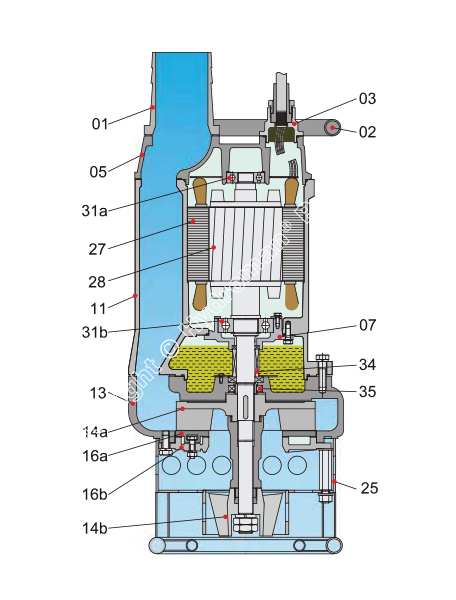 |
Item No. | Part Name | Material | Item No. | Part Name | Material | |
| 01 | Hose coupling | Cast iron | 16b | Inlet plate | Cast iron | ||
| 02 | Handle | Steel | 25 | Strainer | Steel | ||
| 05 | Upper cover | Cast iron | 27 | Stator | — | ||
| 07 | Bearing house | Cast iron | 28 | Rotor | Shaft: AISI420SS | ||
| 11 | Motor body | Cast iron | 31a | Bearing | Ball bearing | ||
| 13 | Pump body | Cast iron | 31b | Bearing | Ball bearing | ||
| 14a | Impeller | High chrome alloy | 34 | Mechanical seal | SiC-SiC/SiC-SiC | ||
| 14b | Agitator | High chrome alloy | 35 | Oil seal | Tc-SiC/SiC-SiC (≥15kW) | ||
| 16a | Inlet plate | High chrome alloy | 47 | Cable | — |
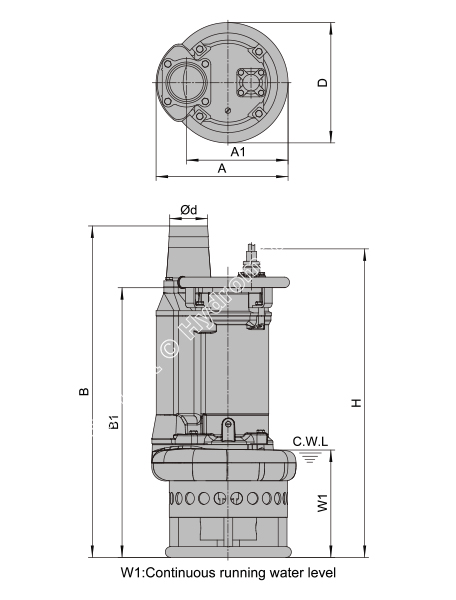 |
Item | Value |
| Model (50/60Hz) | 200TBS422 | |
| d (mm) | 200 | |
| A (mm) | 578 | |
| A1 (mm) | 442 | |
| B (mm) | 1245 | |
| B1 (mm) | 1015 | |
| D (mm) | 528 | |
| H (mm) | 1200 | |
| W1 (mm) | 330 | |
| N.W (Kg) | 408 | |
| G.W (Kg) | 434 | |
| Packing dimension (mm) | 740x570x1460 |
Before startup, check the pump body and cable for shipping or handling damage, and confirm your discharge pipeline is sized to match the 200 mm outlet.
Lower the pump into position — vertically, on a stand or frame as specified for your site — making sure the agitator has clearance to operate without striking the pit floor or obstructions.
Confirm the power supply matches the motor's rated voltage and that motor protection (thermal overload, phase failure) is wired in.
Verify the pump is fully submerged to the depth specified before starting the motor, since submersible motors rely on the surrounding fluid for cooling.
After startup, monitor flow, discharge pressure, and motor current during the first operating cycle to confirm the pump is performing to its rated curve.
What is a submersible sand pump?
It's a pump designed to be fully submerged in sand, slurry, or sediment and pump that material directly, rather than being installed above the fluid and drawing it up through a suction line.
What's the difference between a sand pump and a slurry pump?
In practice the terms overlap heavily. "Sand pump" typically emphasizes handling grit and sand-sized particles; "slurry pump" is the broader category covering any solid-liquid mixture, including mineral tailings, mud, and sludge. The 200TBS422 is built to handle both.
Can the Hydroman 200TBS422 pump abrasive sand?
Yes — the high chrome alloy impeller and heavy-duty casing are specifically selected for abrasive, high-solids sand and slurry service.
Does the 200TBS422 have an agitator?
Yes, it's built as a submersible sand pump with agitator as standard, not an optional add-on.
What does a submersible sand pump agitator actually do?
It stirs and re-suspends settled sand and sediment ahead of the impeller intake, so the pump can draw in solids that have packed down at the bottom of a pit or pond rather than pumping only the clearer water above them.
Can a submersible sand pump handle sludge?
Yes — the same wet-end design that handles sand and slurry is also effective as a submersible sludge pump for solids-laden sludge, within the particle size and concentration limits of the configuration selected.
Is the 200TBS422 an electric submersible sand pump?
Yes, it's driven by an oil-cooled 4-pole electric motor rated for continuous submersible operation.
What's the advantage of a high chrome alloy impeller?
High chrome alloy (roughly 25–28% chromium) forms hard chromium carbides in the metal's microstructure, giving it substantially higher wear resistance than standard cast iron or stainless steel — which is why it's the standard material choice across the slurry pump industry for abrasive duty.
Is the 200TBS422 suitable for high-head applications?
High head submersible sand pump configurations are available within the 200TBS422 range — confirm your required lift and pipeline length with our team so we can match the right motor and impeller configuration.
How do I choose the right submersible sand pump?
Start with flow rate, head, solids concentration, and maximum particle size — see the Selection Guide above.
What information do you need to give me a submersible sand pump price?
Pump model or application, required flow rate and head, the material being pumped, solids concentration, maximum particle size, motor voltage and frequency, quantity, and destination country. The more of that we have upfront, the more accurate the quote.
Request a Quote
Whether you're sourcing directly from a submersible sand pump manufacturer for a mining project, comparing options as a submersible sand pump supplier for your own distribution line, or specifying a single unit for a dredging job, our engineering team can help you land on the right configuration — not just the closest catalog match.
To get an accurate submersible sand pump price and technical recommendation, send us:
Contact Hydroman® for technical specifications, pump selection support, and a quotation for the 200TBS422 submersible sand pump — or any other model in our submersible sand and slurry pump range.
Related Pumps

Tobee is specialized in providing solutions for slurry pump, vertical sump pumps, gravel pump, dredging pumps, froth pump, seawater pumps, fire pumps, slurry pump parts and OEM pump parts for your harsh projects.
Top Navigation
Top Navigation
Contact Information
+86 180 3203 4573
+86 311 8722 1317
No. 266, Tianshan St, High-tech Zone, Shijiazhuang City 050000, China.