A submersible pump for muddy water, built for the sumps, pits and worksites where ordinary water pumps don’t last.
If you’ve ever pulled a standard sump pump out of a pit after a week and found a worn impeller and a seized seal, you already know the problem. Muddy water is not just dirty water. It is abrasive, heavier than clean water, and it settles the moment it stops moving.
The Hydroman® 100TJQ30-50H6A is a vertical, electric-driven submersible muddy pump with a 100 mm (4-inch) discharge. It is designed for dewatering and transferring mud-laden liquid from sumps, excavation pits and collection basins. This page explains where it fits, how to judge whether it suits your conditions, and what we need from you to confirm the right configuration.
Clean water has a specific gravity of 1.0. Muddy site water typically runs somewhat higher, and as solids rise, three things happen:
That is why a pump chosen only by its flow and head numbers often fails early. A muddy pump has to be chosen for the liquid as well as the duty point.
Vertical submersible layout. The pump sits directly in the sump or pit and pushes liquid up through the discharge line. There is no suction pipe to prime and no long suction run to block with sediment, and the footprint at the surface is small. For excavations and collection pits where space is tight, that matters.
Electric drive. A submersible electric motor is cooled by the liquid around it, runs quietly compared with an engine-driven unit, and produces no exhaust at the pit. It suits any site where reliable power is available, from fixed plant sumps to temporary construction supplies.
Heavy-duty construction for abrasive liquids. For solids-handling work, wetted parts are typically specified in wear-resistant materials. High-chrome white iron (for example ASTM A532 Class III, with around 25–28% chromium) is a common choice for gritty, abrasive slurry, with hardness commonly in the 600 HBW range. Where the water is acidic or chemically aggressive, such as some mine drainage, stainless or duplex materials may be a better fit. Materials and seal arrangements for this model are selected to match your actual conditions, so tell us what is in your water.
| Parameter | Specification |
| Model | 100TJQ30-50H6A |
| Brand | Hydroman® |
| Pump type | Vertical submersible muddy pump |
| Discharge outlet | 100 mm (4 in) |
| Drive | Electric |
| Flow rate | 60 m³/h |
| Head | 46 m |
| Motor power | 30 kw |
| Speed | 980 r/min |
| Maximum solid particle size | 19 mm |
| Wetted parts material | Selected to suit your application |
| Cable length | 10 m |
We would rather give you confirmed numbers than rounded marketing ones. Send us your duty point and we will return the datasheet and performance curve for the configuration that matches it.
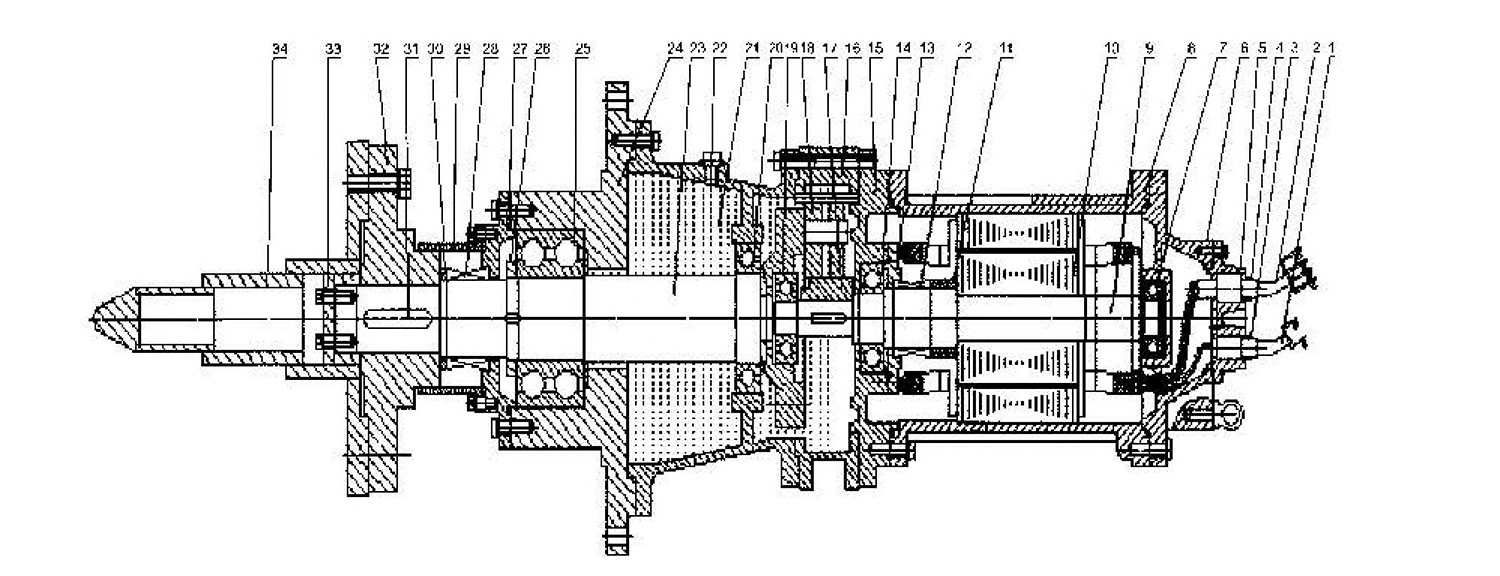
| Serial No. | Name | Serial No. | Name | Serial No. | Name |
| 1 | Control cable | 2 | Power cable | 3 | Control cable gland |
| 4 | Power cable gland | 5 | Cable seat | 6 | Upper end cover of the motor |
| 7 | Bearing | 8 | Stator | 9 | Rotor axle |
| 10 | Rotor | 11 | Mechanical seal pad | 12 | Mechanical seal |
| 13 | Gland | 14 | Bearing | 15 | End cover |
| 16 | Pin wheel housing | 17 | Bearing | 18 | Cycloid gear |
| 19 | Bearing | 20 | Bearing | 21 | Engine oil |
| 22 | Oil plug | 23 | Main shaft | 24 | Bearing body |
| 25 | Bearing | 26 | Round nut | 27 | Bearing body gland |
| 28 | Mechanical seal | 29 | Sheatding | 30 | Mechanical seal pressure pad |
| 31 | Key | 32 | Coupling flange | 33 | Axle head pressure plate |
| 34 | Stirring head |

Mining and quarry dewatering. Pit bottoms and sumps collect rainwater and groundwater loaded with fines and silt, and sometimes with low pH. This is where a heavy duty pump with abrasion-resistant wetted parts earns its keep.
Construction site muddy water removal. Foundation excavations, trenches and temporary sumps fill with silty water after rain. You need something that keeps running when the pit floor is churned to mud, rather than a light utility pump that clogs.
Industrial wastewater and sump pumping. Production floors, wash-down areas and process sumps often carry suspended solids. A muddy water sump pump here keeps the area dry without a constant clean-out routine.
Dredging and sediment handling. For light sediment and mud transfer, the pump can be considered once solids size and concentration are confirmed. This is not a blanket claim: very coarse sand, gravel or high-concentration slurry is a job for purpose-built dredge or slurry pumps, and we will tell you plainly if your case falls outside this model.

People ask us for “the best pump for muddy water,” and the honest answer is that it depends on the water. These are the four questions that decide it.
1. How much solid, and how big? Measure or estimate solids by weight, particle size and hardness. As a rough guide, centrifugal slurry pumps are used for concentrations in the tens of percent by weight, while dewatering-type pumps are usually applied at much lower concentrations. Fine silt behaves very differently from angular sand of the same concentration.
2. What flow and head do you really need? Head is more than vertical lift. Add friction loss in the discharge pipe, which grows with length, fittings and slurry density.
3. Can the pipeline keep solids moving? If velocity is too low, solids settle in the line and block it. Discharge lines for fine slurries are commonly designed for roughly 1.5–3 m/s. Going much faster raises wear. A pump that is slightly oversized and throttled hard will often wear faster than one sized properly.
4. What is the material chemistry? Abrasive but neutral water calls for hardness. Acidic or chloride-rich water calls for corrosion resistance. Many sites need both, and that is where configuration choices matter most.
A quick sizing reference: hydraulic power (kW) = flow (m³/h) × head (m) × SG ÷ (367 × efficiency). Use it to sanity-check motor size, then leave margin for solids.
Search results for this category mix very different machines, so here is how they differ.
| Pump type | Typical use | What decides the choice |
| Vertical submersible muddy pump | Sumps, pits, underwater dewatering | Submergence level, solids, power supply |
| Centrifugal mud pump (dry-mounted) | Slurry circulation and transfer systems | Flow, head, suction conditions, medium |
| Electric mud pump | Any powered muddy water transfer | Motor power and supply |
| Mud sucker pumps | Varies widely by design | Confirm actual construction and purpose |
Two terms deserve a clear warning. In oil and gas drilling, “mud pump” usually means a high-pressure reciprocating (triplex) pump that circulates drilling fluid at pressures in the thousands of psi. That is a different machine from a submersible muddy water pump. Likewise, “mud hog” and “mud mixing” pumps are built around specific drilling or mixing duties, not general sump dewatering. If that is your application, say so and we will point you in the right direction rather than sell you the wrong pump.
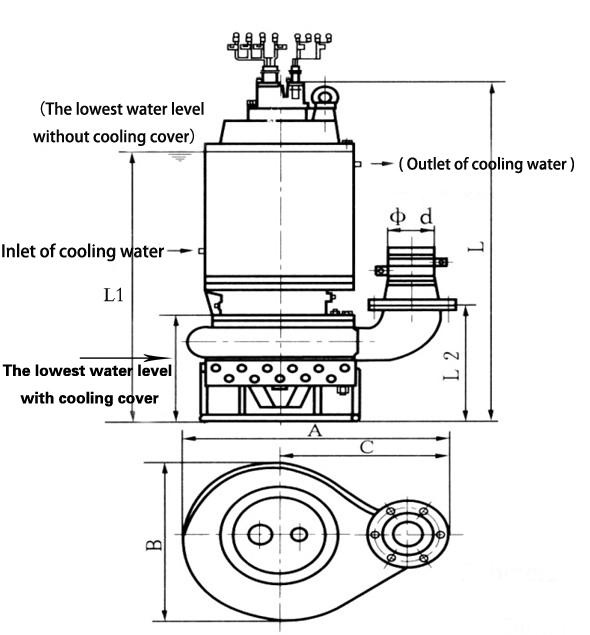 |
|
| Model | 100TJQ30-50H6A |
| L (mm) | 1452 |
| L1 (mm) | 1144 |
| L2 (mm) | 425 |
| A (mm) | 832 |
| B (mm) | 630 |
| C (mm) | 605 |
| d (mm) | 100 |
You are not buying a catalogue number. You are buying a pump that has to survive your site. So we start from your working conditions, not from stock.
What is a muddy pump used for?
It moves water carrying silt, mud and fine solids out of places where it collects: mine and quarry pits, construction excavations, industrial sumps and similar sites.
Can a submersible pump handle muddy water?
Some can, but being submersible isn’t enough. What matters is the impeller and casing design, the particle size and concentration the pump can pass, and whether the wetted parts resist wear. A general-purpose submersible not built for solids can clog or wear out quickly.
How do I choose the best sump pump for muddy water?
Start with solids size and concentration, then flow and head including pipe friction, then material compatibility, then installation conditions. Send those details and we will match a configuration.
What is the difference between a mud pump and a muddy water pump?
The names overlap in search results but not always in design. A drilling mud pump is a high-pressure fluid circulation machine. A muddy water pump is built to lift and move abrasive, solids-laden water. Choose by the liquid and duty, not the label.
What affects the price of a mud pump?
Size and motor power, wetted-part materials, required performance, accessories such as cable length and controls, quantity, and delivery terms.
How can I get a quote for the Hydroman® 100TJQ30-50H6A?
Share your target flow and head, mud properties, power supply and installation environment. We will confirm the model suitability and reply with a quotation.
If you are searching for a mud pump for sale or comparing mud pump manufacturers, the quickest route to an accurate price is to give us the working conditions. Pump price depends on configuration, wetted-part materials, motor power, accessories, order quantity and delivery terms, so we do not publish a single figure that would mislead you.
Send us:
[Request a Quote for the 100TJQ30-50H6A]
 Sara Liang
 +86 189 3110 6396 (Whatsapp/Wechat)
 Inquiry@tobeepump.com
Related Pumps

Tobee is specialized in providing solutions for slurry pump, vertical sump pumps, gravel pump, dredging pumps, froth pump, seawater pumps, fire pumps, slurry pump parts and OEM pump parts for your harsh projects.
Top Navigation
Top Navigation
Contact Information
+86 180 3203 4573
+86 311 8722 1317
No. 266, Tianshan St, High-tech Zone, Shijiazhuang City 050000, China.