If you have ever pulled a sump pump out of a pit only to find it buried in sand, clogged with sludge, or starved because everything heavy had settled below the inlet, you already know why a general-purpose dewatering pump is the wrong tool for dirty water. The Hydroman® 200TJQ22-50H6A was built for exactly that situation. It is a heavy duty, cast iron submersible solids handling pump with a 200 mm discharge, a 22 kW electric motor and a bottom-mounted agitator that stirs settled material back into suspension before the pump draws it in.
On paper it delivers 300 m³/h at a 10 m head and passes solids up to 56 mm. In practice, that means you can keep sumps, pits and tanks moving instead of stopping every few shifts to dig them out by hand.
In most sumps and settling pits, solids do not stay in suspension. Sand, silt and sludge drop to the floor, and a standard pump sitting above them mostly pumps clear water while the sediment layer keeps growing. The bottom-mounted agitator on the 200TJQ22-50H6A churns that layer back into the liquid around the inlet, so the pump has something worth lifting. If your job is sediment removal rather than simple dewatering, this is the feature that matters most.
A screen on the bottom inlet keeps oversized items such as rocks, timber offcuts and rubbish from being pulled into the impeller. Think of it as a gatekeeper, not a filter. It is sized to the solids the pump can pass, and it will not make the pump immune to clogging with stringy or fibrous material. Tell us what is actually in your pit and we will help you choose a suitable opening.
The 300 m³/h at 10 m duty point puts this squarely in the high-volume, low-lift category. For context, that flow rate moves roughly 83 litres every second. In a 200 mm discharge line, it works out to a velocity of about 2.65 m/s, which sits comfortably inside the 1.5 to 3 m/s range commonly used for pumping sand-bearing slurries. Go much slower and sand begins to settle in the pipe. Go much faster and you accelerate pipe and bend wear.
This is a cast iron submersible pump, chosen for its rigidity and abrasion resistance in demanding duty. Cast iron is a long-established material for solids transfer pumps and works well in many sand, silt and general industrial effluent applications. If your liquid is strongly acidic, chloride-rich or highly abrasive, discuss material options with our team before ordering.
Because the motor sits below the water line with the pump, there is no long vertical shaft, no dry-pit space to build and no priming to worry about. The surrounding liquid also helps carry heat away from the motor. That is a big advantage over a vertical pump with a dry-mounted motor if your site is a deep, narrow pit or a flooded excavation.
Here are the numbers you will need for a first-pass selection.
| Parameter | Specification |
| Model | 200TJQ22-50H6A |
| Pump type | Submersible solids handling pump |
| Discharge outlet | 200 mm |
| Rated flow rate | 300 m³/h |
| Rated head | 10 m |
| Motor power | 22 kW |
| Rotational speed | 980 r/min |
| Maximum particle size | 56 mm |
| Weight | 600 kg |
| Agitator | Bottom-mounted |
| Inlet protection | Bottom-mounted screen |
| Drive | Electric, submersible motor |
| Installation | Fully submerged operation |
The 980 r/min rating tells you something useful about the motor. A 50 Hz motor with six poles has a synchronous speed of 1,000 r/min, and slip brings it down to the high 900s. A slower six-pole design is a common choice for pumps that handle abrasive solids, because lower impeller speeds generally mean less wear on the wet end than a 2-pole machine running near 2,900 r/min. Your voltage, frequency and winding details should be confirmed with us when you place an order, so the pump matches your site supply.
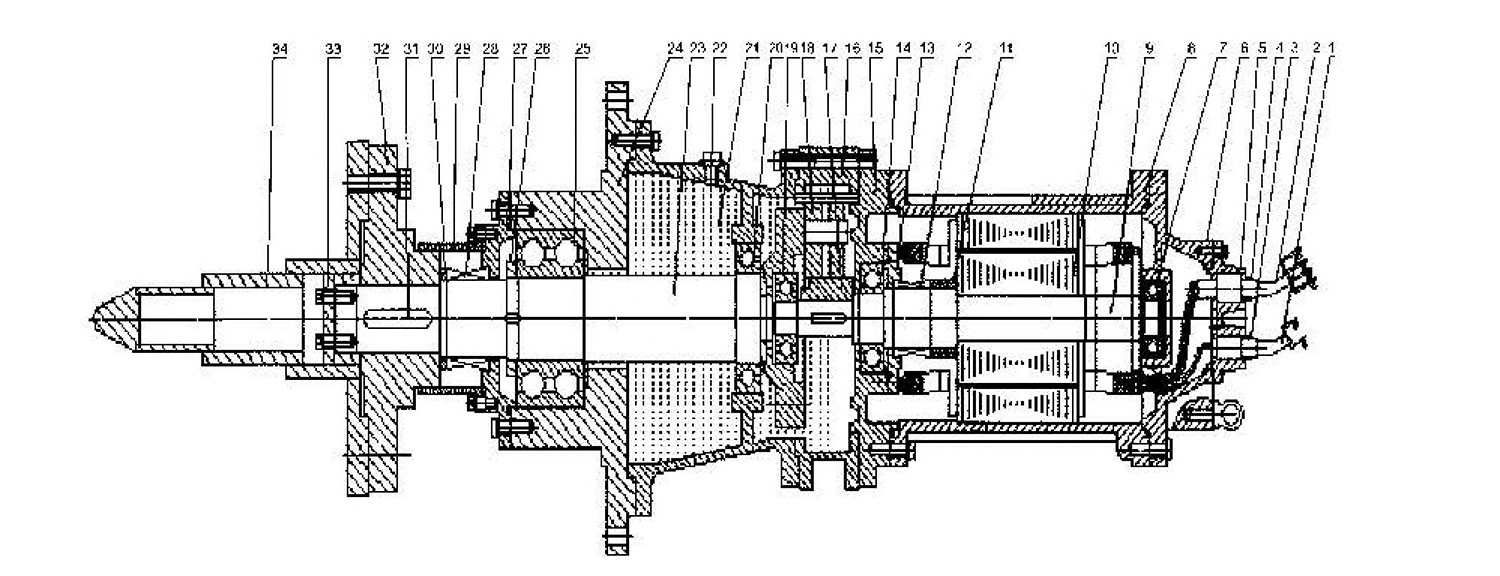
| Serial No. | Name | Serial No. | Name | Serial No. | Name |
| 1 | Control cable | 2 | Power cable | 3 | Control cable gland |
| 4 | Power cable gland | 5 | Cable seat | 6 | Upper end cover of the motor |
| 7 | Bearing | 8 | Stator | 9 | Rotor axle |
| 10 | Rotor | 11 | Mechanical seal pad | 12 | Mechanical seal |
| 13 | Gland | 14 | Bearing | 15 | End cover |
| 16 | Pin wheel housing | 17 | Bearing | 18 | Cycloid gear |
| 19 | Bearing | 20 | Bearing | 21 | Engine oil |
| 22 | Oil plug | 23 | Main shaft | 24 | Bearing body |
| 25 | Bearing | 26 | Round nut | 27 | Bearing body gland |
| 28 | Mechanical seal | 29 | Sheatding | 30 | Mechanical seal pressure pad |
| 31 | Key | 32 | Coupling flange | 33 | Axle head pressure plate |
| 34 | Stirring head |
Here is a number worth knowing. Moving 300 m³/h of clean water through 10 m of head takes roughly 8.2 kW of hydraulic power (ρ × g × Q × H, with water at 1,000 kg/m³). Slurry is heavier. If your mixture has a specific gravity of 1.3, that hydraulic requirement climbs to roughly 10.6 kW before pump and motor losses are counted, and the agitator also draws power. The 22 kW motor gives you the headroom to deal with denser mixtures, start-up loads and the extra work of stirring settled material, which is exactly where lightly powered dewatering pumps struggle.
As a practical guide, here is how the rated duty compares at different slurry densities, based on the physics above.
| Mixture | Specific gravity | Approx. hydraulic power at 300 m³/h, 10 m |
| Clean water | 1.0 | 8.2 kW |
| Light silty water | 1.1 | 9.0 kW |
| Sandy slurry | 1.3 | 10.6 kW |
| Heavy sludge | 1.5 | 12.3 kW |
These figures exclude hydraulic and motor efficiency losses and agitator load. Actual flow and head will also shift with slurry density, solids size and your system curve, so treat the table as a sizing guide rather than a performance guarantee.

This is an industrial submersible pump designed for dirty, heavy and unpredictable liquids. Typical uses include the following.
| Application | What you are pumping | Why this pump fits |
| Mining sumps | Water with mineral fines and sediment | Agitator keeps fines moving; solids passage up to 56 mm |
| Industrial wastewater | Process effluent with settled solids | Clears sumps and collection tanks that lose capacity to sediment |
| Sand and sludge transfer | Sand-bearing water, settled sludge | Bottom agitation mobilizes the layer at the inlet |
| Dredging and sediment handling | Low-head transfer of water with suspended solids | High volume at modest lift |
| Construction pits and drainage | Muddy, debris-laden groundwater | Handles solids that would stall a standard pump |
For abrasive mineral applications and long-run duty, ask us about material specifications and wear parts, because performance depends heavily on particle hardness and concentration.

Particle size matters, so it helps to place 56 mm in context. Under the ISO 14688 soil classification, sand runs from roughly 0.063 to 2 mm, and gravel from 2 to 63 mm. A 56 mm passage size therefore means the pump can pass gravel up to the coarse range, which is far beyond sand and silt. Passing a particle is not the same as pumping it all day, though. Large, hard particles at high concentration will wear the wet end faster, and the inlet screen opening needs to be consistent with the largest piece you want to let through. Confirm the particle-size definition and screen opening for your configuration when you request a quote.
A good pump choice can still be undermined by a poor setup. Before you commission the pump, there are a handful of things we recommend you check.
Start with your duty point. Know your required flow, total dynamic head (including pipe friction and any elevation change), discharge pipe diameter, liquid temperature, solids concentration and particle characteristics. Oversizing the discharge line is cheaper than fighting friction losses and settling later.
Next, think about electrical supply. This is a 3 phase submersible pump, so confirm voltage, frequency and cable arrangement. As a rough guide, a 22 kW motor on a 380 V supply draws in the region of 42 to 45 A at full load, though exact figures depend on efficiency and power factor, so size your cable and protection from the motor nameplate rather than from this estimate.
Then choose the right control panel. A good control panel for a submersible pump should provide motor starting, overload protection and phase-failure protection at the very least. Direct-on-line starting can pull six to eight times full-load current for a moment, which is hard on weak supplies or generators. A soft starter or variable frequency drive can smooth that out, and a VFD also lets you tune flow to the demand. Tell us your site conditions and we can discuss a compatible panel.
Finally, respect submergence and cooling requirements. Confirm minimum submergence with us for your configuration, and avoid running the pump dry. Make a habit of checking the screen and agitator for wear, tangled material or damage. How often depends on what you pump, so set an inspection schedule after the first few weeks of operation and adjust from there.
When you are shortlisting a submersible solids pump, price per unit is only part of the picture. What you are really buying is fewer manual clean-outs, fewer clogged pumps and a more predictable discharge. The Hydroman® 200TJQ22-50H6A pairs an agitator and inlet screen with a 22 kW submersible electric motor, giving you a single self-contained unit for sumps, pits and tanks. It also comes with application-based support, so we can review your operating conditions with you and discuss materials, control equipment and accessories before you order.
What is a submersible solids handling pump?
It is a pump designed to move liquids that carry suspended solids while operating underwater. How large the solids can be, and how much of the mixture they can make up, depends on the pump's design. The 200TJQ22-50H6A is specified for solids up to 56 mm.
What is the rated flow and head of the 200TJQ22-50H6A?
The rated duty is 300 m³/h at a 10 m head. Your actual performance will follow your system curve and operating conditions.
What does the bottom-mounted agitator do?
It loosens and suspends settled sediment near the inlet, so the pump can draw in solid-laden liquid rather than just the clearer water above it.
What is the inlet screen for?
It restricts oversized debris from entering the pump. How effective it is depends on the opening size and on the shape and nature of the debris. It is not a fine filter and does not guarantee against clogging.
Can this pump handle sand and sludge?
Yes, within its operating limits. Solids concentration, particle hardness, slurry density and material compatibility should all be assessed before ordering, and we are happy to help you do that.
Is it a vertical or horizontal pump?
It is a submersible unit installed in the liquid itself, so you do not need a separate dry-mounted motor or a long drive shaft as you would with a conventional vertical pump.
Can I get it with a control panel?
A compatible control panel can be discussed based on your voltage, frequency, starting method, protection requirements and site conditions.
Can it be used for clean water?
It can move water, but it is designed for solids duty. If you only need to move clean water, a standard dewatering pump may be more economical.
Looking for a heavy duty submersible solids handling pump for sediment transfer, sump cleaning or solid-laden wastewater? Send us your required flow rate, total head, liquid composition, solids concentration, particle size and power supply details. Our team will review your application and help you confirm the right pump configuration, material options, control panel and installation accessories.
Contact Hydroman® today to get a quote and technical recommendation for your project.
 Sara Liang
 +86 189 3110 6396 (Whatsapp/Wechat)
 Inquiry@tobeepump.com
Related Pumps

Tobee is specialized in providing solutions for slurry pump, vertical sump pumps, gravel pump, dredging pumps, froth pump, seawater pumps, fire pumps, slurry pump parts and OEM pump parts for your harsh projects.
Top Navigation
Top Navigation
Contact Information
+86 180 3203 4573
+86 311 8722 1317
No. 266, Tianshan St, High-tech Zone, Shijiazhuang City 050000, China.