Submersible Sand Pump Description
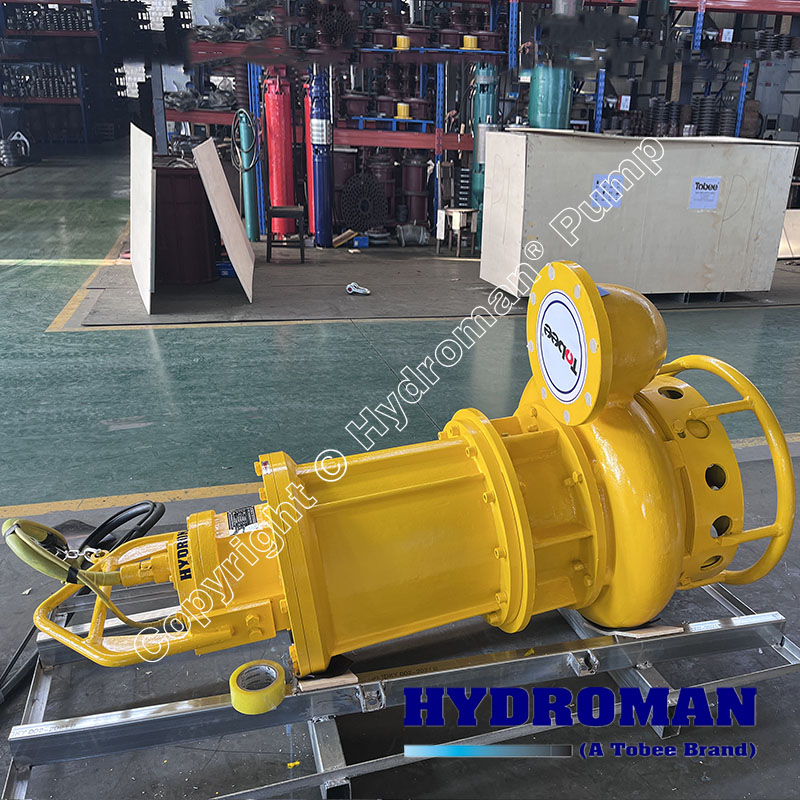
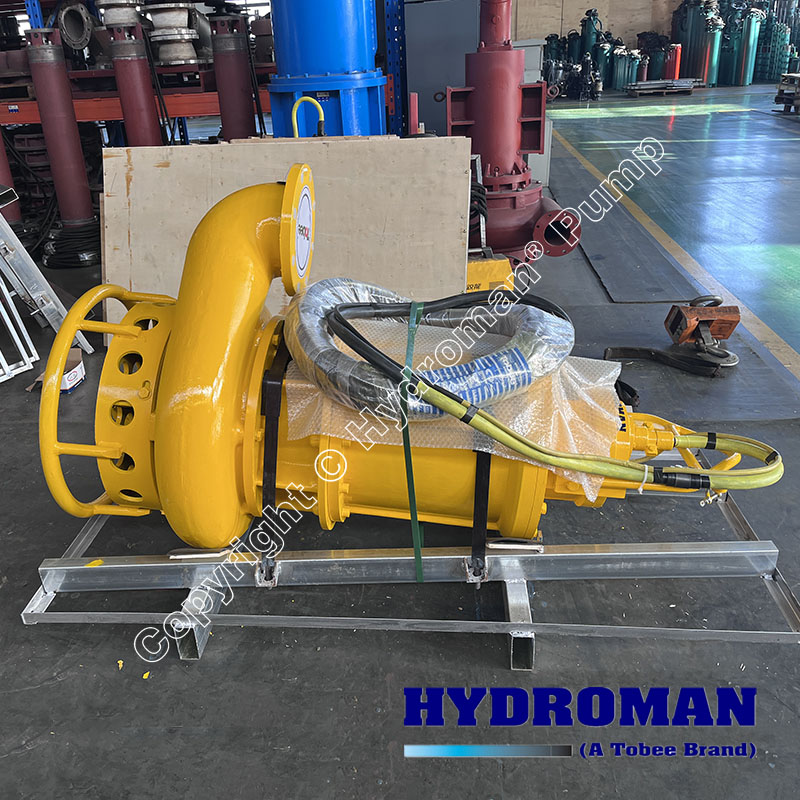
When you're moving sand, sediment, or slurry that would tear apart a conventional pump within days, you need equipment built specifically for that fight. The Hydroman 150TJQ18.5-50H6A is a heavy-duty electric submersible sand pump engineered to sit directly in the material you're pumping — pits, ponds, dredging sites, tailings dams — and keep working through conditions that would sideline a standard water pump.
You'll find this model on job sites where sand recovery, construction dewatering, or sediment removal is a daily operation, not an occasional task. It's built for people who need a pump they can trust to run shift after shift without constant rebuilds.
The model number tells you what you're buying before you ever open a datasheet:
| Code segment | What it means |
| 150 | Discharge outlet diameter — 150 mm (6 inch) |
| T | Submersible (potong/submersible series) |
| JQ | Agitator-equipped configuration (jiaoban / mixing agitator) |
| 18.5 | Motor rated power — 18.5 kW |
| 50H | Rated frequency — 50 Hz |
| 6A | Motor pole configuration/design revision |
So at a glance, you're looking at a 6-inch, agitator-fitted, 18.5 kW submersible pump built for 50 Hz power supply — a mid-to-upper capacity unit built for demanding sand and slurry transfer rather than light dewatering duty. (A 60 Hz version is available on request for markets that run on that supply standard.)
Why Sites Choose the 150TJQ18.5-50H6A
Direct submerged operation. You place the pump directly in the pit, sump, or pond. No long suction hose, no suction-lift limitations, no re-priming after a power interruption — it simply restarts submerged.
Built for abrasive solids, not just wet sand. The wet end is cast in high-chrome alloy rather than standard cast iron, which matters enormously in sand service: unprotected components in an abrasive slurry can lose wall thickness within weeks, while a properly matched high-chrome wet end is designed to hold up over a full season of continuous duty.
Electric submersible convenience. An electric submersible sand pump connects straight to your site power and control panel — no diesel engine, no fuel logistics, no exhaust to manage in a confined pit. For continuous multi-shift operations, that's a real difference in running cost and maintenance overhead.
Agitator advantage where it counts. A submersible sand pump with agitator earns its keep specifically on settled, compacted, or high-density sand — pond bottoms, tailings, material that's been sitting undisturbed. If your material is already fluid and free-flowing, a non-agitator model may suit you just as well and cost less to run; if it's compacted, skipping the agitator usually means low flow and a pump that "won't pick up sand" no matter how deep you submerge it.
Compact footprint, fast deployment. No priming system, no separate suction line to lay out — the unit goes in, gets connected, and starts pumping. That matters on temporary dewatering jobs where setup time is part of the cost.
Electric motor. A sealed, oil- or water-jacket-cooled submersible motor rated for continuous submerged operation, with thermal protection built in as standard on most configurations.
Impeller. The primary hydraulic component, cast in wear-resistant high-chrome alloy. Impeller geometry (open, semi-open, or closed vane depending on solids content) is what actually determines how large a particle the pump can pass and how efficiently it holds head under abrasive wear.
Pump casing / volute. Also high-chrome or hard-alloy lined, sized to handle the internal pressure generated by the impeller while resisting the constant erosive contact of sand particles moving through it at velocity.
Shaft and bearings. Transfer torque from motor to impeller; oversized relative to a clean-water pump of the same power, because sand pumps see far higher radial loads from unbalanced abrasive wear over time.
Mechanical seal. Usually a tandem or double mechanical seal with an oil-filled barrier chamber between the pump side and motor side — this is the single most important component standing between an abrasive slurry and a burned-out motor winding.
Agitator. Mounted at the suction inlet on JQ-configuration pumps, the agitator's rotating arms loosen and suspend settled sand so the impeller has fluid material to draw rather than a compacted bed it can't touch.
Key Specifications
| Parameter | Typical value for this class |
| Model | 150TJQ18.5-50H6A |
| Pump type | Submersible sand pump, agitator-equipped |
| Discharge size | 150 mm / 6 inch |
| Motor power | 18.5 kW |
| Power supply | 380V/415V, 50Hz (60Hz on request) |
| Rated speed | ~980 rpm (6-pole) |
| Max. capacity | Up to ~150 m³/h, duty-point dependent |
| Max. head | Up to ~18 m, duty-point dependent |
| Max. solids passage | ~28 mm |
| Wet-end material | High-chrome wear-resistant alloy (A05/A49, Cr26–27, ~HRC58–62) |
| Sealing | Tandem mechanical seal with oil-lubricated seal chamber |
| Protection class | IP68 |
| Approx. dry weight | 550 kg (configuration dependent) |
Because sand pumps are almost always duty-matched to a specific site — pumping distance, static lift, sand concentration — Hydroman confirms exact head, flow, and weight figures against your actual duty point rather than a single fixed number on a spec sheet. Ask for the pump curve and you'll see exactly where your operating point sits on it.
A submersible sand pump is a centrifugal pump paired with a sealed, submersible motor so the entire unit operates directly inside the sand-water mixture instead of sitting on the bank drawing suction through a long pipe. That single design choice removes most of the headaches that come with surface-mounted pumps — no priming, no suction lift limits, no risk of losing prime when the water level drops.
An ordinary submersible pump is built for clean or lightly contaminated water. A submersible sand dredging pump like the 150TJQ18.5-50H6A is a different animal: the impeller, casing, and wear plates are cast from abrasion-resistant high-chrome alloy, the seal arrangement is designed to keep grit out of the motor chamber, and — on the TJQ variant — an agitator is mounted around the suction inlet to break up compacted sand before it ever reaches the impeller eye.
The working sequence is straightforward once you see it laid out: Motor → Shaft → Impeller → Pump Casing → Suction → Discharge
The submersible motor turns the shaft, the shaft spins the impeller, and the impeller's centrifugal force throws the sand-laden liquid outward into the volute casing and up through the discharge pipe. Where settled or compacted sand sits below the intake — the situation an ordinary pump chokes on — the agitator paddles rotate around the suction opening, loosening and suspending the sediment so it can actually be drawn in rather than sitting there blocking flow.

What Makes It Fully Submersible
Full submersion isn't just "the pump happens to be underwater" — it's an engineering requirement. The motor housing is a sealed, IP68-rated enclosure. The mechanical seal system keeps the pumped liquid physically isolated from the motor's internal windings even under continuous submerged pressure.
The power cable enters through a sealed, strain-relieved gland designed to prevent water ingress at the single most common failure point on submersible equipment. And in most designs, the surrounding liquid itself acts as the motor's cooling medium — which is exactly why correct submergence depth matters: run the motor too shallow or intermittently exposed, and you lose both the cooling effect and the seal's operating margin.
This is also where total operating cost matters more than sticker price. A pump built with thinner castings or a single mechanical seal may look attractively priced up front, but in continuous sand duty the difference shows up as unplanned downtime, premature motor failure, and impeller replacement far sooner than a properly specified unit. Reliable heavy-duty construction is what actually keeps your cost per operating hour down.

Types of Submersible Pumps — and Where This One Fits
| Pump type | Best suited for |
| Submersible sand pump | Sand, sediment, moderately abrasive solids |
| Submersible slurry pump | Higher-density, higher-solids-content slurry |
| Submersible sewage pump | Wastewater, soft solids, non-abrasive debris |
| Submersible dredging pump | Underwater sediment and material removal |
| Submersible agitator pump | Settled or compacted solids requiring agitation before intake |
150TJQ18.5-50H6A sits at the intersection of the first and last rows on that table — it's a dedicated sand pump with an agitator built in, which is exactly why it performs well on jobs where the sand isn't already suspended and moving.

Where the 150TJQ18.5-50H6A Gets Used
• Sand and gravel processing. Sand recovery from washing plants, transfer of sand-water mixtures between processing stages, and general aggregate handling.
• Construction site dewatering. Excavation and foundation pits where groundwater inflow carries sediment — a job that fouls a standard dewatering pump within hours but is exactly what this pump is built for.
• Mining operations. Mine sump dewatering, tailings transfer, and general abrasive slurry handling where pump reliability directly affects production uptime.
• Pond and lake sediment removal. Settled sand, accumulated mud, and bottom material where an agitator-equipped design is often the difference between a pump that works and one that just sits there cavitating.
• Dredging and sediment transfer. Underwater sand removal and sediment slurry pumping in applications matched to the pump's rated head and solids-passage limits.

Choosing the Right Size: 6-Inch Class and Beyond
The 150TJQ18.5-50H6A's 150 mm discharge puts it firmly in the 6-inch submersible pump category — a size that generally balances flow capacity against portability and power draw well for medium-scale sand and dewatering work. Smaller sites with lower flow requirements often step down to 4-inch class pumps; larger dredging and mining operations frequently move up to 8-inch or 10-inch units.
Getting the size right comes down to a handful of real numbers, not guesswork:
Undersizing on flow or head means a pump that struggles and wears out chasing a duty point it was never built for. Oversizing wastes power and, on sand duty specifically, can actually accelerate wear by running components outside their designed velocity range.
Selecting a Submersible Sand Pump: What Actually Matters
Flow rate and head together, not separately. A pump's true output is defined by its duty point — the flow rate it delivers at your specific head requirement — not by either number in isolation. This is why Hydroman works from your pumping distance and elevation change rather than a single "capacity" figure.
Sand concentration and solids content. A standard clean-water submersible pump simply isn't built to survive continuous exposure to abrasive particles. Once solids concentration climbs past a few percent by volume, wear rates on unprotected components increase sharply — this is the threshold where a dedicated sand pump stops being optional.
Material and wear resistance. High-chrome alloy (commonly Cr26–Cr27, heat-treated to roughly HRC58–62) is the industry standard for abrasive sand and slurry service because it resists both erosive wear from particle impact and, to a meaningful degree, corrosive attack. Standard cast iron or mild steel components in the same duty typically show measurably shorter service life.
Agitator or non-agitator. Choose a submersible agitator sand pump when your material is settled, compacted, or sitting undisturbed — pond bottoms, tailings ponds, stockpile runoff. Choose a standard non-agitator sand pump when material is already fluid, actively fed, or continuously suspended; the agitator adds power draw and mechanical complexity you don't need in that situation.
Electrical requirements. Confirm motor power, voltage, phase, and frequency against your site supply before ordering — a mismatch here is the single most common (and most avoidable) cause of installation delays.
New pump or replacement submersible sand pump? If you're replacing existing equipment, gather this before you contact anyone for a quote: existing model number, required flow and head, discharge size, motor power, mounting/installation dimensions, wet-end material, and electrical specification. Hydroman's team can cross-match most existing sand pump models to an equivalent or upgraded configuration from this data alone.
Installation basics: confirm the pump reaches full required submergence depth before startup, check discharge piping is properly supported and free of unnecessary bends, secure the pump against movement or tipping on the pit floor, verify all electrical connections and cable condition, confirm motor voltage and frequency match your supply, and make sure the suction area is clear of oversized debris that exceeds the rated solids passage.
Daily checks worth two minutes of your time: cable condition, unusual vibration, motor temperature (where monitoring is fitted), abnormal noise, and delivered flow/pressure against what you'd expect at your duty point.
Preventive maintenance that actually extends service life: periodic impeller wear inspection, casing wall-thickness checks, bearing condition, mechanical seal inspection (including oil chamber condition on tandem-seal designs), agitator arm and bearing inspection, and prompt replacement of components once wear crosses the manufacturer's tolerance — waiting until failure almost always costs more than proactive replacement.
If flow drops off or the pump seems to be running without moving material, work through these in order: confirm the pump is actually submerged to its required depth; check whether the suction inlet is blocked or packed with debris; check whether sand concentration at the intake has exceeded what the pump is rated to handle; inspect the impeller for wear or blockage; check the discharge line for blockage or excessive back-pressure; and, on agitator models, confirm the agitator is actually turning — a stalled or damaged agitator on compacted sand will starve the pump of intake material even though everything else is running normally.
Not entirely — and that's the point. A submersible sand pump is specifically built to handle sand, not exclude it. What you can control is how much wear that sand causes: select a pump genuinely rated for your solids concentration and particle size rather than pushing a smaller unit past its limits, keep oversized debris out of the intake area, run the correct agitator configuration for your material, avoid running the pump outside its designed duty point, and keep to a regular wear-part inspection schedule. Those five habits, more than any single design feature, are what separate a sand pump that lasts a season from one that doesn't make it through the month.
| Symptom | Likely cause |
| Low flow | Worn impeller, partial blockage, or agitator not engaging compacted sand |
| Low head | Impeller wear, wrong duty point, excessive pipe friction loss |
| Excessive vibration | Impeller imbalance from uneven wear, bearing wear, loose mounting |
| Motor overheating | Insufficient submergence/cooling, electrical fault, extended dry-running |
| Seal leakage | Seal wear from abrasive ingress, damaged seal faces, chamber oil depleted |
| Impeller/agitator wear | Normal abrasive service life reached — schedule replacement |
Depending on your site configuration, Hydroman can supply the 150TJQ18.5-50H6A with: discharge hose or rigid pipe sized to your run length, appropriately rated electrical cable, a matched control panel with motor protection, a lifting chain or frame for safe deployment and retrieval, agitator assembly (if not already specified), and a starter set of wear parts — spare impeller, mechanical seal, and wear-resistant casing liners — so a planned maintenance stop doesn't turn into unplanned downtime. Accessory selection should always be matched to the specific pump configuration and site conditions rather than ordered generically.
The components you'll replace over a normal service life are the impeller, mechanical seal, bearings, shaft (in cases of severe wear or damage), agitator components, and wear-resistant casing liners. Consider scheduling a repair or overhaul when you notice reduced capacity against your baseline, rising vibration, unusual operating noise, higher-than-normal power draw, visible wear on accessible components, or any sign of seal leakage.
If you're looking for a replacement submersible sand pump rather than a repair, Hydroman's engineering team can match your existing model — competitor or legacy Hydroman unit — to a current configuration, confirming flow, head, discharge size, material, and electrical specification against your actual duty point before you commit to an order.
There's no honest single figure for submersible sand pump price — anyone quoting one without asking about your application first is guessing. What genuinely moves the number:
A 6 inch submersible pump price for a comparable duty point will typically sit meaningfully lower than an 8-inch or 10-inch unit at the same head, simply on casting size and motor power alone — but the honest comparison only happens once someone has your actual flow, head, and solids data in hand.
 |
 |
Hydroman manufactures and supplies the 150TJQ18.5-50H6A directly, and if you're comparing options for a submersible sand pump for sale, the fastest way to get an accurate number is to request a technical quotation with your duty point, along with the pump curve, full datasheet, and spare parts list for the matched configuration. That gives you something you can actually compare against alternatives, rather than a headline price that may not reflect your real application.
Heavy-duty construction built for the wear curve, not the spec sheet. High-chrome wet-end components, a sealing arrangement designed around abrasive service, and a motor rated for continuous submerged duty — all matched to what sand and sediment actually do to a pump over months of operation.
Purpose-built for sand-laden liquids. This isn't a clean-water pump adapted for sand duty; the hydraulic design starts from the assumption that the fluid is carrying abrasive solids.
Configurable to your site. Flow, head, motor rating, wet-end material, cable length, discharge connection, and agitator configuration can all be matched to your actual duty point rather than sold as a fixed, one-size package.
Support that doesn't stop at delivery. From initial pump selection through installation guidance, maintenance planning, and spare parts supply, Hydroman's team stays involved for the working life of the pump — including matching a replacement unit years down the line if your original model is discontinued elsewhere.
Selecting the right submersible sand pump comes down to a short list of real numbers about your site — send us the following and we'll come back with a matched recommendation, not a generic catalog listing:
Required flow rate · pumping head · sand/slurry concentration · maximum solids size · pumping distance · discharge pipe size · power supply · application type
What is a submersible sand pump?
A submersible sand pump is a centrifugal pump with a sealed, submersible electric motor, designed to operate fully immersed in sand-laden or sediment-laden liquid. Because the wet-end components are built from abrasion-resistant materials, it can handle continuous exposure to sand and grit that would quickly wear out a standard clean-water pump.
What's the difference between a submersible sand pump and a submersible slurry pump?
Both are built for abrasive service, but a sand pump is typically optimized for sand and moderate sediment concentrations, while a slurry pump is engineered for denser, higher-solids-content mixtures — often with thicker wear liners and a hydraulic design tuned for higher specific gravity fluids. In practice, the lines blur at the high end of sand-pump duty, which is why duty-point data matters more than the category label.
Does the 150TJQ18.5-50H6A have an agitator?
Yes — the "JQ" in the model code indicates an agitator-equipped configuration, designed for settled or compacted sand that needs to be loosened before it can be drawn into the impeller.
What size is the 150TJQ18.5-50H6A?
It's a 150 mm (6-inch) discharge submersible sand pump with an 18.5 kW motor — a mid-to-upper capacity unit in the 6-inch class, suited to medium-scale sand transfer and dewatering applications.
How much does a 6-inch submersible sand pump cost?
It depends on your duty point, wet-end material, agitator configuration, and cable/control panel specification — there's no accurate fixed price without that information. Request a quotation with your flow, head, and application details for a real number.
Can this pump handle sand and sediment?
Yes — that's specifically what it's built for. The high-chrome wet end and agitator configuration are designed around continuous exposure to sand and sediment, not as an afterthought bolted onto a standard water pump.
Can I use the 150TJQ18.5-50H6A for dredging?
Within its rated head, flow, and solids-passage limits, yes — it's commonly used for sediment and sand-slurry transfer in dredging-adjacent applications. For open-water dredging at scale or particle sizes beyond its rated solids passage, a dedicated dredge pump configuration may be a better fit; confirm your application details before assuming universal dredging capability.
How do I choose the right submersible sand pump?
Start with your flow rate, head, sand concentration, and maximum particle size, then match wet-end material and agitator configuration to those numbers rather than to price alone. The pump that looks like the best deal on paper is rarely the one with the lowest cost per operating hour once wear and downtime are factored in.
Can Hydroman supply replacement parts?
Yes — impellers, mechanical seals, bearings, shafts, agitator components, and wear-resistant casing liners are available to match existing pump models, including cross-matching for units originally supplied by other manufacturers.
Contact Us Today
Looking for a submersible sand pump for sale that's actually matched to your site, not just pulled off a shelf? Send Hydroman your flow rate, head, sand concentration, discharge size, and application details, and our engineering team will recommend a configuration built for your actual duty point.
Request a Quote · Send Your Pump Requirements · Download Datasheet
Related Pumps

Tobee is specialized in providing solutions for slurry pump, vertical sump pumps, gravel pump, dredging pumps, froth pump, seawater pumps, fire pumps, slurry pump parts and OEM pump parts for your harsh projects.
Top Navigation
Top Navigation
Contact Information
+86 180 3203 4573
+86 311 8722 1317
No. 266, Tianshan St, High-tech Zone, Shijiazhuang City 050000, China.