Hydroman Stainless Submersible Pump
Some pumping jobs are quietly brutal. A process sump that never fully dries out. A tank where the liquid is slightly acidic, slightly salty and warmer than you’d like. A drain pit where a carbon steel pump would look tired within a year.
The Hydroman® 150TJQ22-50H6A is a stainless steel submersible pump built for exactly these conditions. The pump body is stainless steel, and it sits directly in the liquid, so you don’t need a separate dry-pit installation, a priming routine or a long suction line. You lower it in, connect the discharge, and let it work.
If you’re comparing options, you’ll find everything below: what the pump is made of, where it fits, how 304 and 316 differ, and how to size one correctly. When you’re ready, request a quote and we’ll match the configuration to your liquid and duty point.
The 150TJQ22-50H6A is an SS submersible pump, so the casing and the other wetted parts are made of stainless steel rather than coated cast iron. That matters for three practical reasons.
First, stainless steel forms a thin, self-healing chromium oxide film. A scratch doesn’t start a rust bloom the way it does on painted steel. Second, a smooth stainless surface cleans easily and sheds deposits, which helps if you switch between liquids or want to keep the sump tidy. Third, you won’t be chasing peeling coatings or replacing corroded casings every few seasons, so lifecycle cost often beats the lower purchase price of a cast iron pump.
A submersible pump puts the motor and hydraulic end in one sealed unit that operates underwater. The surrounding liquid cools the motor, the pump is always flooded (no priming, no suction lift limits), and you avoid the noise and floor space of a dry-installed pump.
You’ll typically use it in sumps, collection pits, process tanks and industrial basins, anywhere access is tight and a pump on the floor above would need long, leak-prone suction piping.
Stainless steel is corrosion resistant, not corrosion proof. Whether it lasts depends on what’s in your liquid. Chlorides, low pH, heat and stagnant conditions are the four factors we ask about first. We’d rather ask you a few questions now than see a pump come back with pitting later, and the sections below show you what to check yourself.
Key Features and Benefits
Stainless steel wetted parts, from casing to impeller. You get a submersible pump with a stainless steel impeller, so the part under the highest velocity and wear is protected too. In a pump with a mismatched impeller, that’s usually where trouble starts.
Space-saving, quiet installation. With the pump working below the liquid surface, you save floor space, remove the suction piping, and cut noise considerably. For plants where the pump pit shares space with other equipment, that’s a real advantage.
No priming, no cavitation worries at the suction. Because the pump is flooded, you avoid the most common cause of damaged impellers in dry-installed units, which is poor suction conditions. You still need to keep the minimum submergence level in mind, but that is a far easier rule to follow.
Configurable for your operating conditions. Cable length, mechanical seal arrangement, voltage and material grade can be adapted to your site. If your liquid is more aggressive than standard, tell us before you order and we’ll look at the right option rather than the default one.
Technical Specifications
Use the table below as a snapshot. Values marked “per quotation” are confirmed against your duty point and the performance curve for your order, so you receive numbers that apply to your actual unit, not a generic range.
| Specification | Hydroman® 150TJQ22-50H6A |
| Pump type | Stainless steel submersible pump |
| Installation | Fully submersible, vertical operation |
| Pump body | Stainless steel |
| Impeller | Stainless steel |
| Outlet diameter | 150 mm |
| Rated flow | 150 m³/h |
| Rated head | 22m |
| Motor power | 22 kW |
| Voltage / frequency | Configured to your supply (e.g. 380–415 V / 50 Hz, 460 V / 60 Hz) |
| Maximum liquid temperature | ≤ 80 ℃ |
| Maximum solids passage | 28 mm |
| Cable length | Configurable to your sump depth |
A word of caution we give every buyer: the digits in a model code don’t replace a confirmed curve. Always ask for the performance curve and a material statement before you finalize.

Applications of the Stainless Steel Submersible Pump
Rather than list industries, here is how people actually use this pump.
In chemical plants, a chemical resistant submersible sump pump often handles floor drains, bund collection and process tank emptying. A stainless pump copes well with many mild acids, alkalis, brines and cleaning solutions, provided the concentration and temperature are within the grade’s limits. For anything strongly acidic or high in chlorides, we’ll check compatibility with you first.
Equipment drain-down, cooling water collection, machining coolant pits and wash-bay sumps are everyday jobs. A stainless steel submersible pump handles them without the rust staining and scale flakes that can contaminate a clean process.
Use it as a stainless steel transfer pump to move process water, condensate return, rinse water or plant effluent between tanks. It works as an ss transfer pump wherever you can place the unit in the source tank.
Food, beverage, pharmaceutical and electronics plants often prefer stainless for cleanliness and corrosion resistance. If you need hygienic design or specific certifications, mention them upfront. Material alone doesn’t make a pump sanitary, and we’ll tell you honestly what the 150TJQ22-50H6A can and can’t support.

Stainless Steel Material Options: 304 vs. 316
This is the question that decides whether a pump lasts three years or fifteen, so it’s worth a few minutes.
Both are austenitic stainless steels. The key difference is molybdenum: 316 contains roughly 2–3% Mo, while 304 contains none. That addition lifts resistance to pitting and crevice corrosion, especially in chloride environments.
| Property | 304 stainless steel | 316 stainless steel |
| Chromium | ~18–20% | ~16–18% |
| Nickel | ~8–10.5% | ~10–14% |
| Molybdenum | none | ~2–3% |
| Typical PREN* | ~18–20 | ~23–26 |
| Chloride tolerance (rule of thumb, ambient water) | up to roughly 200 ppm | up to roughly 1,000 ppm or more |
| Best for | Fresh water, mild chemicals, general industrial use | Salt-bearing water, coastal sites, many chemical and food duties |
*PREN = Cr + 3.3 × Mo + 16 × N. A higher number means better pitting resistance. Chloride limits vary with temperature, pH and crevice conditions, so treat them as guidance, not guarantees.

When is a 316 stainless steel submersible pump appropriate?
Choose 316 when your liquid contains chlorides (brackish water, brine, bleach residues, de-icing salts), when the site is coastal, or when the liquid is warm. Above about 60 °C, chlorides can also cause stress corrosion cracking in austenitic grades, so temperature and chloride level need to be considered together.
Stay realistic, too. Neither grade suits hydrochloric acid, and hot concentrated sulfuric or strongly oxidizing mixtures call for other alloys altogether.
Ask for the material grade of each part: casing, impeller, shaft, fasteners and seal faces. A pump described as “stainless” can still have a mix of grades. We state the material configuration of your 150TJQ22-50H6A in the quotation so you can compare like with like.
Send us the liquid name, concentration, pH, temperature and chloride content. With those five facts, we can usually say within a day whether 304 or 316 is the right call, or whether you should look at something else.

Why Source Stainless Steel Pumps from Hydroman®?
Plenty of suppliers sell pumps. What we try to do differently is slow down at the start so you don’t have problems later.
We help you size it. Send us your flow, head and liquid details, and we’ll check them against the curve rather than selling you the nearest model.
We confirm materials in writing. You’ll see the grade of each wetted part before you pay, which makes a real difference when you’re comparing stainless steel submersible pump manufacturers and every datasheet looks alike.
We support you with documents. Drawings, performance curves, technical data and quotation details are available, so your engineer and your purchasing team can both do their jobs.
How to Select the Right Stainless Steel Submersible Pump
Looking for the best stainless steel submersible pump? The best one is the one whose duty point sits near the middle of its curve for your actual system. Here’s how to get there.
Start with the flow you need in m³/h, then add up the static lift and the friction losses in the discharge pipe. As a design habit, keep discharge velocity roughly between 1.5 and 3 m/s. Slower lets solids settle, and faster raises friction losses and wear.
A quick power check: shaft power in kW ≈ (flow in m³/h × head in m × specific gravity) ÷ (367 × pump efficiency). A pump moving 100 m³/h against 20 m of head at 65% efficiency needs about 8.4 kW at the shaft, so you can see how quickly power climbs with head. Motor sizing then adds margin on top.
If you ever run the pump at a different speed (for example with a VFD), the affinity laws apply: flow changes in proportion to speed, head with the square of speed, and power with the cube. A 20% speed reduction cuts power by almost half.
Note the temperature, density, viscosity, pH, chloride level and any abrasive content. Many standard submersible motors are designed for liquid up to about 40 °C, so tell us early if yours is hotter.
Confirm voltage, frequency and phase, and check cable voltage drop over long runs. A common target is to keep it under 3–5%. Also check sump depth against minimum submergence, and think about how often the pump will start. Frequent short cycles are harder on motors than steady running.
Clear water and light process liquids suit a closed or semi-open impeller. If your liquid carries fibres, grit or sludge, tell us the maximum particle size so we can check solids passage and clogging risk before you buy.
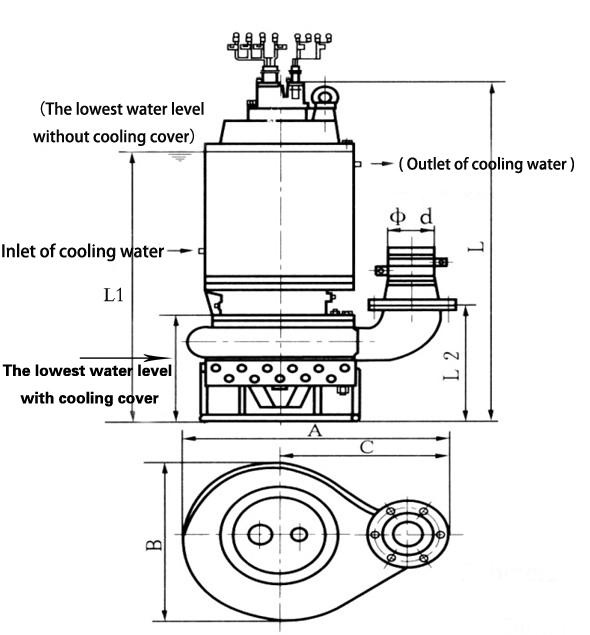 |
|
| Model | 150TJQ22-50H6A |
| L (mm) | 1370 |
| L1 (mm) | 1105 |
| L2 (mm) | 502 |
| A (mm) | 925 |
| B (mm) | 650 |
| C (mm) | 505 |
| d (mm) | 150 |
Yes. The pump body is stainless steel. Grade options (304 or 316) are confirmed per order, and we’ll state them in your quotation, along with the material of the shaft, fasteners and seals.
Often, but not always. Resistance depends on the chemical, its concentration, temperature and the pump’s seals as well as its metal parts. Send us your liquid data and we’ll tell you plainly whether stainless is suitable.
Mainly motor power, flow and head, the stainless grade (316 costs more than 304 because of its nickel and molybdenum content), cable length, seal type and any custom requirements. An ss submersible pump price therefore varies widely from one project to another, which is why we quote against your duty point rather than publishing a single figure. For the same reason, an ss centrifugal pump price from another source may not be a like-for-like comparison.
Yes, when you can place it in the source tank or sump and your flow, head and liquid properties fall within its performance range. It’s a good fit for tank-to-tank and sump-to-process transfers.
Send us your target flow rate, total head, liquid and its temperature, power supply and quantity. If you have a drawing or photo of your sump, include that too.
Request a Quote for Hydroman® 150TJQ22-50H6A
You don’t need a finished specification to start. A rough idea of your liquid, flow and head is enough for us to begin.
Tell us your flow rate, head, liquid and temperature, preferred material grade, voltage and quantity, and our engineers will come back with a matching configuration, a performance curve and a quotation. You can also ask us to check material compatibility or talk through pump performance before you commit.
[Contact Hydroman® for Technical Support]
 Sara Liang
 +86 189 3110 6396 (Whatsapp/Wechat)
 Inquiry@tobeepump.com
Related Pumps

Tobee is specialized in providing solutions for slurry pump, vertical sump pumps, gravel pump, dredging pumps, froth pump, seawater pumps, fire pumps, slurry pump parts and OEM pump parts for your harsh projects.
Top Navigation
Top Navigation
Contact Information
+86 180 3203 4573
+86 311 8722 1317
No. 266, Tianshan St, High-tech Zone, Shijiazhuang City 050000, China.