If you’ve ever tried to clear a silted-up pond with an ordinary drainage pump, you already know how it ends: the impeller clogs, the seals wear out in a few weeks, and the mud stays where it is. The Hydroman® 100TJQ30-50H6B is a heavy-duty submersible silt removal pump built for this job. It sits at the bottom of the pond, tank or pit, pulls in the sediment-laden water, and pushes it through your discharge line to wherever you want it to go.
It works as a silt pump for ponds and lakes, an industrial silt pump for settling basins, and a silt water pump for muddy construction sites. If you’ve been searching for a pump to remove silt from a pond that won’t give up after one season, this is the class of equipment you should be looking at.
Have your pond size, silt depth and discharge distance ready, and our engineers can confirm whether this model fits your site. You can request a quote or talk to our technical team at any point.
A submersible silt pump works where the problem is. Because the pump is lowered to the sediment layer, there’s no long suction line to lose prime and no suction lift limiting how deep you can work. For you, that means less setup time and fewer air leaks.
Silt is finer than sand, but it’s far from harmless. Quartz, the main component of most silt, has a Mohs hardness of about 7, harder than ordinary steel. Pumped continuously, it eats away at casings, impellers and seals. That’s why a heavy duty silt pump needs wear-resistant materials in the flow path, and why a standard clean-water pump rarely lasts in this service. We can match wear-resistant options for the impeller and casing to your sediment, and the wearing parts are designed to be replaced rather than scrapping the pump.
The motor and pump are one compact unit that runs underwater, so you can lower it from a bank, a pontoon or a lifting frame. You don’t need a pump house or a suction pipe run, which makes it a good fit for remote ponds and tight industrial pits.
Slurry behaves differently from water. It’s denser, it creates more friction in the pipe, and it lowers the pump’s effective head compared with its clean-water curve. Good selection means looking at your solids concentration and particle size, not just flow and head. We’ll help you size this properly so the pump runs stable instead of surging and clogging.
Thick, compacted sediment often needs help getting into the pump. Depending on your application, we can discuss agitation, cutting arrangements, control panels and cable lengths. Let us know your conditions and we’ll confirm which options are available for this model.
| Parameter | Specification |
| Model | 100TJQ30-50H6B |
| Pump type | Submersible silt removal pump |
| Discharge diameter | 100 mm (4 in) |
| Installation | Vertical, fully submersible |
| Flow rate | 70m³/h |
| Head | 38m |
| Motor power, speed | 30 kW; 980 r/min |
| Speed | 980 r/min |
| Max. solid size | 19 mm |
| Manufacturer | Hydroman® |
Performance figures depend on the motor and impeller configuration you choose, so we’d rather send you the exact datasheet than publish a number that might not match your build. Tell us what you’re pumping and we’ll send the right curve.
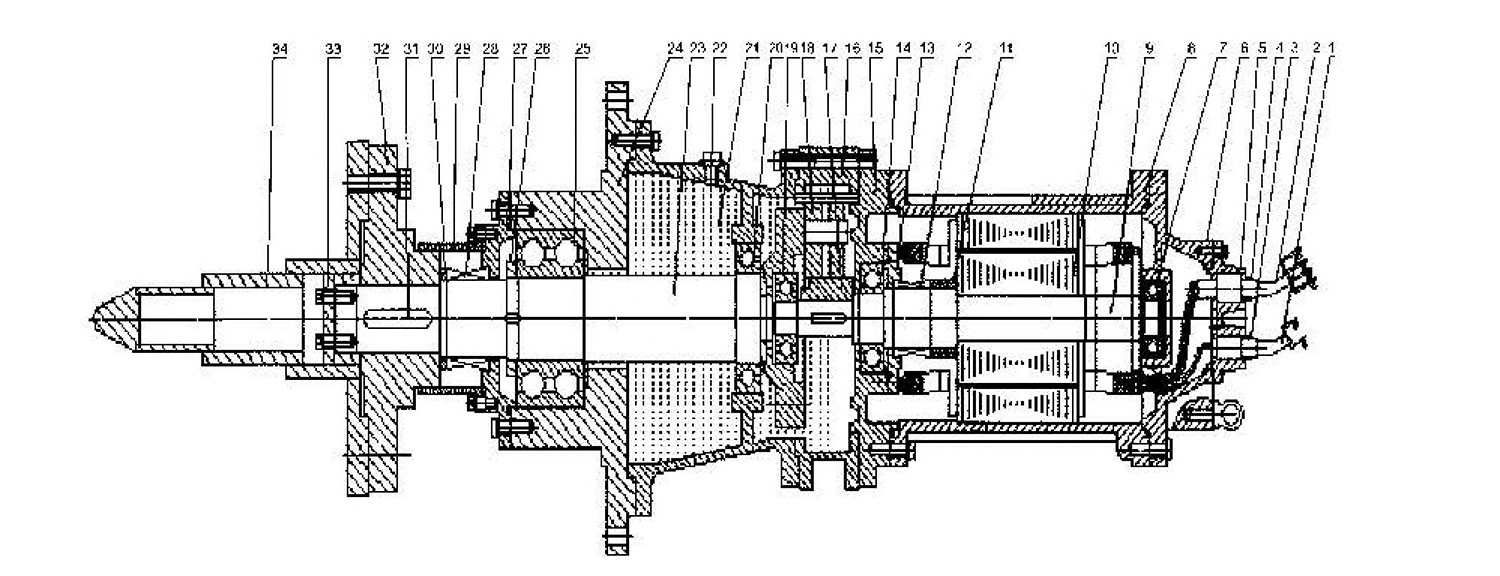
| Serial No. | Name | Serial No. | Name | Serial No. | Name |
| 1 | Control cable | 2 | Power cable | 3 | Control cable gland |
| 4 | Power cable gland | 5 | Cable seat | 6 | Upper end cover of the motor |
| 7 | Bearing | 8 | Stator | 9 | Rotor axle |
| 10 | Rotor | 11 | Mechanical seal pad | 12 | Mechanical seal |
| 13 | Gland | 14 | Bearing | 15 | End cover |
| 16 | Pin wheel housing | 17 | Bearing | 18 | Cycloid gear |
| 19 | Bearing | 20 | Bearing | 21 | Engine oil |
| 22 | Oil plug | 23 | Main shaft | 24 | Bearing body |
| 25 | Bearing | 26 | Round nut | 27 | Bearing body gland |
| 28 | Mechanical seal | 29 | Sheatding | 30 | Mechanical seal pressure pad |
| 31 | Key | 32 | Coupling flange | 33 | Axle head pressure plate |
| 34 | Stirring head |

Reservoirs lose storage capacity as sediment settles, and removal is usually done in sections. A silt dredge setup built around a submersible pump, often on a floating platform, lets you work area by area without heavy excavation equipment on site.
Settling tanks, cooling-water basins and wastewater lagoons all collect sludge that has to be removed on a schedule. An industrial silt pump handles that routine cleaning without needing a crew to enter the tank, which is a real safety gain.
Sumps and settling ponds at mines and quarries fill with fine tailings and wash-water fines. The material is abrasive and the duty is often continuous, so wear-part life matters more here than anywhere else.
Foundation pits and trenches fill with muddy water after rain. A clean-water dewatering pump tends to jam on the first heavy load of fines, while a silt water pump keeps moving.

Pond bottoms collect fine soil, leaves, algae and organic matter year after year. Over time the pond gets shallower, water quality drops and storage capacity shrinks. A pond silt removal pump lets you clean it while it stays full or partly full, with no need to drain and excavate. The pump mixes the sediment with water and sends the slurry through a pipe to a settling area, a geotextile tube or a field, depending on where you’re allowed to put it.
If you’re planning this yourself, here’s a quick estimate. A 1,000 m² pond with 0.3 m of silt holds about 300 m³ of sediment in place. If your slurry runs at around 15% solids by volume and you pump 60 m³/h, that’s roughly 9 m³ of sediment per hour, or about 33 running hours for the whole job. Your numbers will differ, but it’s a useful way to see whether a project takes days or weeks.

Placement. You lower the pump into the pond or pit, usually raised slightly off the bottom or set at the sediment surface, depending on how firm the material is.
Suction. The impeller creates a low-pressure zone at the inlet, and the water and fine sediment mix flows in. This is why a silt suction pump can work without a separate priming system.
Discharge. The slurry is pushed through your hose or pipe to a settling area or treatment point. With a 100 mm discharge, a flow of 60 m³/h gives a velocity of about 2.1 m/s in the line. At 100 m³/h it’s about 3.5 m/s. Slurry lines usually need enough velocity to keep solids from settling inside the pipe, but not so much that you wear out the pipe walls and bends, so the right flow is a balance.
Running and maintenance. Check the pump and the discharge line regularly. Watch for falling flow, rising motor current or unusual vibration, because they often signal a worn impeller or a partly blocked line. Plan inspections around how abrasive your material is.

| Silt Removal Pump | Standard Drainage Pump | |
| Main job | Removing silt and sediment | Moving water |
| Medium | Muddy water and suitable slurry | Clean to lightly dirty water |
| Solids handling | Designed for specified solids | Usually limited |
| Wear resistance | Heavy-duty, wear-resistant options | Depends on construction |
| Typical use | Pond dredging, sediment removal | Flood and general drainage |
Standard pumps are cheaper at the start. In silty water they usually cost more over time, through clogging, early replacement and lost days on site.
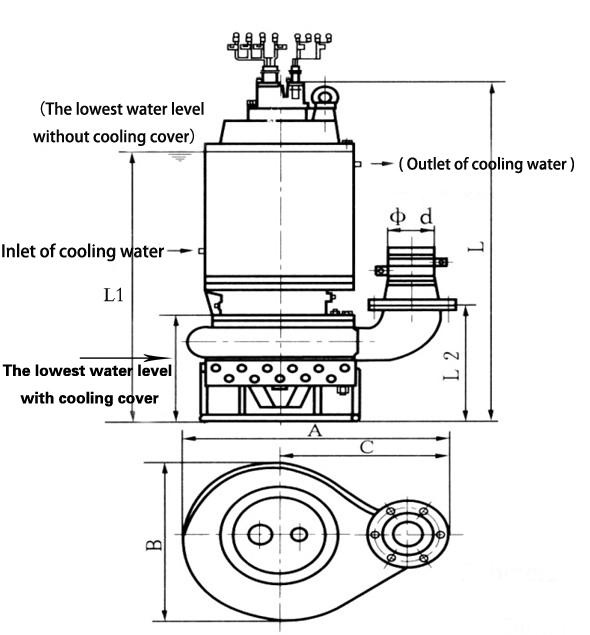 |
|
| Model | 100TJQ30-50H6B |
| L (mm) | 1452 |
| L1 (mm) | 1144 |
| L2 (mm) | 425 |
| A (mm) | 832 |
| B (mm) | 630 |
| C (mm) | 605 |
| d (mm) | 100 |
1. Focused on slurry, not just water. Hydroman® builds submersible slurry and sludge pumps for underwater pumping, so silt pumping equipment is our everyday work, not a side product.
2. Configured around your project. Flow, head, outlet size and accessories can be matched to your site rather than forcing your project into a standard pump.
3. Built to be maintained. Wear-resistant materials and replaceable parts mean you service the pump instead of replacing it, which keeps long-term running costs down.
4. Selection support from people who ask good questions. Send us your medium, particle size, flow, head and discharge distance, and we’ll recommend a configuration instead of guessing.
For most ponds, a submersible silt pump is the practical choice. What matters is matching it to your silt concentration, particle size, working depth and discharge distance. A pump sized only on flow rate tends to disappoint.
Yes, within the pump’s design limits. Very thick or sticky sediment usually needs to be loosened and mixed with water first, using an agitator or other dredging tools, so the pump receives a slurry rather than a solid mass.
A silt pump is typically a compact submersible unit for fine sediment and muddy water in ponds, tanks and pits. A silt dredge pump is usually part of a larger dredging system, often on a vessel or platform, built for bigger volumes, coarser material and longer pipelines. If your job is somewhere in between, tell us the scale and we’ll point you to the right one.
Start with pond depth, the thickness of the silt layer, how thick the slurry will be, the largest particle, the flow you need and how far you need to send it. Those five or six numbers are enough for us to give you a sound recommendation.
Silt pump price depends on flow and head, motor power, materials, accessories and quantity. Send us your working conditions and we’ll quote a configuration that fits, rather than a generic price.
You can order directly from Hydroman® through Tobee. If you’re looking for a silt pump for sale that’s matched to your site, share your operating details and our team will help you choose.
Ready to move forward? Send us the following and we’ll come back with the latest specifications, a recommended configuration and pricing:
 Sara Liang
 +86 189 3110 6396 (Whatsapp/Wechat)
 Inquiry@tobeepump.com
Related Pumps

Tobee is specialized in providing solutions for slurry pump, vertical sump pumps, gravel pump, dredging pumps, froth pump, seawater pumps, fire pumps, slurry pump parts and OEM pump parts for your harsh projects.
Top Navigation
Top Navigation
Contact Information
+86 180 3203 4573
+86 311 8722 1317
No. 266, Tianshan St, High-tech Zone, Shijiazhuang City 050000, China.