4 Inch Submersible Pump Description
When a sump floods, a pit fills with abrasive slurry, or a plant needs to move process water around the clock, you don’t need a pump that merely works on a datasheet. You need one that keeps running when the liquid is dirty, the duty is hard and the shutdown window is short.
The Hydroman® 100TJQ22-50H6B is an electric industrial submersible pump built for that kind of work. It sits directly in the liquid, so there is no suction line to prime and no pump house to build. It is designed for contractors, plant engineers, distributors and OEM buyers who need dependable drainage and transfer, and who want a supplier that can talk through flow, head and solids before the order is placed.
Key Features of the Industrial Submersible Pump
Built to sit underwater and keep going. The motor and pump are a single sealed unit that operates fully submerged. The liquid itself helps cool the motor, which is why correct submergence matters so much (more on that below). Quality units in this class use a protected motor housing and a double mechanical seal arrangement, typically with silicon carbide faces, to keep water out of the stator.
Heavy duty construction. Industrial duty means abrasion, grit and the occasional piece of debris that was never supposed to be in the pit. As a heavy duty submersible pump, the 100TJQ22-50H6B uses robust castings and a wear-resistant hydraulic end. Wear-resistant material options, such as high-chrome alloys commonly specified at roughly 58–65 HRC for abrasive service, can be discussed for your application.
Performance matched to your system, not just a headline number. A pump is only useful at the point where its curve meets your pipe system curve. We supply the full performance curve so you can check the real working point rather than relying on a maximum-flow figure.
Add-ons that make installation easier. Control cabinets with overload and phase protection, VFDs where compatible, discharge pipe sets and lifting accessories are available, subject to model compatibility.
Technical Specifications
Specifications drive every purchase decision, so here is the summary view. Exact figures are confirmed from the official datasheet and test curve for your order and voltage.
| Parameter | Specification |
| Brand / Model | Hydroman® 100TJQ22-50H6B |
| Pump type | Industrial electric submersible pump |
| Installation | Submerged, vertical or with auto-coupling (per configuration) |
| Discharge size | 100 mm |
| Flow rate | 100 m³/h |
| Total head | 30 m |
| Motor power | 22 kW |
| Power supply | 380 V / 50 Hz typical; other voltages and 60 Hz on request |
| Maximum particle size |
16 mm |
| Wetted materials | High chrome, Hyperchrome, SS304, SS316L, Duplex SS, CD4MCu etc. |
| Cable length | Standard length plus custom lengths |
| Motor protection | Ingress protection to IP68 (IEC 60529), insulation class F or higher |
If you are comparing models across our submersible pump range, send us your duty point and we will confirm whether this model is the right fit or whether a neighbouring size would serve you better.
Most projects need more than the pump alone. You can specify a control panel with motor protection, a variable frequency drive for flow control and energy savings, discharge hose or pipe fittings, a guide rail and auto-coupling system for easy lift-out, and alternative wear materials where supported. Spare impellers, seals and wear plates are also available so your maintenance team isn’t waiting weeks for a part.
An electric submersible pump places a sealed motor directly beneath the hydraulic end. As the motor turns the impeller, liquid is thrown outward by centrifugal force, pressure builds in the volute casing, and the flow is pushed up the discharge line. Because the pump is already surrounded by the liquid, it pushes rather than draws. That removes the suction-lift limits and priming problems that affect surface-mounted pumps.
A standard clean-water pump is optimised for clear liquid at moderate temperatures. Put it in a sump with sand, silt or fibrous material and the wear on its impeller will be fast and expensive. An industrial submersible pump is designed for the opposite environment, with larger passages, harder materials, stronger shaft seals and a motor built to run in harsh conditions.
That doesn’t mean one pump fits every liquid. Chemical content, temperature and solids load all matter, which is why we ask about your medium before we recommend a configuration.
Most industrial installations use a vertical submersible pump arrangement: the unit hangs from a lifting chain or sits on a base elbow at the bottom of the sump, with the discharge pipe running upward. A few practical points will save you trouble later:
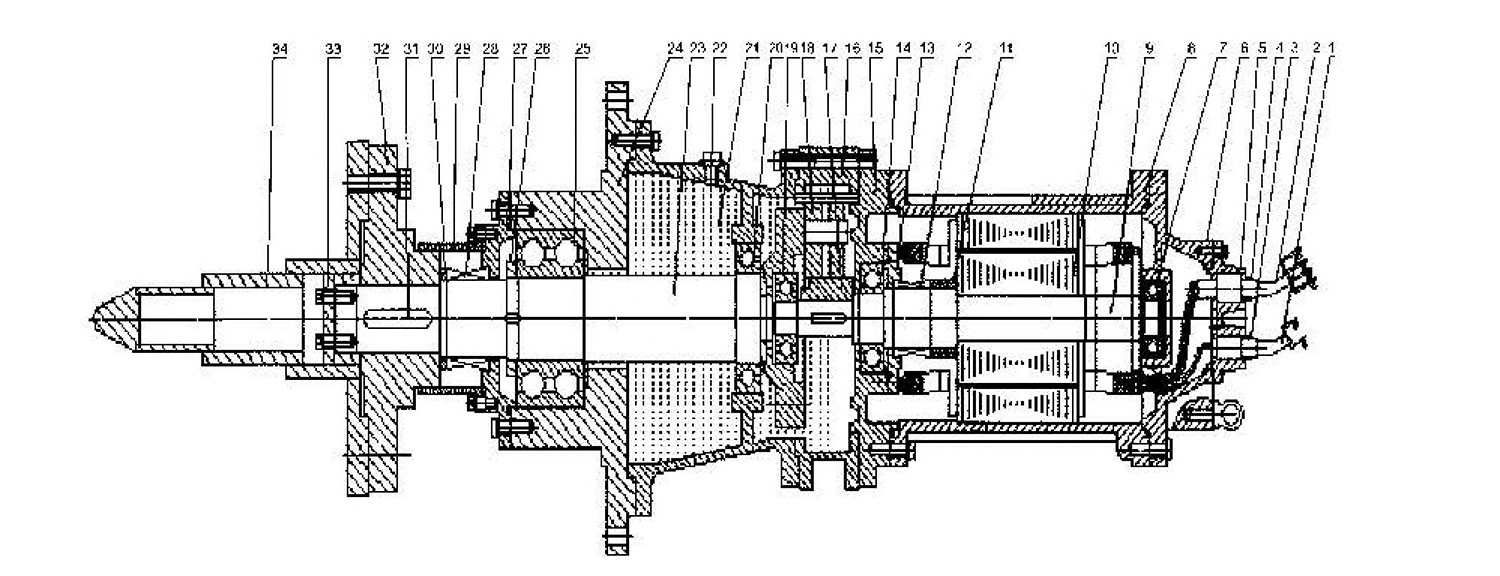
| Serial No. | Name | Serial No. | Name | Serial No. | Name |
| 1 | Control cable | 2 | Power cable | 3 | Control cable gland |
| 4 | Power cable gland | 5 | Cable seat | 6 | Upper end cover of the motor |
| 7 | Bearing | 8 | Stator | 9 | Rotor axle |
| 10 | Rotor | 11 | Mechanical seal pad | 12 | Mechanical seal |
| 13 | Gland | 14 | Bearing | 15 | End cover |
| 16 | Pin wheel housing | 17 | Bearing | 18 | Cycloid gear |
| 19 | Bearing | 20 | Bearing | 21 | Engine oil |
| 22 | Oil plug | 23 | Main shaft | 24 | Bearing body |
| 25 | Bearing | 26 | Round nut | 27 | Bearing body gland |
| 28 | Mechanical seal | 29 | Sheatding | 30 | Mechanical seal pressure pad |
| 31 | Key | 32 | Coupling flange | 33 | Axle head pressure plate |
| 34 | Stirring head |

Direct Liquid Handling and Reduced Priming Requirements

Heavy-Duty Construction for Industrial Operation
The parts that fail first in rough service are the impeller, wear ring or plate, and shaft seal. The 100TJQ22-50H6B is designed with those in mind: a strong hydraulic end, a sealed motor housing and a shaft seal arrangement intended for dirty liquids. Where your medium is gritty, we can discuss harder-wearing material options so the pump keeps its performance for longer between overhauls.

Motor Protection and Operational Reliability
A submersible motor lives in a hard place. Look for these protections when you compare suppliers:
Float switches are widely used for automatic start and stop. Whether this specific configuration includes one, or is supplied for use with an external float or level controller, is confirmed at quotation. Tell us how you want the pump controlled and we will quote accordingly.

Maintenance and Service Life
Service life depends on the liquid and the duty cycle, but the habits that extend it are simple. Check motor current regularly, because a rising trend usually signals wear or a partial blockage. Inspect and clear debris from the intake. Replace wear parts before clearances open up and efficiency falls away. Record seal condition and insulation resistance at each service. As a rule, most manufacturers limit starts to around 10–15 per hour for submersible motors, so frequent cycling should be handled with sump sizing or a VFD.

Applications for Industrial Submersible Pumps
In factories, mines and processing plants, a submersible transfer pump is often the simplest way to clear collection pits, move process water between tanks, or handle plant drainage. Before you finalise a selection, confirm particle size, pH, temperature and chemical content, because those details decide the materials.
Excavations, foundation pits, tunnels and basements all fill with water, often at the worst time. A construction submersible pump needs to be portable, tough and quick to deploy. Size it on the real head, including pipe friction and hose length, not just the vertical lift. Choosing by maximum flow alone is a common mistake on site, because the actual flow at your head may be much lower.

Electric Submersible Pump Project
Where the liquid carries sand, silt or fine solids, the focus shifts to passage size, impeller design and wear materials. Keep the discharge velocity high enough to prevent settling in the pipe. For many slurries, a velocity of roughly 1.5–2.5 m/s is used as a planning range, but the right figure depends on particle size and density. Send us your solids data and we will tell you honestly whether this pump suits the job.
A marine submersible pump faces salt, corrosion and demanding duty. Seawater contains roughly 19,000 mg/L of chloride, which attacks ordinary cast iron and standard stainless grades. If your project involves seawater, ballast or offshore use, tell us early so we can discuss suitable materials, such as duplex stainless steel, and confirm whether this model can be configured for it. We would rather recommend the right option than promise something the standard pump can’t deliver.
Similarly, if you are looking for a high temperature submersible pump, note that standard models are generally rated for liquids up to about 40 °C. Higher temperatures need a specifically designed motor and seal arrangement, so share your temperature with your enquiry.
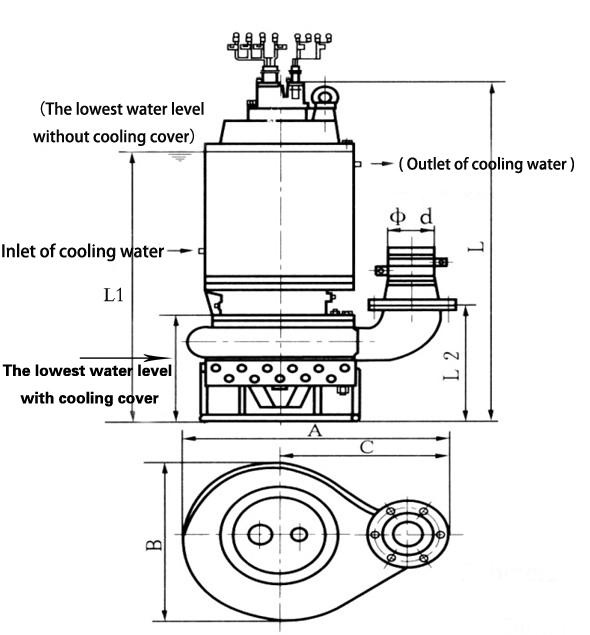
Hydroman® 100TJQ22-50H6B Industrial Submersible Pump Outline Dimension
 |
|
| Model | 100TJQ22-50H6B |
| L (mm) | 1401 |
| L1 (mm) | 1135 |
| L2 (mm) | 535 |
| A (mm) | 883 |
| B (mm) | 630 |
| C (mm) | 545 |
| d (mm) | 100 |
Start with two numbers: how much liquid you need to move, and how high and how far you need to push it. Total head is the static lift plus friction losses in the pipe and fittings. Read the pump curve at that head, and make sure the working point is close to the best efficiency point.
If your specification is in US units, a quick conversion helps: 300 gpm is about 68 m³/h, and 1 m³/h is about 4.4 gpm.
Discharge size affects velocity, friction loss and how easily the pump handles solids. As a reference when you compare products:
| Nominal size | Approx. metric | Typical use |
| 2 inch | 50 mm | Small sumps, light dewatering |
| 3 inch | 80 mm | General site dewatering, small transfer |
| 4 inch | 100 mm | Industrial drainage, medium flow |
| 6 inch | 150 mm | High-volume dewatering and transfer |
If you’re searching for a 2 inch submersible pump or a 3 inch submersible pump, check the actual discharge size and curve of any model you consider, because the bore alone doesn’t tell you the capacity. Your pipe size should match the pump outlet; reducing the pipe sharply adds head loss.
Write down the following before you ask any supplier for a price: liquid type, temperature, pH, density, solids concentration and maximum particle size. These facts decide whether you need a standard cast iron pump or a wear-resistant or corrosion-resistant build.
Check voltage and frequency (380 V/50 Hz and 460 V/60 Hz are common industrial options), motor power, cable length, installation depth and whether a VFD or soft starter is required. Long cable runs cause voltage drop, so mention your cable distance. Make sure the pump will have enough submergence to cover the motor during operation, especially for continuous duty.
If you’re looking for the best industrial submersible pump, remember that “best” depends on your duty, not a ranking. A good supplier will give you the data to judge for yourself. When you compare submersible pump manufacturers, including submersible pump manufacturers in China, look for:
Whether you want to buy a submersible pump for a single site or are searching for submersible pumps for sale in volume, a reliable submersible pump supplier will answer your technical questions before asking for a deposit. That is how we work at tobee.com with Hydroman® pumps.
It is used for industrial drainage, wastewater and process water transfer, sump emptying, construction dewatering and, where the model is suitable, handling liquids that contain solids.
Begin with flow, total head, liquid properties, solids size, power supply and installation conditions. Then check the pump curve to be sure the duty point falls in the efficient range. We are happy to review your numbers.
It depends on the motor design, cooling, liquid level, duty point and the manufacturer’s rating. Continuous operation generally requires the motor to stay fully submerged. Tell us your duty cycle and we’ll confirm.
Float switches are a common option for automatic control, but not every industrial pump comes with one. Ask us about the control configuration for the 100TJQ22-50H6B, and we will confirm what is included or available.
Always disconnect power first. Lift the pump using the lifting eye or chain, never the cable. Secure the discharge pipe, protect the cable and follow the installation manual. Inspect regularly, monitor current, clear debris and replace worn parts on schedule.
How Can I Get a Quote for the Hydroman® 100TJQ22-50H6B?
Send us your required flow rate and head, the liquid and solids details, power supply, quantity and destination. Our team will reply with a quotation and technical recommendation.
Get Technical Support
 Sara Liang
 +86 189 3110 6396 (Whatsapp/Wechat)
 Inquiry@tobeepump.com
Related Pumps

Tobee is specialized in providing solutions for slurry pump, vertical sump pumps, gravel pump, dredging pumps, froth pump, seawater pumps, fire pumps, slurry pump parts and OEM pump parts for your harsh projects.
Top Navigation
Top Navigation
Contact Information
+86 180 3203 4573
+86 311 8722 1317
No. 266, Tianshan St, High-tech Zone, Shijiazhuang City 050000, China.