Hydroman® TBZ33.7 Submersible Water Pump Description
When water starts collecting somewhere it shouldn't — a flooded pit, a construction excavation, a factory floor with standing wastewater — you don't need theory, you need a pump that goes into the water and moves it out, reliably, shift after shift. That's exactly what the Hydroman® TBZ33.7 submersible water pump is built to do.
The TBZ33.7 is an electric submersible pump from Hydroman's TBZ series, a single-stage centrifugal design that runs fully submerged in the liquid it's pumping. It's a mid-power model in the range (3.7 kW / 5 HP), sized for the kind of jobs where you need more muscle than a small sump pump but don't yet need a heavy dewatering unit — sump and pit drainage, construction dewatering, general industrial water transfer, and dirty water with a reasonable amount of suspended solids. If you've been comparing submersible water pumps for a job site, a plant, or a farm and want something that's rugged enough for daily industrial use without the complexity of a slurry-grade machine, the TBZ33.7 is worth putting on your shortlist.
At its core, the TBZ33.7 is an electric submersible centrifugal water pump: a single impeller stage, driven by a hermetically sealed motor, with the whole unit designed to sit down in the water rather than pull it up from above ground. Because the pump and motor go in together, you avoid the priming issues and suction-lift limits that come with surface-mounted units — you drop it in, plug it in, and it starts moving water.
Within Hydroman's TBZ lineup, the "33.7" designation tells you two things: an 80 mm discharge outlet and a 3.7 kW motor. That combination puts it in a practical middle ground — enough flow and head for most sump, pit, and site-drainage jobs, and light enough to carry and reposition by hand or with a simple hoist, which matters when you're moving a pump between sumps on a job site every few days.
How the TBZ33.7 Actually Works
It's easy to overcomplicate this, but the working principle behind any electric submersible pump is straightforward, and understanding it helps explain why the TBZ33.7 performs the way it does on site.
The pump goes down into the sump, pit, or tank so the volute and impeller sit below the liquid surface. Once powered, the motor spins the impeller inside the pump casing, and that rotation generates centrifugal force — water is thrown outward from the center of the impeller, which drops the pressure at the eye of the impeller and continuously draws more water in through the inlet. The moving water is then pushed through the discharge channel and out through the top-mounted 80 mm outlet, up the discharge hose or pipe, to wherever it needs to go.
Because the whole assembly is submerged, there's no suction lift to fight and no priming step required, which is one of the real practical advantages of a submersible pump over a surface-mounted one — you're not limited by how far the pump can "pull" water vertically before it loses suction, and you don't lose time bleeding air out of a suction line every time you set the pump up in a new location.
Sump and pit dewatering. If you're managing a collection pit, a basement sump, or an industrial holding pit that fills faster than gravity drainage can handle, the TBZ33.7 gives you a practical submersible sump pump solution with enough head (up to 29 m at shut-off) to lift water well above ground level.
Construction site dewatering. Excavations and foundation trenches fill with groundwater and rain runoff more often than anyone plans for. Because the pump is portable and doesn't need priming, you can move it between excavation pits as work progresses without losing production time re-setting suction lines.
Industrial water transfer. Factory floors, equipment pits, cooling water sumps, and general process water collection systems all benefit from a dependable industrial submersible pump that can run unattended for long stretches — the TBZ33.7's thermal overload protection is there specifically for that kind of continuous, semi-unmanned duty.
Agricultural and irrigation drainage. With a rated flow of 30 m³/h, the TBZ33.7 works well as a submersible irrigation pump for moving water out of ponds, reservoirs, and drainage channels, or transferring irrigation water across a farm where head requirements stay within its curve.
General dirty water drainage. Anywhere water is mixed with a moderate amount of sediment — job-site runoff, general wastewater, drainage water with suspended solids — the TBZ33.7 functions as a capable submersible dirty water pump, provided particle size stays under the 8.5 mm impeller passage.
One honest note on scope: the TBZ33.7 is engineered for drainage and industrial water handling, not for ornamental water features. If you're looking for a submersible water pump for a fountain or a submersible waterfall pump, that's a different product category built around low head, quiet operation, and decorative flow control — check Hydroman's fountain and landscape pump range instead rather than trying to make an industrial drainage pump do a decorative job.
Hydroman® TBZ33.7 Submersible Water Pump Curve

TBZ33.7 Technical Specifications
These are the manufacturer-rated performance figures for the TBZ33.7, tested at 50 Hz. Use them to check the pump against your actual flow and head requirement before ordering — pumps in this class are usually selected slightly above your worst-case duty point, not at it.
| Parameter | TBZ33.7 |
| Pump type | Submersible centrifugal water pump |
| Drive type | Electric, single-stage |
| Discharge outlet | 80 mm (3") |
| Motor power | 3.7 kW / 5 HP |
| Rated current (400V, 3-phase) | 7.7 A |
| Rated capacity | 30 m³/h (0.5 m³/min) |
| Rated head | 20 m |
| Maximum capacity | 55 m³/h (0.92 m³/min) |
| Maximum head | 29 m |
| Impeller passage (max solid size) | 8.5 mm |
| Frequency | 50 Hz / 60 Hz |
| Max. immersion depth | 25 m |
| Liquid temperature | 0–40 °C |
| Liquid pH range | 6.5–8.5 |
| Motor protection | IP68, Class F insulation, built-in thermal overload protection |
| Cable length | 10 m (standard) |
| Body material | Cast iron |
One thing worth flagging honestly: with an 8.5 mm impeller passage, the TBZ33.7 is a general water and light dirty-water pump, not a slurry or sludge pump. If your water carries fibrous debris, gravel, or heavier grit, Hydroman's TWQ or slurry-duty TJQ series are the better fit — the TBZ line is meant for drainage water with moderate suspended solids, not aggregate.
| Feature | Hydroman TBZ33.7 | Typical light-duty submersible pump |
| Pump design | Single-stage centrifugal, cast iron body | Often plastic or thin-wall metal housing |
| Motor power | 3.7 kW, IP68, Class F, built-in thermal protection | Fractional to 1 kW, basic sealing |
| Head capability | Up to 29 m | Usually under 10 m |
| Dirty water handling | 8.5 mm solids passage | Clean or lightly turbid water only |
| Duty cycle | Designed for continuous industrial use | Intermittent, residential use |
| Typical use | Job sites, plants, agriculture | Household sumps, small ponds |
The gap isn't just about power on paper — it's about what happens after a few hundred hours of run time. A cast-iron body, a mechanical seal rated to 0.5 MPa, and thermal protection built into the motor are the details that keep a pump running through a full construction season instead of failing halfway through it.

Why Buyers Choose Hydroman for This Class of Pump
Hydroman has been building electric and hydraulic submersible pumps for dewatering, drainage, and slurry handling for industrial and municipal customers for years, and the TBZ series reflects that background in a few specific design choices rather than generic marketing claims.
The cast-iron motor and pump body is chosen for durability under repeated handling and rough job-site conditions, not just corrosion resistance. The semi-open impeller is made from high-chrome alloy paired with a ductile-iron wear plate — a combination aimed at extending service life when water carries fine grit, rather than assuming perfectly clean water. The mechanical seal is rated to 0.5 MPa, which is part of why the pump can be safely operated at depths up to 25 m. The discharge channel is cast as part of the motor housing itself, which helps keep the motor cooler during continuous running instead of relying only on the surrounding water. And below 15 kW, Hydroman builds in thermal overload protection directly into the hermetically sealed motor, so a blockage or dry-run condition is less likely to end in a burned-out winding.
None of this is unique in the abstract — plenty of manufacturers describe similar features — but it's the combination, at this power and price point, that makes the TBZ33.7 a reasonable pick when you want an electric submersible water pump you can rely on without stepping up to a larger, more expensive dewatering unit. Hydroman also supports OEM and application-based configurations — different cable lengths, control panel pairing, and voltage/frequency options — if the standard build doesn't quite match your site.

Installing the TBZ33.7
Getting a submersible pump running correctly comes down to a handful of checks, most of which take a few minutes but prevent most of the early failures people run into.
Before lowering the pump, check the power cable for cuts or abrasion, confirm the discharge connection is the right size for your hose or pipe (80 mm on this model), and make sure the impeller inlet is free of debris left over from shipping or storage. Match your discharge pipework to the 80 mm outlet where possible; every reducer, extra elbow, and excess length of hose adds friction loss that eats into your effective head, so keep the run as direct as practical.
When you lower the pump into the sump or pit, place it on a stable, level surface — silt beds and loose debris can let the pump tip or draw in more solids than necessary — and route the cable so it isn't pinched against sharp edges or crushed under the pump's own weight. All electrical connections should be made by a qualified electrician, with protection devices sized to the pump's rated current (7.7 A at 400V). Once it's running, it's worth a quick check of rotation direction, flow rate, vibration, noise, and motor current before you walk away and let it run unattended — catching a wiring or clearance issue in the first few minutes saves a call-out later.

Keeping It Running: Maintenance and Troubleshooting
Most problems with submersible pumps show up as one of three symptoms, and each one points toward a fairly specific cause.
If flow drops off gradually, check the inlet screen and impeller for blockage first — a partially clogged impeller passage is the most common reason output falls below the rated 30 m³/h. If you notice new vibration or noise, it's usually either the pump resting unevenly on debris at the bottom of the sump, wear starting on the impeller or wear plate, or a foreign object caught in the impeller passage. If the motor trips on overload, check the incoming power supply and rated current draw against the 7.7 A spec before assuming the motor itself has failed — a partial blockage that makes the impeller work harder is a more common culprit than a motor fault.
Beyond troubleshooting, a simple routine extends service life a long way: clean the pump and inlet strainer after heavy-solids jobs, inspect the impeller and wear plate periodically for erosion, check the cable jacket for nicks before every redeployment, and follow the recommended seal inspection interval rather than waiting for a leak to show up as a tripped motor.
Hydroman® TBZ33.7 Submersible Water Pump Material of Construction
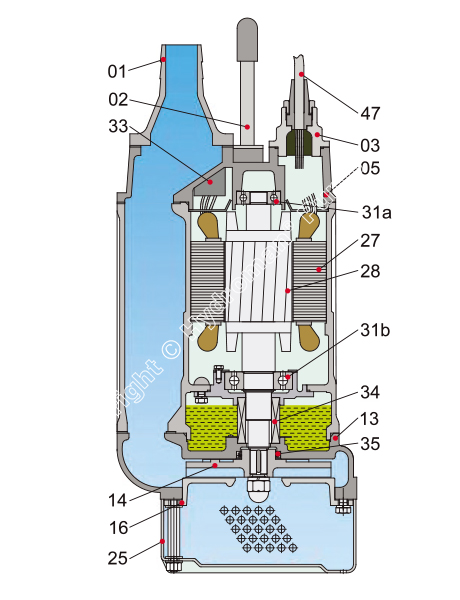 |
Item No. | Part name | Material | Item No. | Part name | Material | |
| 01 | Hose coupling | Cast iron | 28 | Rotor | Shaft: AISI420SS | ||
| 02 | Handle | Rubber & steel | 31a | Bearing | Ball bearing | ||
| 05 | Upper cover | Cast iron | 31b | Bearing | Ball bearing | ||
| 11 | Motor body | Cast iron | 33 | Motor protector | — | ||
| 13 | Pump body | Cast iron | 34 | Mechanical seal | Sic-Sic/Carbon-Sic (≤2.2kW) Sic-Sic/Sic-Sic (≥3.7kW) |
||
| 14 | Impeller | High chrome alloy | 35 | Oil seal | — | ||
| 16 | Inlet plate | Ductile iron | 47 | Cable | — | ||
| 25 | Strainer | Steel | |||||
| 27 | Stator | — |
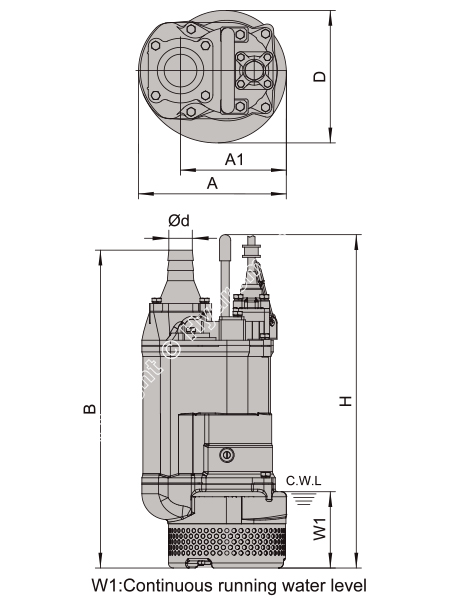 |
|
| Model (50/60Hz) | TBZ33.7 |
| d (mm) | 80 |
| A (mm) | 283 |
| A1 (mm) | 208 |
| B (mm) | 628 |
| D (mm) | 252 |
| H (mm) | 629 |
| W1 (mm) | 150 |
| N.W (Kg) | 63 |
| G.W (Kg) | 68 |
| Packing dimension(mm) | 710x320x295 |
What is the Hydroman TBZ33.7 submersible water pump? It's an electric-driven, single-stage centrifugal submersible pump with an 80 mm discharge and a 3.7 kW motor, built for drainage, dewatering, and general industrial water transfer.
Is the TBZ33.7 an electric submersible pump? Yes — the motor and pump are a single sealed unit that operates fully submerged in the liquid being pumped, with no separate drive shaft or above-ground motor.
Is the TBZ33.7 a centrifugal water pump? Yes, it uses a single-stage semi-open centrifugal impeller design.
Can the TBZ33.7 pump dirty water? Yes, within limits — the 8.5 mm impeller passage handles moderate suspended solids typical of drainage and sump water, but it isn't rated for slurry, sludge, or coarse aggregate.
Can the TBZ33.7 be used as a sump pump? Yes. Its head range (up to 29 m) and flow (up to 55 m³/h) make it suitable for sump and pit dewatering well beyond what a residential sump pump handles.
Can this pump be used for irrigation? In many cases, yes — check your required flow and head against the rated curve (30 m³/h at 20 m head) to confirm it matches your irrigation or drainage-transfer application.
How does a submersible water pump work? The motor drives an impeller submerged in the liquid; centrifugal force moves water from the inlet to the discharge outlet, without needing suction lift or priming.
How do I choose the right submersible water pump? Start with your required flow and head, then check discharge size, the liquid's solids content and temperature, motor power, and your installation depth against the pump's rated specifications — matching the duty point to the pump curve is what prevents underperformance or premature wear.
Get a Quote for the TBZ33.7
If you're weighing the TBZ33.7 against other submersible pumps for sale, the fastest way to know if it's the right fit is to send over your actual operating conditions — required flow, total head, liquid characteristics, discharge size, power supply, and how deep the pump needs to sit. Hydroman's team can confirm whether the TBZ33.7 covers your duty point or recommend another model in the TBZ, TBS, or TJQ range if your application calls for heavier solids handling or a different head range.
Contact Hydroman® to get a quote or technical recommendation for your application.
Related Pumps

Tobee is specialized in providing solutions for slurry pump, vertical sump pumps, gravel pump, dredging pumps, froth pump, seawater pumps, fire pumps, slurry pump parts and OEM pump parts for your harsh projects.
Top Navigation
Top Navigation
Contact Information
+86 180 3203 4573
+86 311 8722 1317
No. 266, Tianshan St, High-tech Zone, Shijiazhuang City 050000, China.