TBZ47.5 Submersible Pump for Septic Tank
If you've ever stood over a septic access hatch trying to figure out why a pump keeps tripping its overload, you already know the real question isn't "what's the best submersible septic pump on paper." It's "what will still be running in this tank three years from now, with this wastewater, at this depth." The Hydroman® TBZ47.5 was built around that question.
The TBZ47.5 is a 7.5 kW / 10 HP electric submersible septic pump designed to sit fully underwater inside a septic tank, wastewater pit, or sewage collection chamber and move liquid that isn't clean — organic solids, grease, grit, and general domestic or industrial effluent — out to a drain field, holding tank, treatment system, or municipal sewer connection. It's built on Hydroman®'s heavy-duty submersible platform, which means the same core design logic used in our dewatering and sewage pump lines has been carried over here: a rugged cast iron body, a motor sealed for continuous submerged duty, and a centrifugal wet end sized to keep moving even when the tank contents aren't.
This page walks through how the pump works, where it fits, how a facility team actually installs and runs one, and what tends to go wrong with submersible septic pumps in general — so you can judge, on your own terms, whether the TBZ47.5 is the right fit for your tank.
What Is a TBZ47.5 Submersible Septic Pump?
A submersible septic pump is different from the pump you'd use to move clean water around a house or irrigation system, and it's worth being precise about why. A standard submersible water pump for septic tank duty — or any general-purpose submersible — is built with tight clearances and a motor cooling strategy that assumes reasonably clean liquid. Put raw or partially settled sewage through one, and the fibrous material and grit will jam the impeller, wear the seals, and eventually take the motor with it.
The TBZ47.5 is built the other way around. It's an electric septic tank pump engineered from the start for liquid that contains suspended solids, fats, and organic matter. The pump sits directly inside the tank or collection pit — fully submerged, not mounted externally with a suction line running down to the liquid. The motor drives a centrifugal impeller that pulls wastewater in through the suction inlet and pushes it out through the discharge line under pressure. Because the whole unit is underwater, there's no priming step and no suction lift to manage on the intake side — the pump is already surrounded by the liquid it needs to move.
That's the core distinction people are usually looking for when they search for a submersible septic pump versus a generic sewage pump for septic tank use: it's not just about horsepower, it's about whether the pump was designed to tolerate the actual contents of a septic system.
It helps to walk through the cycle the way it actually happens in the tank, rather than as a spec sheet.
The TBZ47.5 is lowered into the septic tank or wastewater collection pit and rests either on guide rails or directly on the tank floor, depending on how your system is configured. Because the pump is designed for submerged septic pump operation, you're not building a separate dry-pit housing or managing a suction line — the unit lives where the wastewater is.
As liquid rises in the tank, it enters the pump through the suction inlet. This is the point where solids handling actually matters. A pump that isn't designed for septic duty will start struggling here, long before the motor itself is stressed.
Inside the housing, the impeller spins and creates centrifugal force that accelerates the wastewater outward and into the discharge passage. This is the same basic principle used across submersible centrifugal septic pump designs generally, but the impeller geometry and clearances on the TBZ47.5 are set up specifically to pass septic-tank-grade solids rather than clean water.
From there, the wastewater is pushed up through the discharge pipeline to wherever your system routes it next — a drainage field, a downstream treatment system, a holding tank, a municipal sewer tie-in, or an effluent discharge line. The pump's job effectively ends the moment liquid clears the discharge check valve; everything after that is your piping design.
Hydroman® TBZ47.5 Electric Septic Tank Pump

TBZ47.5 Submersible Septic Pump Specification
Before you read another paragraph, here's the shape of the pump in table form. Some of the figures below depend on your specific configuration (impeller trim, voltage, discharge size), so treat this as a starting reference and confirm exact numbers against the datasheet for your order — we'd rather give you an honest "check with us" than a number that doesn't hold up in the field.
| Model | Outlet | Motor power | Rated current (400V) | Rated capacity | Rated head | Max capacity | Max head | Impeller passage | |||
| 50Hz | mm | kW | HP | A | m³/h | m³/min | m | m³/h | m³/min | m | mm |
| TBZ47.5 | 100 | 7.5 | 10 | 15 | 48 | 0.80 | 30 | 84 | 1.40 | 40 | 11.5 |
We'd rather you walk away from this table with an accurate picture than a padded one. If you tell us your tank depth, discharge run, and expected flow, we can send back the exact curve for your configuration.
Rather than just telling you the TBZ47.5 is a good pump, it's more useful to walk through the kind of situation it was actually selected for.
The background. A commercial site — the kind of property with a below-grade septic collection tank feeding into a centralized treatment point some distance away — had been running an older submerged pump that needed servicing far more often than anyone wanted. The wastewater sat in an underground tank, the discharge run to the treatment system was long, and the pump was expected to run continuously or near-continuously depending on occupancy. Every time it needed maintenance, someone had to arrange tank access, which wasn't quick or cheap.
The challenge. The liquid level in the tank moved constantly depending on usage, so the pump had to tolerate variable submergence rather than a fixed, comfortable operating point. It had to run fully underwater indefinitely, not just for short bursts. The wastewater itself carried organic matter and suspended solids typical of a septic environment, which ruled out anything built for cleaner service. Installation space around the tank was tight, and — critically — maintenance access was limited, which meant the previous pump's frequent service intervals were a real operational cost, not just an inconvenience.
Why the TBZ47.5 fit. The 7.5 kW / 10 HP motor gave the site enough reserve capacity to handle peak flow without running the pump at its limit continuously, which matters for a 10 hp submersible septic pump expected to operate for long, unattended stretches. The submerged installation matched the existing tank layout without requiring a new dry-well structure. The centrifugal design and heavy-duty cast iron construction were suited to the solids content in the wastewater, and because the pump installs directly inside the tank, it didn't add to the site's already-tight footprint.
How it went in. The installation sequence followed a fairly standard sequence for this type of retrofit: position the pump inside the septic collection tank on its mounting or guide rail system, connect the discharge pipeline and secure all joints, install and wire the electrical control panel, verify motor rotation direction before running it under load, confirm the liquid level and float or sensor settings match the tank's actual operating range, then start the pump and observe discharge flow and pressure before leaving it in unattended service. This is the same general process anyone researching how to install a submersible septic pump should expect, though your electrical code and local permitting requirements will shape the details.
What changed. The site saw more stable wastewater transfer through normal level swings, less reliance on manual intervention to keep the tank from backing up, a simpler routine for draining the tank during service events, and easier day-to-day maintenance because the pump's construction was matched to what was actually flowing through it. We're intentionally not quoting a percentage improvement here — every site's baseline is different, and a real B2B buyer should ask for site-specific commissioning data, not a marketing number.

Where the TBZ47.5 Gets Used
Residential septic tanks. Larger residential systems, rural properties without municipal sewer access, and private sewage collection tanks that need reliable transfer to a drain field or holding tank all fall into this category. If you're comparing a submersible pump for septic tank use at a single-family or multi-unit rural property, motor sizing and duty cycle are what actually separate a good fit from an oversized one.
Commercial septic systems. Hotels, restaurants, office buildings, shopping centers, and other commercial properties that run their own septic system rather than connecting to municipal sewer typically need more consistent duty cycles than a residential setup, simply because occupancy and wastewater generation are higher and less predictable hour to hour.
Industrial wastewater collection. Factories, workshops, industrial wastewater pits, and temporary wastewater collection setups on job sites often need an electric pump for septic tank or pit duty that can handle a rougher solids profile than domestic wastewater, along with more frequent starts and stops as production schedules change.

TBZ47.5 vs. a Conventional External Septic Pump
| Feature | TBZ47.5 (submersible) | Conventional external pump |
| Installation | Submerged, inside the tank/pit | Mounted externally |
| Priming | Not required — pump is already in the liquid | Often required |
| Space requirement | Inside the tank footprint | Needs a separate external installation area |
| Drive | Electric | Varies by model |
| Septic tank suitability | Purpose-built for septic/wastewater duty | Depends on the specific unit and configuration |
| Maintenance access | Requires tank access | External access, no tank entry needed |
Neither approach is universally "better" — a submersible septic pump for sale into a site with easy external pump-house access might not be the obvious pick, and an external pump bolted onto a tight urban lot with no room for a pump house isn't either. The honest way to use this table is to match it against your own site constraints rather than defaulting to whichever pump type your last system happened to use.

How to Select a Submersible Septic Pump
Start with pumping flow rate. This comes from your tank volume, the rate wastewater flows into the tank, how often the system needs to pump, and how quickly you need each pumping cycle to finish. A tank that fills slowly and drains on a long cycle needs a very different flow rate than a high-occupancy commercial site with sharp usage peaks.
Work out the required head. Add up the vertical lift from the pump to the discharge point, the total pipeline length, friction losses through that pipe, and any valves or fittings in the run. Underestimating head is one of the most common reasons a pump that looked fine on paper underperforms once installed.
Size the motor to match. Motor power follows from flow rate, head, and overall system efficiency — not the other way around. The TBZ47.5's 7.5 kW / 10 HP rating puts it in a mid-to-upper range for septic and wastewater transfer duty, appropriate for tanks and discharge runs that exceed what a smaller residential unit can handle.
Know your wastewater's actual characteristics. Solid particle size, suspended solids load, fiber content, temperature, and any chemical characteristics of the wastewater all affect which pump construction and impeller type will hold up. This is where a lot of "best submersible pump for septic tank" searches go wrong — the right answer depends entirely on what's actually in your tank, not just how big it is.
Check your installation conditions. Tank depth, discharge pipe size, available power supply, whether you're running automatic level control, and how much maintenance access you'll realistically have all shape which pump — and which accessories — make sense.

TBZ47.5 Installation Considerations
A vertical septic pump installation goes more smoothly when you work through it in order rather than improvising on site.
Submersible Septic Pump Troubleshooting
Most submersible septic pump troubleshooting calls fall into a handful of recurring categories. Here's a quick reference for what to check before calling a service technician out.
| Problem | Likely cause | What to check |
| Pump won't start | Power or control issue | Power supply, breaker, control panel, float switch wiring |
| Low flow output | Blockage or system mismatch | Discharge pipe for obstructions, impeller for wear or clogging |
| Pump cycles too frequently | Level control problem | Float or sensor calibration, tank liquid level |
| Excessive vibration | Installation or mechanical issue | Pump mounting, impeller balance and condition |
| Motor overheating | Overload or duty cycle issue | Load current versus rated current, supply voltage, submergence depth |
| Unusual noise | Foreign material or wear | Impeller and volute for debris, bearing condition |
If you're seeing more than one of these at once, it's usually worth pulling the pump for a full inspection rather than chasing symptoms one at a time — a worn impeller, for instance, can cause low flow, vibration, and eventually overheating together.
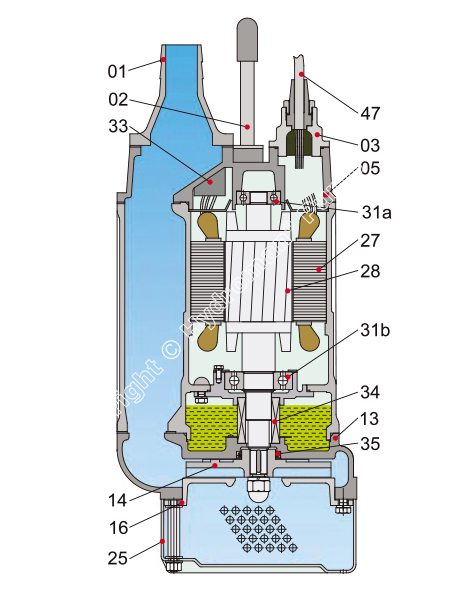 |
Item No. | Part name | Material | Item No. | Part name | Material | |
| 01 | Hose coupling | Cast iron | 28 | Rotor | Shaft: AISI420SS | ||
| 02 | Handle | Rubber & steel | 31a | Bearing | Ball bearing | ||
| 05 | Upper cover | Cast iron | 31b | Bearing | Ball bearing | ||
| 11 | Motor body | Cast iron | 33 | Motor protector | — | ||
| 13 | Pump body | Cast iron | 34 | Mechanical seal | Sic-Sic/Carbon-Sic (≤2.2kW) Sic-Sic/Sic-Sic (≥3.7kW) |
||
| 14 | Impeller | High chrome alloy | 35 | Oil seal | — | ||
| 16 | Inlet plate | Ductile iron | 47 | Cable | — | ||
| 25 | Strainer | Steel | |||||
| 27 | Stator | — |
 |
|
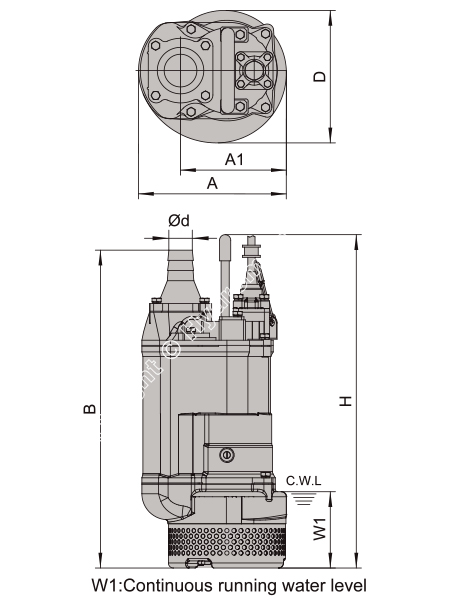
| Model (50/60Hz) | TBZ47.5 |
| d (mm) | 100 |
| A (mm) | 330 |
| A1 (mm) | 240 |
| B (mm) | 764 |
| D (mm) | 314 |
| H (mm) | 676 |
| W1 (mm) | 190 |
| N.W (Kg) | 106 |
| G.W (Kg) | 116 |
| Packing dimension(mm) | 835x365x385 |
Septic pump maintenance at this scale is closer to industrial pump maintenance than to a household appliance routine, and it's worth treating it that way.
Heavy-duty construction built for continuous submergence. Wastewater environments are harder on equipment than clean-water service — corrosion, abrasive solids, and constant submersion all take a toll over time. The TBZ47.5's cast iron construction is chosen for that environment specifically, not adapted from a clean-water product line.
A 10 HP electric drive sized for real septic loads. The 7.5 kW motor configuration gives you the power headroom to handle demanding wastewater transfer applications — longer discharge runs, higher static lift, or larger tank volumes than a smaller pump can serve — without running the motor at its ceiling during normal operation.
Submerged installation that doesn't compete for space. Because the pump installs directly in the tank or pit, you're not carving out room for an external pump house or dry-pit enclosure, which matters on sites where space was tight before the pump was ever part of the conversation.
Built for commercial, municipal, and industrial duty, not just residential. The TBZ47.5 sits in a capacity range suited to sites with more demanding flow and duty-cycle requirements than a typical household system.
Engineering support that goes beyond the sale. Pump selection, performance matching against your actual flow and head, installation guidance, spare parts, and after-sales technical support are all part of working with Hydroman® — because getting the right pump on paper is only half the job; getting it running reliably in your specific tank is the other half.
What is a submersible septic pump? It's a pump designed to operate fully underwater inside a septic tank, wastewater pit, or sewage collection system, moving wastewater — including organic solids and suspended matter — out to a drain field, treatment system, or sewer connection.
Can the TBZ47.5 be used in a septic tank? Yes. It's designed specifically for septic tank, wastewater pit, and sewage collection applications where the pump needs to sit submerged and handle wastewater rather than clean water.
Is the TBZ47.5 a 10 HP submersible septic pump? Yes, it's built around a 7.5 kW / 10 HP electric motor, positioning it for mid-to-large septic and wastewater transfer applications rather than small residential duty alone.
What's the difference between a septic pump and a sewage pump? In practice, the terms overlap heavily. "Septic pump" usually refers to the specific application — moving wastewater out of a septic tank — while "sewage pump" is a broader category that includes septic tank duty along with other wastewater collection and transfer applications. A pump designed as a sewage pump for septic tank use, like the TBZ47.5, is built to handle both.
How do you install a submersible septic pump? In general terms: confirm the tank and discharge pipe are ready, position the pump inside the tank on its mounting system, connect and secure the discharge line, wire and test the electrical control system, verify rotation and liquid-level settings, and run a supervised test before leaving the pump in continuous service. Always follow your local electrical code and any site-specific engineering requirements.
How often should a septic pump be serviced? This depends heavily on wastewater characteristics, duty cycle, and tank conditions, so there's no single universal interval. A reasonable approach is a scheduled visual and electrical inspection on a regular cycle, with impeller and cable checks tied to how much solids and abrasive material the pump actually sees.
What causes a submersible septic pump to stop working? Common causes include power or control failures, blockages from solids or debris, worn or damaged impellers, cable damage at the entry point, and level-control issues that leave the pump running dry or constantly cycling. Most failures trace back to one of these rather than a sudden, unexplained motor fault.
How do I choose the right septic tank pump? Work through flow rate, required head, motor power, wastewater solids characteristics, and your actual installation conditions in that order. A pump that's correctly sized for your flow and head but mismatched to your wastewater's solids content will still fail early — sizing and suitability both matter.
Get a Quote for the Hydroman® TBZ47.5 Submersible Septic Pump
If you're evaluating a submersible pump for septic tank or wastewater pit duty, the fastest way to get an accurate recommendation is to send us the details that actually drive pump selection: your required flow rate, total head, septic tank depth, discharge pipe size, and available power supply. Our engineers can match those numbers against the TBZ47.5 — or another configuration in the Hydroman® line — rather than leaving you to guess from a generic spec sheet.
Related Pumps

Tobee is specialized in providing solutions for slurry pump, vertical sump pumps, gravel pump, dredging pumps, froth pump, seawater pumps, fire pumps, slurry pump parts and OEM pump parts for your harsh projects.
Top Navigation
Top Navigation
Contact Information
+86 180 3203 4573
+86 311 8722 1317
No. 266, Tianshan St, High-tech Zone, Shijiazhuang City 050000, China.