Hydroman® TBZ611 Mud Pump Description
If you've ever tried to empty a foundation pit full of clay-heavy water, or clear a settling pond that hasn't been touched in two years, you already know the problem: ordinary water pumps clog, wear out in weeks and leave you standing in the mud wondering why the job isn't done.
The Hydroman® TBZ611 is a 6-inch, electric, fully submersible mud pump built for exactly that kind of work. You lower it into the mud, connect the discharge hose and start it. There's no priming and no long suction line to leak air. It's a heavy duty mud pump made for thick, gritty, abrasive liquids, the kind that destroy standard dewatering equipment.
And if you're currently running a KBZ611, the TBZ611 is a 100% replacement. You can swap it in without redesigning your discharge piping or your site layout.
Why People Choose the TBZ611 for Mud Pumping
It's built for the abuse. Mud isn't just water with dirt in it. Sand and silt grind away at the impeller and casing with every rotation. The TBZ611's wet-end parts are designed for abrasive duty, and that's the difference between a mud pump that lasts seasons and one that lasts weeks. For reference, serious slurry pump wet ends are typically made from high-chrome white iron (around 26–28% Cr) with a hardness in the range of 550–650 HB, far harder than the grey cast iron used in general-purpose drainage pumps.
It works where the mud is. Because the pump sits directly in the pit, pond or tank, it doesn't fight its own suction line. A surface pump has to lift mud up a hose by suction, and in practice that limits it to a few meters of lift at sea level, while any air leak stops the flow entirely. A submersible mud suction pump pushes from below instead of pulling from above, so it keeps moving material even when the liquid level drops.
It moves real volume. The 6-inch discharge is the size many contractors reach for when 3- or 4-inch pumps simply can't keep up. A 6-inch line can carry on the order of 100–150 m³/h at sensible velocities, enough to drain a large excavation in hours rather than days.
It's simple to live with. Electric drive means no fuel runs, no exhaust in enclosed spaces and far less noise on site. You need a power supply, a hose and a safe place to set the pump.
Hydroman® TBZ611 Submersible Mud Pump Curve

TBZ611 Specification
| Parameter | TBZ611 |
| Pump type | Submersible mud pump |
| Discharge size | 6 inch (DN150) |
| Drive | Electric |
| Structure | Vertical submersible, centrifugal |
| Pumping medium | Mud, slurry, muddy water, bentonite, fine sand |
| Impeller type | Semi-open impeller |
| Motor power | 11 kW |
| Flow rate | 147 m³/h |
| Head | 22-32 m |
| Speed | 2950 rpm |
| Max. solids passage | 19.5 mm |
| Cable length | 8 m |
| Weight | 133 kg |
We publish the real numbers and nothing more. If your project needs a specific head or flow, tell us and we'll confirm whether the TBZ611 fits before you spend a cent.

How the TBZ611 Works
It's a centrifugal mud pump, and the principle is straightforward. The sealed electric motor sits directly above the pump end, both fully underwater. When you start it, the motor spins the impeller, mud is drawn in through the suction area at the bottom, and the rotating impeller throws it outward by centrifugal force. From there it leaves through the volute and into your discharge pipeline.
Submersible motors are cooled by the liquid around them, which is why they're usually rated IP68 with Class F insulation and double mechanical seals on the shaft. That's the reason this type of vertical mud pump can run continuously in demanding dewatering applications, provided the motor stays adequately submerged.

Where the TBZ611 Gets Used
Construction sites. This is the classic job: foundation pits, excavations, trenches and temporary ponds that fill with muddy water after rain. A mud removal pump has to handle silty, sandy water without stopping, and this is where a submersible design saves the most time.
Ponds, lagoons and settling basins. Sediment builds up slowly and then all at once. As a pond mud pump, the TBZ611 transfers accumulated silt and sludge from the bottom so you can restore capacity without draining the whole pond first.
Industrial mud transfer. Wash plants, aggregate processing, ceramic and brick production and similar operations generate slurry constantly. As an industrial mud pump, it moves that material between tanks, pits and treatment areas.
Mines and quarries. Sumps in pit floors collect water loaded with fine rock and sand. A mud dewatering pump keeps them clear so equipment can keep working.
Dredging and sediment removal. For shallow sediment, canals and small reservoirs, the TBZ611 works as a mud dredge pump. It suits cleanup jobs and short-range removal, but not deep-water, large-scale dredging, which calls for dedicated dredging equipment.
Wastewater and sludge handling. Where the pump's materials and solids passage match the medium, it can handle sludge and sediment at treatment sites.

TBZ611 vs. a Conventional Surface Mud Pump
Neither type is better everywhere. The right one depends on the job.
| TBZ611 submersible | Surface-mounted pump | |
| Installation | Placed directly in the mud | Sits above the liquid |
| Suction | Short, direct path | Needs suction hose, priming |
| Air leaks | Not an issue | A common cause of lost flow |
| Moving between sites | Lift, relocate, restart | More equipment to move |
| Footprint | Small | Larger |
| Best for | Pits, ponds, tanks, temporary jobs | Permanent pumping stations |
If you need a permanent installation with a long horizontal run and easy access for maintenance, a surface pump may be the right answer. If the mud is in a hole and you need it out, the submersible wins.

Installing and Running the TBZ611
Position. Stand the pump on a firm base or suspend it slightly off the bottom so the suction inlet isn't buried in settled sludge. In deep silt, a platform or lifting chain prevents the pump from sinking and choking itself.
Discharge line. Use a hose or pipe matched to your calculated flow, keep bends to a minimum and avoid kinks. Secure the line so it can't whip when the pump starts.
Electrical. Connection must be done by a qualified electrician following local safety rules, with proper overload, phase-failure and earth-leakage protection. Never lift or carry the pump by its power cable.
First start. Before you switch on, check the pump's position, cable condition, discharge connection and valve settings. Briefly start it to confirm the rotation direction is correct, since three-phase motors can run backward if two phases are swapped, and a reversed impeller will move little or no liquid.
Choosing a 6-Inch Mud Pump: A Practical Guide
Most buying mistakes happen because nobody sized the job properly. Here's how to do it in five steps.
1. Start with the flow you need. Take the volume of the pit or tank and divide by the time you have to empty it. A 600 m³ pit that must be cleared in 4 hours needs roughly 150 m³/h.
2. Work out your total head. This is the vertical lift plus friction losses from pipe length, bends and valves. A rough rule is to add 1–3 m of head for every 100 m of straight 6-inch pipe, depending on flow and slurry density. Mud adds more friction than clean water.
3. Understand the mud. Solids content, particle size, abrasiveness and temperature all change what pump you need. As a general guide, centrifugal submersible slurry pumps handle solids up to around 30% by weight comfortably. Above that, you'll want an agitator or a different pump type altogether.
4. Check your electrical supply. Motor power, voltage, frequency and phase must match your site. Six-inch submersible mud pumps typically run on three-phase power (380–460 V, 50 or 60 Hz). If you're searching for a single phase mud pump, that's normally found in smaller machines, so if you only have single-phase power, tell us what you need and we'll advise honestly.
5. Match the pipe. The 6-inch discharge should fit your actual flow. For slurries, a line velocity of roughly 2.5–4 m/s is the target. Go too slow and solids settle and block the pipe; go too fast and you wear out fittings. As an example, 150 m³/h through a 150 mm pipe runs at about 2.3 m/s, which is the lower end of a safe range for sandy mud.
The shaft power a pump needs is roughly: flow × head × slurry density × 9.81 ÷ pump efficiency. For 150 m³/h at 20 m head, with mud at a specific gravity of 1.3 and 55% overall efficiency, you need about 19 kW at the shaft. Heavier mud means a bigger motor, so don't size for clean water.
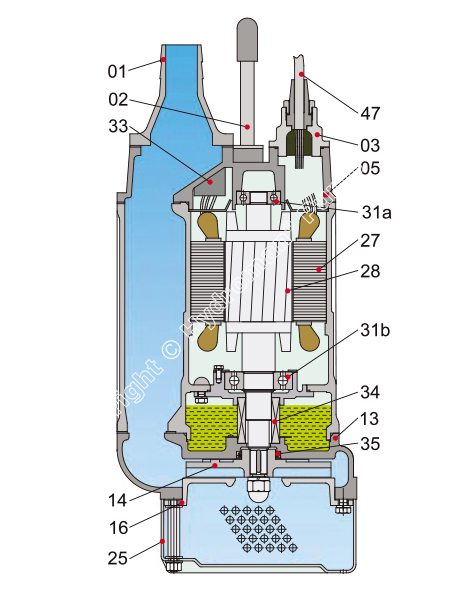 |
Item No. | Part name | Material | Item No. | Part name | Material | |
| 01 | Hose coupling | Cast iron | 28 | Rotor | Shaft: AISI420SS | ||
| 02 | Handle | Rubber & steel | 31a | Bearing | Ball bearing | ||
| 05 | Upper cover | Cast iron | 31b | Bearing | Ball bearing | ||
| 11 | Motor body | Cast iron | 33 | Motor protector | — | ||
| 13 | Pump body | Cast iron | 34 | Mechanical seal | Sic-Sic/Carbon-Sic (≤2.2kW) Sic-Sic/Sic-Sic (≥3.7kW) |
||
| 14 | Impeller | High chrome alloy | 35 | Oil seal | — | ||
| 16 | Inlet plate | Ductile iron | 47 | Cable | — | ||
| 25 | Strainer | Steel | |||||
| 27 | Stator | — |
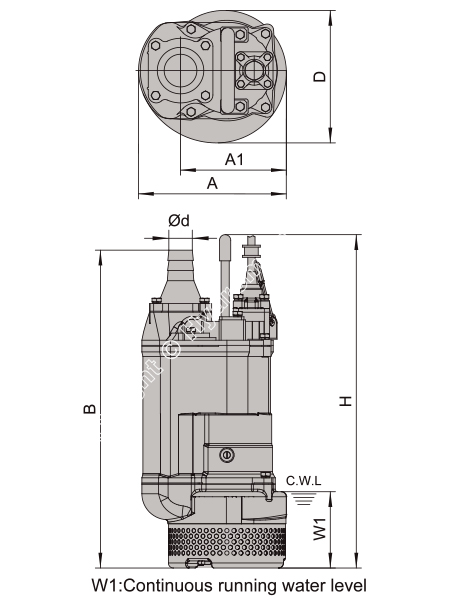 |
|
| Model (50/60Hz) | TBZ611 |
| d (mm) | 150 |
| A (mm) | 373 |
| A1 (mm) | 255 |
| B (mm) | 807 |
| D (mm) | 350 |
| H (mm) | 695 |
| W1 (mm) | 190 |
| N.W (Kg) | 139 |
| G.W (Kg) | 120 |
| Packing dimension(mm) | 885x415x435 |
Mud pumps don't fail suddenly. They tell you first. Watch for:
Any of these usually points to a worn impeller, a clogged inlet or a failing seal. Check the wet-end parts regularly, since impeller and casing wear is the main maintenance cost in abrasive duty. Inspect the cable and motor protection every service interval, and when the job allows, flush the pump and line with clean water before shutdown. Mud that dries inside a pump can lock the impeller at the next start.
Construction: excavation dewatering, foundation pit drainage, mud removal.
Mining: sump clearing, process area sediment transfer.
Dredging: shallow sediment and muddy water pumping.
Industrial processing: slurry, mud and contaminated water transfer.
Wastewater: sludge and sediment handling, where pump materials and solids passage suit the medium.
What is a submersible mud pump, and how is it different from a normal water pump?
A submersible mud pump is a sealed pump-and-motor unit that works underwater, designed to pass solids and resist abrasion. A normal water pump expects clean or lightly dirty water, and in mud it clogs or wears out quickly.
What can the Hydroman® TBZ611 pump?
Mud, muddy water, sediment, sandy slurry and other liquids containing solids within its rated passage size and concentration. Fibrous materials such as rags, plastic or long vegetation are best screened out first.
Is the TBZ611 suitable for pond mud pumping?
Yes, as long as the sludge concentration, particle size and required head are within its specification. Send us your pond details and we'll confirm the configuration.
Can I use it for mud dewatering?
Yes. It suits mud dewatering where flow, head and solids content fit the pump's rating.
Is this a high pressure mud pump?
It's a centrifugal pump, so what matters is total head, not pressure in the drilling-rig sense. If you need very high head, tell us the number and we'll tell you whether the TBZ611 reaches it or whether a different model is better.
Can the TBZ611 replace a KBZ611?
Yes, it's a 100% replacement, so you can swap it in without changing your piping plan or site layout.
What affects submersible mud pump price?
Motor power, flow and head, wet-end materials, solids handling capability, accessories such as an agitator, and the control system. The more abrasive the duty, the more the material choice matters, so the cheapest pump on paper is rarely the cheapest over a season.
How do I choose a mud transfer pump?
Start with flow, then total head, then the pipeline, the solids, the motor and the application. The sizing steps above cover each one. Or send us the details and we'll do the sizing with you.
Is this a mud hog pump or a mud sucker pump?
Those are common trade names for the same idea: a rugged pump that lifts mud out of a pit. If that's what you're searching for, the TBZ611 belongs in your shortlist.
Choosing a mud pump supplier comes down to whether they'll still be helpful after the pump ships. With Hydroman® you get:
Request a TBZ611 Mud Pump Quote
Looking for a 6-inch submersible mud pump for your project? Tell us about the job and we'll come back with a configuration and a quote, not a generic catalog price.
It helps to have these ready:
Contact Hydroman® today for TBZ611 specifications, configuration advice and pricing.
 Sara Liang
 +86 189 3110 6396 (Whatsapp/Wechat)
 Inquiry@tobeepump.com
Related Pumps

Tobee is specialized in providing solutions for slurry pump, vertical sump pumps, gravel pump, dredging pumps, froth pump, seawater pumps, fire pumps, slurry pump parts and OEM pump parts for your harsh projects.
Top Navigation
Top Navigation
Contact Information
+86 180 3203 4573
+86 311 8722 1317
No. 266, Tianshan St, High-tech Zone, Shijiazhuang City 050000, China.