SPECIFICATIONS
TBZ67.5 Electric Fine Sand Pump Description
If you've ever stood at the edge of a foundation pit watching groundwater rise faster than your crew can dig, you already know why a standard dewatering pump isn't enough. Clean-water pumps clog, wear out, or simply can't keep up once fine sand starts moving through the water column. That's the exact problem the Hydroman® TBZ67.5 submersible fine sand pump was built to solve.
The TBZ67.5 is an electric submersible fine sand pump designed specifically for construction environments where sand, silt, and sediment are mixed into the water you need to remove. You lower it straight into the pit, sump, or excavation, and it goes to work — no long suction lines, no separate priming pump, no surface pump station taking up space on an already crowded job site.
If you've been running a KBZ67.5 and looking for a direct swap, this is where you'll want to pay attention: the TBZ67.5 is built as a drop-in replacement for the KBZ67.5, with the same mounting footprint and connection sizing, but with the sand-handling improvements that come from a strainer-protected intake and a wider impeller passage.
Most "submersible water pumps" on the market are built around clean or lightly contaminated water. The moment you introduce fine sand — the kind you get in riverbank excavation, foundation pits near the water table, or sediment-heavy trenches — those pumps start to lose efficiency, then start to fail. Impellers erode, seals wear early, and volutes get scored by abrasive particles moving at velocity.
The TBZ67.5 sits in a different category. It's classified as a light-duty submersible slurry pump, which means the wetted parts and impeller geometry are built with abrasive media in mind, without the added weight, footprint, and cost of a heavy-duty slurry pump meant for dredging or mining tailings. That makes it the right fit for construction dewatering and sand-water transfer — jobs that involve real sand content, but not the continuous heavy solids loading you'd see in a mining slurry circuit.
Where the TBZ67.5 Gets Used
Construction site dewatering. Foundation pits, trenches, and basement excavations all collect groundwater, and in most soil profiles that groundwater carries fine sand with it. Left unmanaged, that sand settles, compacts, and slows your schedule. The TBZ67.5 is sized to keep pace with typical pit inflow while handling the sand load without binding.
Foundation and pile excavation. Pile-driving and foundation work near the water table routinely produces sand-laden water at the base of the excavation. Because the pump is fully submersible, you place it at the lowest point of the excavation — where the water and sand actually collect — rather than trying to pull it up and over with a surface unit.
River, shoreline, and bridge construction. Riverbank work and near-water construction projects deal with sand deposition constantly. A submersible sand pump lets you position the unit directly in the wet area and transfer the sand-water mixture to a sedimentation tank or discharge point without repositioning a surface pump every time water levels shift.
Sand-water transfer to sedimentation systems. On sites where sediment needs to be captured before discharge, the TBZ67.5 moves the sand-water mixture to settling ponds or treatment systems as part of a continuous dewatering cycle.
The working principle is straightforward, and understanding it helps explain why submersible sand pumps outperform surface units in sand-heavy conditions.
The pump is lowered directly into the pit, sump, or excavation so the intake sits below the water surface. The impeller — a centrifugal design — spins and creates the pressure differential that draws the sand-laden water in through the intake. On the TBZ67.5, that intake sits behind a strainer/screen at the base of the pump, which is a detail worth pausing on: the screen physically blocks oversized particles, debris, and larger stones from entering the impeller passage, which is what allows a comparatively compact pump to handle continuous fine sand content without premature wear or jamming. Once inside, the rotating impeller accelerates the mixture outward and forces it toward the discharge port, where it exits through the connected discharge pipeline to wherever you're routing it — a settling tank, a drainage ditch, or a treatment point.
Because there's no suction lift involved (the pump is already submerged at the point of extraction), you avoid the priming issues and suction-line limitations that come with surface-mounted centrifugal sand pumps. This is also the core reason submersible units have become the standard choice over surface pumps for sand extraction on active construction sites: you eliminate a long suction pipe, reduce the equipment footprint at grade, and can reposition the pump easily as the excavation progresses.
Sizing a sand pump correctly is less about the biggest number on the spec sheet and more about matching flow, head, and particle handling to your actual site conditions. Here's the sequence experienced site engineers typically work through:
Start with required flow rate. Estimate your pit or sump volume, your expected groundwater inflow rate, and how quickly you need the water level brought down. A pit with steady moderate inflow needs a very different flow rate than one with a sudden surge after rainfall. The TBZ67.5's 124.8 m³/h maximum capacity gives you headroom for most mid-sized foundation and trench dewatering jobs, but always size against your actual inflow curve, not just peak flow.
Calculate total dynamic head. This is where a lot of pump selections go wrong. Add up your vertical lift (from the pit bottom to the discharge point), the length of horizontal pipe run, and friction losses from pipe diameter, elbows, valves, and fittings. A pump rated for 31 m of head at zero flow will deliver noticeably less flow as you approach that head limit — plot your system curve against the pump curve rather than just checking the maximum head number.
Account for sand concentration and particle size. Sand concentration changes how a pump performs in the field versus its clean-water rating. Higher solids content increases the effective viscosity and density of the fluid, which reduces achievable flow and increases wear rate on the impeller and volute. The TBZ67.5's 19.5 mm impeller passage and bottom strainer are what allow it to hold up under fine sand loading that would erode a standard water pump within weeks.
Match the discharge pipeline to the outlet size. The TBZ67.5's 150 mm discharge outlet is designed to move sand-water mixtures at a velocity high enough to keep solids in suspension. Undersizing your discharge hose or pipe increases friction loss and cuts your effective flow; oversizing it can drop velocity below the point needed to keep sand suspended, which leads to settling and blockage inside the line itself.
Confirm your power supply. Voltage, frequency, phase, and available site power all need to be confirmed against the 7.5 kW motor rating before the pump ships. This is a five-minute check that avoids a wasted trip when the pump arrives and the site generator can't support it.
Hydroman® TBZ67.5 Submersible Fine Sand Pump Curve

TBZ67.5 Electric Fine Sand Pump Specifications
| Parameter | TBZ67.5 |
| Pump Type | Submersible Fine Sand Pump / Light-Duty Submersible Slurry Pump |
| Drive Type | Electric, direct-coupled submersible motor |
| Pumping Principle | Centrifugal |
| Application | Construction dewatering, fine sand & sand-water transfer |
| Discharge Outlet Size | 150 mm (DN150) |
| Maximum Flow Rate | 124.8 m³/h |
| Maximum Head | 31 m |
| Motor Power | 7.5 kW / 10 HP |
| Impeller Passage | 19.5 mm |
| Intake Protection | Bottom strainer / screen to exclude oversized solids |
| Direct Replacement For | Hydroman® KBZ67.5 |
A note on the model number, since it trips people up: the "67.5" in TBZ67.5 does not mean 67.5 kW. The motor is rated at 7.5 kW (10 HP) — worth confirming before you spec power supply or generator capacity for the site.
The 19.5 mm impeller passage is the number to focus on if you're evaluating whether this pump fits your sand profile. It tells you the maximum solid size the impeller can pass without clogging, which is a standard way sand and slurry pumps are rated across the industry — passage size, not just flow and head, is usually the deciding factor for whether a pump survives in sand service or wears out in a season.
| Feature | TBZ67.5 Fine Sand Pump | Standard Submersible Water Pump |
| Clean water | Yes | Yes |
| Sand-laden water | Yes | Limited |
| Fine sand handling | Yes, via strainer-protected intake and 19.5mm impeller passage | Limited — typically not rated for continuous sand content |
| Construction dewatering | Yes | Yes, in clean or lightly turbid conditions |
| Sediment/sand removal from pit bottom | Suitable | Usually not recommended |
| Abrasive media resistance | Designed for light-duty slurry conditions | Not designed for abrasive wear |
This isn't a case of one pump being universally "better" — it comes down to matching the pump to what's actually in the water. If your dewatering job is genuinely clean water, a standard submersible pump is the more economical choice. Once fine sand becomes a regular part of the mixture, that's when a fine sand centrifugal pump like the TBZ67.5 earns its keep, both in uptime and in avoided impeller replacement costs.

Why Submersible Beats Surface for Sand Pumping on Active Sites
Surface-mounted sand suction pumps have their place, particularly for very high-volume dredging work, but for day-to-day construction dewatering, submersible units solve problems surface pumps can't:
The pump sits at the actual low point of the excavation, which is where the water and sand collect — no suction lift to fight, no priming required. There's no long suction hose to manage, kink, or drag across a moving job site, which matters more than it sounds like it should once you're relocating the pump for the third time in a week as the excavation shape changes. The compact footprint means it fits in confined pits and trenches where a surface pump station simply doesn't have room to sit. And because deployment is just "lower it in and connect the discharge line," crews spend less time on setup and more time on the actual work.

What Drives Sand Pumping Cost
If you're comparing sand pump for sale listings and the price range looks wide, that's normal — sand pump pricing isn't a single number, it's a function of several variables:
Motor power is the biggest line item, since higher kW ratings mean larger motors and more copper and steel in the build. Flow and head requirements drive impeller and volute sizing. Wetted-part material selection matters a lot in abrasive service — wear-resistant alloys or coatings cost more upfront but extend service life significantly in fine sand conditions, often making them the lower total-cost option over a project's duration. Discharge size and cable length add incremental cost, and any optional configuration (extended cable runs, specific voltage builds, custom strainer mesh sizing) will move the number as well.
Rather than quote a flat price here, the honest answer is that sand pumping cost should be evaluated against total cost of ownership — purchase price plus expected wear-part replacement frequency plus downtime cost — not just the sticker price of the unit.

Maintaining the TBZ67.5 in Fine Sand Service
Abrasive media shortens maintenance intervals compared to clean-water pumping, so a consistent maintenance routine matters more here than it would for a standard drainage pump.
After operation, inspect the pump body, impeller, and other wetted components for wear, particularly around the impeller passage and strainer. Flush sand and sediment out of the pump after shutdown, especially if it's going to sit idle for more than a day or two — settled sand left inside the volute is one of the most common causes of a hard restart. Check cable and electrical connections for insulation integrity, since submersible motors depend on that seal staying intact. Inspect wear parts on a regular schedule when running continuous fine sand service; in abrasive slurry applications, wear parts are consumable by design, and catching erosion early is far cheaper than a full impeller replacement. Finally, check the discharge pipeline periodically for blockage, leaks, or unusual pressure loss, which often signal a partial clog building inside the line before it becomes a full stoppage.
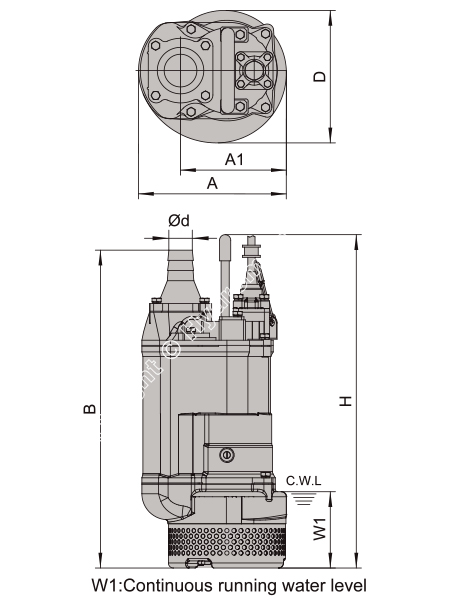
Hydroman<® TBZ67.5 Submersible Fine Sand Pump Dimensions & Weights
 |
|
| Model (50/60Hz) | TBZ67.5 |
| d (mm) | 150 |
| A (mm) | 330 |
| A1 (mm) | 240 |
| B (mm) | 790 |
| D (mm) | 314 |
| H (mm) | 676 |
| W1 (mm) | 190 |
| N.W (Kg) | 108 |
| G.W (Kg) | 119 |
| Packing dimension(mm) | 865x365x385 |
What is a submersible fine sand pump?
It's an electric pump designed to be fully submerged in a pit or sump and pump water that contains fine sand and sediment, rather than clean water alone. The key differences from a standard submersible pump are the impeller design, passage size, and wetted-part material selection, all built to tolerate abrasive particles without rapid wear.
Can the TBZ67.5 pump sand and water together?
Yes — that's its core application. The 19.5 mm impeller passage and bottom strainer are specifically there to manage sand-laden water, though the exact particle size and concentration your site produces should be checked against the pump's rated capability before continuous operation.
Is the TBZ67.5 suitable for construction dewatering?
Yes. It's built for exactly this: foundation pits, trenches, and excavations where groundwater carries fine sand, which is a very common condition on construction sites near the water table.
Can a submersible sand pump remove sediment from the bottom of a pit?
Yes, when sized correctly. Submersible placement at the pit's low point is precisely what allows the pump to draw in settled sediment along with the water above it, rather than leaving sediment behind the way a raised surface pump often does.
What's the difference between a sand suction pump and a submersible sand pump?
"Sand suction pump" is often used loosely to describe both surface and submersible units, but a true submersible sand pump is fully submerged during operation, eliminating suction lift and the need for a separate priming system — an important distinction if you're comparing sand pump for sale listings.
How much does a submersible sand pump cost?
It depends on motor power, flow and head rating, wetted-part materials, discharge size, cable length, and any custom configuration. Rather than working from a flat number, it's worth sending your flow, head, and sand concentration requirements to get an accurate project-based quote.
How do I choose the right sand pump for construction?
Provide your required flow rate, total dynamic head, sand concentration and maximum particle size, discharge pipe size, and available power supply. Those five inputs are what determine whether a pump like the TBZ67.5 is the right match, or whether a different configuration is needed.
Get a TBZ67.5 Recommendation for Your Project
Every job site's sand content, pit geometry, and discharge distance are different, so the best next step is a quick conversation rather than guessing off a spec sheet. To get an accurate recommendation, have the following ready:
Contact Hydroman® for a pump recommendation and a project-based quote. If you're currently running a KBZ67.5 and considering the switch, mention that directly — the TBZ67.5 is built to drop into that same role with improved sand-handling performance.
Related Pumps

Tobee is specialized in providing solutions for slurry pump, vertical sump pumps, gravel pump, dredging pumps, froth pump, seawater pumps, fire pumps, slurry pump parts and OEM pump parts for your harsh projects.
Top Navigation
Top Navigation
Contact Information
+86 180 3203 4573
+86 311 8722 1317
No. 266, Tianshan St, High-tech Zone, Shijiazhuang City 050000, China.