3 HP Submersible Sewage Pump Description
When wastewater needs to move — out of a pit, away from a septic tank, up from a basement, or across a treatment plant — you need a pump that starts every time and keeps running when solids show up in the flow. The Hydroman® TBZ22.2 is a 2.2 kW (3 HP) electric submersible sewage pump built for exactly that job. It sits directly in the liquid, drives wastewater through its volute without you having to prime anything, and is sized to handle the suspended solids that are normal in raw sewage, effluent, and general drainage.
If you've been comparing submersible sewage pumps for a septic tank, a lift station, or a commercial basement, the TBZ22.2 is worth putting on your shortlist — it shares the same field-proven platform as Hydroman's KBZ22.2, so you're getting a design that's already been tested in real wastewater applications, not a first-generation product.
Request a Quote | Send Your Requirements
The TBZ22.2 is a fully submersible, 2.2 kW / 3 HP electric sewage pump designed to transfer sewage, effluent, and wastewater containing suspended solids. It's a self-contained unit — motor, seal, and hydraulic end are sealed inside one submersible housing, so there's no dry-pit motor room to build, no priming line to maintain, and no separate suction piping to size.
That single fact is why submersible sewage pumps have largely replaced dry-pit and self-priming setups in new installations: you drop the pump into the pit, tank, or chamber, connect the discharge line, and it goes to work. For a 3 HP submersible sewage pump like the TBZ22.2, that usually means:
This is the same core engineering used across Hydroman's KBZ line — the TBZ22.2 carries that platform's construction and reliability forward at the 2.2 kW / 3 HP power point.
Key Features of the 2.2 kW / 3 HP Submersible Sewage Pump
2.2 kW / 3 HP electric motor. The motor is sized to give you real working head and flow at this power class, not just a rating on paper — enough to handle typical lift-station and septic dosing duty without running the motor near its service factor limit.
Fully submersible design. The pump operates directly in the sewage — in a wet well, a sump, a septic pump chamber, or a collection tank — with no separate dry pump room required. That cuts both civil works and installation time compared with a dry-pit sewage pump of equivalent duty.
Reliable solids handling. The hydraulic passage and impeller geometry are designed to let soft solids and fibrous material move through the pump rather than build up against the volute or impeller vanes — the difference between a pump that clogs every few weeks and one you can largely forget about.
Durable, wastewater-grade construction. Cast iron casing, wear-resistant impeller, corrosion-resistant fasteners, and a mechanical seal specified for abrasive, solids-laden liquid rather than clean water duty.
Compact footprint. Because there's no separate dry chamber, the TBZ22.2 fits into standard precast wet wells and septic pump chambers without custom civil work.
Low-maintenance operation. A simple, single-stage hydraulic design means fewer wear parts, straightforward seal and impeller inspection, and shorter downtime when service is needed.
Electric Submersible Sewage Pump Specifications
| Model | Outlet | Motor power | Rated current (400V) | Rated capacity | Rated head | Max capacity | Max head | Impeller Passage | |||
| (50Hz) | mm | kW | HP | A | m³/h | m³/min | m | m³/h | m³/min | m | mm |
| TBZ22.2 | 50 | 2.2 | 3 | 5.0 | 18 | 0.30 | 20 | 33 | 0.55 | 26 | 8.5 |
Actual performance curve, voltage, and dimensional data are confirmed against your duty point and market destination at time of quotation — send us your flow and head requirement and we'll match a configuration to it.
This specification set is what most buyers searching for submersible sewage pump specifications are actually comparing pump to pump: motor power, discharge size, head and flow envelope, and solids passage. Those four numbers tell you more about whether a pump fits your job than horsepower alone.

How Does a Submersible Sewage Pump Work?
It's a simple mechanical idea, even though the applications get complicated. Here's what happens inside a pump like the TBZ22.2, step by step.
1. The pump is submerged in the wastewater. It sits on the floor of a sewage tank, sump, collection pit, or pump chamber. Once liquid reaches the operating level — either a preset switch level or a manual start — the pump is ready to run.
2. The electric motor drives the impeller. The sealed motor spins a shaft connected to the impeller inside the volute casing. As the impeller rotates, it generates centrifugal force, which is what turns motor energy into hydraulic pressure.
3. Wastewater enters the pump. Sewage is drawn in through the pump inlet at the base of the volute. Because the hydraulic passage is sized for solids-laden liquid rather than clean water, suspended material moves through with the flow instead of collecting at the inlet.
4. Wastewater is discharged. The impeller transfers kinetic energy to the liquid, converting it into discharge pressure, and the pump pushes the wastewater out through the connected discharge pipe — up and out of the pit, and on to wherever the line is routed.
That's the same basic principle behind how an electric submersible sewage pump works generally, whether it's a small 3 HP unit like the TBZ22.2 or a much larger station pump — the differences between models come down to motor size, impeller design, and how much solids content the hydraulic passage is built to tolerate.

Applications of the Electric Submersible Sewage Pump
Septic tanks and pump chambers. A submersible pump for a septic tank is one of the most common uses for a unit in this power class — dosing effluent from a septic tank to a drain field, or lifting wastewater from a low-lying tank up to gravity sewer level. The TBZ22.2's solids tolerance and float-switch compatibility make it a practical fit here.
Municipal wastewater systems. Sewage transfer stations, neighborhood lift stations, and stormwater/sewer overflow points all rely on submersible pumps of this general class to move flow between elevations without a dedicated dry-pit structure.
Sewage treatment plants. A submersible pump for a sewage treatment plant is typically used for raw wastewater transfer into headworks, or for moving flow between pretreatment stages — duty where reliability under continuous solids exposure matters more than peak efficiency.
Commercial buildings. Hotels, restaurants, apartment buildings, shopping centers, and office basements use pumps in this class for basement drainage and sewage ejection where gravity discharge to the street sewer isn't possible.
Industrial wastewater systems. Manufacturing facilities and process plants use submersible sewage and effluent pumps for general drainage and process wastewater transfer where the liquid may carry sediment or light solids.

Submersible Sewage Pump Installation
Installing the TBZ22.2 is a straightforward process, but a few steps matter more than people expect — getting them right up front is what keeps the pump running trouble-free for years.
Step 1 — Check the pump and power supply. Confirm motor rating, cable condition, supply voltage, and frequency match the pump nameplate, and verify the electrical protection (breaker or overload relay) is sized correctly before energizing anything.
Step 2 — Position the pump correctly. Set the pump on a stable, level base inside the pit or chamber. Keep the inlet clear of the tank wall and floor, make sure the operating liquid level will actually submerge the pump as intended, and leave enough clearance around the unit for normal circulation.
Step 3 — Connect the discharge pipe. Use a pipe sized to the pump's discharge connection, route it to avoid unnecessary elbows, and install a check valve to prevent backflow plus an isolation valve so the pump can be serviced without draining the whole system.
Step 4 — Connect the level control. If you're running the TBZ22.2 as a submersible sewage pump with a float switch, this is where automatic start/stop gets wired in — the float triggers the pump at high level and shuts it off once the tank draws down, so it runs unattended.
Step 5 — Test the pump. Check rotation direction, discharge flow, motor current draw against nameplate, and listen for abnormal vibration or noise. If it's on automatic control, cycle the float through a full start/stop sequence before you walk away.

How to Choose the Right Electric Submersible Sewage Pump
Picking a submersible sewage pump by horsepower alone is the most common mistake buyers make. Power output only matters in the context of what your system actually needs.
Determine your required flow rate. Look at expected wastewater inflow, peak flow during high-use periods, the working volume of your tank or chamber, and how many pump cycles that gives you per day.
Determine your required head. Add up vertical lift, horizontal pipe run, and friction losses through your pipe, fittings, and valves to get total dynamic head — this is what actually determines whether a given pump can deliver its stated flow in your installation.
Check solids-handling requirements. Confirm expected particle size, whether fibrous material is likely, and general wastewater characteristics, then match that against the pump's rated solids passage.
Check motor power against the duty point. The TBZ22.2's 2.2 kW / 3 HP motor should be matched to your actual flow/head combination — oversizing the motor doesn't improve reliability, it just adds running cost and can shorten switch and seal life through excess cycling.
Check electrical requirements. Confirm voltage, frequency, phase, and the type of motor protection and control method (manual, float switch, or panel-controlled) your site needs.
Why Choose a Submersible Sewage Pump?
| Feature | Submersible Sewage Pump |
| Installation | Installed directly in the liquid, no dry pit required |
| Space requirement | Compact — fits standard precast chambers |
| Priming | Not required |
| Sewage/solids handling | Purpose-built for it |
| Installation complexity | Lower than dry-pit equivalents |
| Pump chamber compatibility | Excellent |
| Automatic control | Available with float switch or level sensor |
| Maintenance | Straightforward inspection and service |
For any application where wastewater has to move from a pit, tank, or collection chamber to a higher point or a distant discharge line, a submersible sewage pump is generally the simplest, most compact way to solve the problem — which is why it's become the default choice over dry-pit sewage pumps for most new installations under this duty range.
A little routine attention keeps a 3 HP submersible sewage pump running for years rather than months.
Why isn't my submersible sewage pump starting? Usually a power supply issue, a stuck or miswired float switch, a tripped motor protector, a cable fault, or incorrect control panel settings.
Why is the pump running but not pumping? Check for a blocked inlet, a clogged impeller, a restriction in the discharge line, incorrect installation, or a liquid level too low to prime the pump.
Why is the sewage pump vibrating? Vibration usually traces back to debris caught in the impeller, impeller wear or damage, bearing wear, or a pump that isn't sitting on a stable, level base.
How can I prevent pump clogging? Select a pump with solids-handling capacity matched to your actual wastewater characteristics, keep the inlet area clear, inspect on a regular schedule, and avoid operating outside the pump's rated conditions.
Hydroman® designs its submersible pump range around the application, not the other way around — the TBZ22.2 exists because sewage, effluent, and drainage duty genuinely need different hydraulic and sealing choices than clean-water pumping does.
That shows up in the construction: robust cast iron casings, wear-resistant hydraulic components, and a sealing arrangement chosen for abrasive, solids-laden service rather than adapted from a clean-water pump platform. It also shows up in flexibility — Hydroman configures the TBZ22.2 across different motor power points, voltages, frequencies, cable lengths, discharge connections, control systems, and material options, so you're not forced into a one-size spec that's either underpowered or overbuilt for your job.
For OEM partners and B2B buyers, Hydroman supports custom specifications, bulk orders, technical selection support, and application-based pump matching — which matters if you're speccing pumps across multiple sites or building them into your own equipment line.
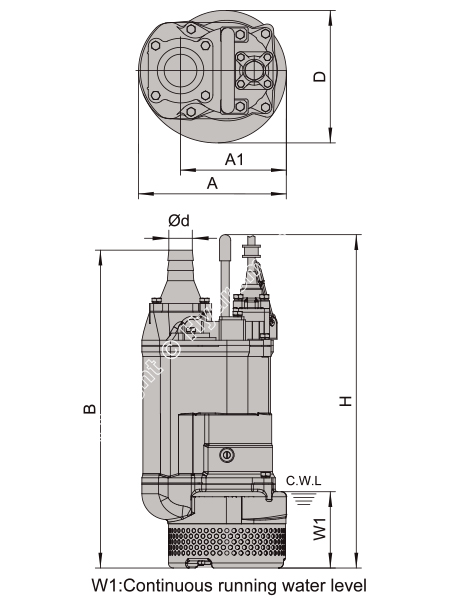 |
|
| Model (50/60Hz) | TBZ22.2 |
| d (mm) | 50 |
| A (mm) | 235 |
| A1 (mm) | 173 |
| B (mm) | 535 |
| D (mm) | 216 |
| H (mm) | 505 |
| W1 (mm) | 120 |
| N.W (Kg) | 39 |
| G.W (Kg) | 43 |
| Packing dimension(mm) | 610x265x265 |
If you're comparing electric submersible sewage pump price and cost across suppliers, it helps to know what actually drives the number. The cost of an electric submersible sewage pump depends on motor power, flow rate, head, discharge size, materials of construction, electrical configuration (voltage, phase, frequency), control options like a float switch, and order quantity. Two pumps with the same "3 HP" label can be priced very differently once you account for seal type, cable length, and casing material — which is also why we don't like quoting a single flat number without knowing your duty point.
As a submersible sewage pump manufacturer and electric submersible sewage pump supplier and factory, Hydroman® quotes based on your actual application — send us your flow, head, and installation details and we'll come back with a configuration and price that's actually built for your job, not a generic listing price.
What is an electric submersible sewage pump? It's a pump designed to operate fully submerged in wastewater, using a sealed electric motor to drive an impeller that moves sewage, effluent, or drainage water containing suspended solids.
How does a submersible sewage pump work? The motor drives an impeller inside the pump's volute casing. The impeller's rotation creates centrifugal force, drawing wastewater in through the inlet and discharging it under pressure through the outlet pipe — all while the pump sits submerged in the liquid it's pumping.
Is a submersible sewage pump suitable for a septic tank? Yes — submersible sewage pumps are commonly used in septic tanks and septic pump chambers to lift effluent to a drain field or to a gravity sewer connection, particularly where the tank sits below the required discharge elevation.
What's the difference between a sewage pump and an effluent pump? A sewage pump is built to handle raw wastewater with a higher solids content, while an effluent pump is typically used for pre-settled or filtered liquid with a lower solids load — the TBZ22.2's hydraulic design is on the sewage-duty end of that spectrum.
Can this 3 HP sewage pump handle solids? Yes. The TBZ22.2's impeller and hydraulic passage are designed to pass soft solids typical of raw sewage and effluent rather than clean water alone — confirm your specific solids size against the pump's rated passage when selecting a configuration.
Can the pump be equipped with a float switch? Yes, the TBZ22.2 can be configured as a submersible sewage pump with a float switch for automatic start/stop control, or supplied for manual/panel-controlled operation depending on your system.
What is the power of this submersible sewage pump? The TBZ22.2 is fitted with a 2.2 kW / 3 HP electric motor.
How much does an electric submersible sewage pump cost? Pricing depends on motor power, flow and head requirement, discharge size, materials, voltage/phase, and any control accessories such as a float switch. Contact Hydroman® with your requirements for a configuration-specific quote.
How do I choose the right sewage pump? Start with your required flow rate and total head, then check your wastewater's solids content against the pump's rated solids passage, and finally confirm the electrical configuration matches your site supply.
How often should a submersible sewage pump be maintained? A basic inspection of the inlet, impeller, seal, and electrical components every few months is typical for continuous-duty applications; heavier sewage or fiber content generally calls for more frequent checks.
Get a Quote for the Hydroman® TBZ22.2 Sewage Pump
Looking for a reliable 2.2 kW / 3 HP electric submersible sewage pump? Send us your required flow rate, head, liquid characteristics, solids size, voltage, and installation conditions, and Hydroman® will help you select a configuration suited to your wastewater application. Contact Hydroman®
Related Pumps

Tobee is specialized in providing solutions for slurry pump, vertical sump pumps, gravel pump, dredging pumps, froth pump, seawater pumps, fire pumps, slurry pump parts and OEM pump parts for your harsh projects.
Top Navigation
Top Navigation
Contact Information
+86 180 3203 4573
+86 311 8722 1317
No. 266, Tianshan St, High-tech Zone, Shijiazhuang City 050000, China.