Hydroman® TBZ23.7 Submersible Pump
When your site is flooding, your pit is filling faster than you can bail it, or a tank needs to come down in a hurry, you don't have time to babysit a pump. The Hydroman® TBZ23.7 is a 3.7 kW (5 HP) submersible centrifugal dirty water pump built for exactly that moment — drop it in, plug it in, and let it move water full of sand, silt, and site debris until the job is done.
It's a direct, drop-in replacement for the KBZ23.7 you may already be running, so if you're standardizing your fleet or simply need a spare that fits your existing hose couplings, mounting brackets, and spare-parts bin, the TBZ23.7 slots straight in — no re-engineering, no adapters, no compromise on performance.
TBZ23.7 Performance: What the Numbers Actually Mean On Site
Specs on a page are one thing — what you actually get in a pit is another. Here's what the TBZ23.7's numbers translate to in practice.
Rated flow and head. At its rated operating point, the TBZ23.7 moves 12 m³/h against 30 m of head. That's the performance you can plan around for a steady, continuous dewatering job — not a peak number that only applies for the first ten minutes.
Maximum flow and maximum head. Under lighter-load conditions (shorter pipe runs, less elevation to fight), the pump can push up to 33 m³/h, and it's capable of generating up to 34 m of head when flow is restricted. These are the outer edges of the performance curve, and they're useful for understanding what the pump can do — but your real-world number will land somewhere between rated and maximum depending on your setup.
What actually determines where you land on that curve is your system, not the pump. Centrifugal pump discharge pressure drops as the length of your discharge hose increases, as elevation gain increases, and as every bend, valve, and coupling adds resistance to the line. A 50 mm discharge run 20 meters horizontally will perform very differently than the same pump pushing water 15 meters straight up through a smaller hose with three tight bends in it. If your actual output seems lower than the rated flow, the pump usually isn't the problem — the pipe run is.
3.7 kW / 5 HP motor. Enough power to handle sustained dewatering without straining, sized correctly for the 50 mm discharge rather than over- or under-powered for it.
Submersible centrifugal construction. You lower it, you plug it in, it runs. There's no separate surface pump housing to protect, no priming chamber to fill, and no exposure to the weather or foot traffic that a surface-mounted unit would face on an active site.
50 mm discharge. Matched to the pump's flow output so you're not restricting performance with an undersized hose, while still staying compact enough for a two-person carry and quick hose changes between jobs.
Impeller passage engineered for solids. The 8.5 mm passage is built to let sand, small stones, and suspended debris pass through the impeller rather than lodge in it. It's designed to significantly reduce clogging on dirty water compared to a clean-water pump — it isn't a claim that it will never clog on anything, and no honest manufacturer should tell you otherwise.
Portable dewatering format. Compact enough to move between excavation pits, sumps, and tanks on the same site without needing a crane or a second crew.
Purpose-built for dirty water, not adapted for it. This isn't a clean-water pump with a bigger inlet bolted on. The impeller geometry, casing clearances, and shaft sealing are all specified around handling suspended solids from the start.
Hydroman® TBZ23.7 Submersible Dirty Water Pump

Key Specifications at a Glance
| Specification | TBZ23.7 |
| Pump Type | Submersible Centrifugal Dirty Water Pump |
| Motor Power | 3.7 kW / 5 HP |
| Discharge Size | 50 mm / 2 in |
| Rated Flow | 12 m³/h |
| Rated Head | 30 m |
| Maximum Flow | 33 m³/h |
| Maximum Head | 34 m |
| Impeller Passage | 8.5 mm |
| Motor Type | Electric Submersible Motor |
| Application | Dirty Water, Drainage, Dewatering |
| Installation | Fully Submersible |
| Interchangeability | 100% compatible replacement for KBZ23.7 |
If you're weighing a centrifugal dirty water pump for sale against other 5 HP options on the market, this table is the one to save — it's what determines whether a pump will actually clear your pit, not just move some water around in it.
If you've ever asked yourself what is a centrifugal water pump, the short answer is: it's a pump that spins water fast enough to push it somewhere else. A rotating impeller inside the pump casing throws water outward by centrifugal force, and that motion is converted into pressure as the water is forced out through the discharge port. No pistons, no diaphragms, no valves clicking open and closed — just a spinning impeller and a steady stream of water.
That's different from what is a dirty water pump, which is a question about the job, not the mechanism. A dirty water pump is any pump — usually centrifugal — engineered to tolerate the sand, grit, mud, and small debris that a clean-water pump would choke on. The TBZ23.7 sits at the intersection of both: it's a centrifugal water pump built specifically to handle dirty, solids-laden water without the impeller jamming or the seal failing after the first hour of use.
A standard clean-water centrifugal pump has tight impeller clearances designed for efficiency on clear water. Push construction runoff or sump water full of grit through one, and you'll be pulling it apart to clear a jammed impeller within a shift. The TBZ23.7's impeller passage is sized specifically for the kind of debris you actually find in a jobsite pit — small stones, sand, and suspended sediment — so it keeps running while a clean-water pump would have already stalled.
Understanding how does a centrifugal water pump work makes it much easier to troubleshoot one when something goes wrong on site, so it's worth walking through in plain terms.
The pump is lowered fully into the water it needs to move — that's the "submersible" part, and it means there's no priming step, no suction hose to bleed air out of, and no surface unit to protect from splash. Water is drawn in through the intake at the base of the pump housing and enters the eye of the impeller, which is the center point of the spinning disc inside the casing. As the motor drives the impeller around, its curved vanes fling the water outward toward the edge of the casing, converting the motor's rotational energy into the water's kinetic energy. According to the Hydraulic Institute, the global standards body for pump design and testing, a centrifugal pump works by using a rotating impeller to increase the fluid's kinetic energy, which is then converted into usable pressure once the water reaches the outer edge of the impeller and is collected in the pump casing, before being pushed out through the discharge outlet.
That pressurized water then travels up the discharge line to wherever you're sending it — a drainage ditch, a tanker, a storm drain — and the pump keeps running until the water level around it drops low enough to shut off, either manually or via an automatic float switch if one is fitted. It's a continuous cycle: submerge, draw in, spin, discharge, repeat, for as long as there's water to move.
| Feature | TBZ23.7 Dirty Water Pump | Standard Clean Water Pump |
| Fluid handled | Water with suspended solids and debris | Relatively clean water |
| Installation | Fully submersible | Often surface-mounted |
| Priming | Not required | Frequently required |
| Debris tolerance | Built for it | Usually very limited |
| Typical use | Dewatering and drainage | Water transfer, irrigation |
| Portability | High — single-unit, submersible | Depends on the design |
If you've been running a clean-water centrifugal pump on a jobsite and burning through impellers or seals every few weeks, this is usually why: the wrong pump for the water it's actually seeing.

Where the TBZ23.7 Gets Used
Construction crews reach for this pump most often for excavation pit and foundation trench dewatering — keeping a footing dry enough to pour, or keeping an open trench workable through a rain delay. Facilities and industrial sites use it for sump and collection pit drainage, particularly where sediment settles out and a standard sump pump would clog. It also does steady work in basement and underground drainage, tank and reservoir emptying when a tank needs to come offline for inspection or maintenance, and general industrial drainage wherever water on the floor is more than just clean rinse water.
It shows up occasionally in agricultural settings too. A centrifugal water pump for irrigation context is a legitimate secondary use — moving water from a pond, ditch, or holding tank into a field system — but it's worth being clear that the TBZ23.7 is engineered first as a drainage and dewatering pump for dirty water, not as a dedicated irrigation pump. If your primary need is clean irrigation water transfer at high volume, it's worth talking to us about which model in the Hydroman range fits that use case best; if your water source has sediment in it, this is very much the right tool.

How to Choose a Centrifugal Dirty Water Pump
Picking the right pump is less about finding the biggest number on the spec sheet and more about matching the pump to your specific site conditions. Start with the flow rate you actually need, in m³/h or L/min, based on how quickly water is entering the space you're draining — not how much the pump could theoretically move. From there, work out the head you'll need to overcome: the vertical lift from the pump to the discharge point, plus friction losses from your pipe length and every fitting and bend along the way.
Check that your discharge pipe size matches the pump's outlet — the TBZ23.7 uses a 50 mm discharge, and stepping down to a smaller hose will choke your flow regardless of what the pump is rated for. Confirm the impeller passage is sized for the actual solids you're dealing with; sand and fine grit behave very differently from small stones or larger debris. Then confirm your power supply — voltage, phase, and available capacity — matches what the motor requires, and think through the installation depth and duty cycle you're planning for, since a pump running continuously in a deep pit has different demands than one cycling on and off in a shallow sump.

How to Use a Dirty Water Pump
Getting the most out of any dirty water pump comes down to a handful of habits that are easy to skip when you're in a hurry and easy to regret later.

TBZ23.7 Installation Guide
Before you lower the pump, inspect the casing, cable, and inlet for any shipping damage or debris.
1. Prepare your discharge line first, making sure the hose or pipe diameter matches the 50 mm outlet and that the run is as direct as your site allows — every unnecessary bend costs you head.
2. Position the pump on stable, level ground at the bottom of the pit or sump, away from loose debris that could be drawn into the inlet.
Connect the power supply only after the pump is positioned and the discharge line is secured, and always route the cable clear of foot traffic and sharp edges.
3. Start the pump and monitor it for the first few minutes, checking that discharge flow looks normal and that the motor isn't laboring.
4. When the job is done, shut the pump down before disconnecting power, then lift it clear of the water for cleaning and storage.

Maintenance of the TBZ23.7 Centrifugal Dirty Water Pump
A pump that's cleaned and checked after every use will outlast one that gets thrown in the truck bed still wet.
What Can Cause a Centrifugal Pump to Not Deliver Water?
This is one of the most common calls we get, and it's almost always one of a handful of causes.
| Problem | Likely Cause | What to Check |
| Pump won't deliver water | Blocked inlet or air lock | Clean the inlet; confirm the pump is fully submerged |
| Flow is lower than expected | Discharge pipe restriction or undersized hose | Check hose diameter and length against the pump's rated discharge |
| Head seems low | Excessive system resistance | Review pipe layout, elevation, and number of fittings |
| Pump is vibrating | Impeller obstruction or wear | Stop the pump immediately and inspect the impeller |
| Motor is overheating | Overload or restricted cooling flow | Confirm correct voltage and that the pump is fully submerged |
| Motor runs but no water moves | Incorrect installation or reversed rotation | Check pump positioning and discharge connection |
If you've worked through this list and the pump still isn't performing, it's worth having someone check impeller wear directly — worn vanes lose their ability to build pressure long before they look obviously damaged.
It's worth being precise about categories here, because the terms get used loosely in the field. A dirty water pump like the TBZ23.7 is built for grit, sand, and suspended solids — it is not a sewage pump, which is engineered specifically for solids handling and often for softer, larger solids that need to pass through without shredding.
It's also not the same as a submersible slurry pump, which is built for far higher solids concentrations and more abrasive, heavier material than typical construction dewatering ever produces — if that's your application, ask us about Hydroman's dedicated slurry pump range rather than pushing this model past what it's designed for.
And as a centrifugal pump, it works fundamentally differently from a positive displacement pump: a centrifugal design gives you flow that varies with system pressure, while a positive displacement pump delivers a fixed volume per cycle regardless of pressure, which suits very different applications like metering or high-viscosity fluids.
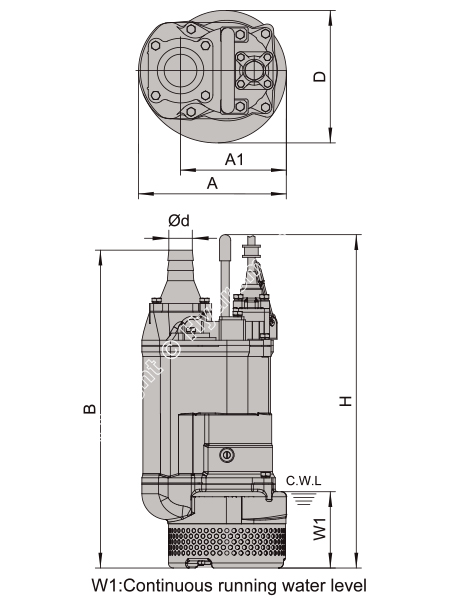 |
|
| Model (50/60Hz) | TBZ23.7 |
| d (mm) | 50 |
| A (mm) | 283 |
| A1 (mm) | 208 |
| B (mm) | 628 |
| D (mm) | 252 |
| H (mm) | 629 |
| W1 (mm) | 150 |
| N.W (Kg) | 63 |
| G.W (Kg) | 68 |
| Packing dimension(mm) | 710x320x295 |
You're not just buying a motor and an impeller — you're buying the ability to keep a job moving when water shows up where it shouldn't be. Hydroman® builds the TBZ23.7 for stable performance across its full duty cycle, not just at the number printed on the box, with a submersible construction designed to handle the day-to-day reality of a working jobsite rather than a controlled test bench.
It's available across multiple electrical configurations to match different site power setups, and because it's built as a direct match for the KBZ23.7, replacement parts and technical support are straightforward whether you're maintaining one unit or standardizing a fleet. We support OEM and customized configurations for buyers with specific requirements, and we work with both single-unit orders and bulk purchasing for distributors and rental fleets.
Keeping a pump running long-term is mostly about keeping the wear parts on hand. The components most worth stocking are the impeller, pump casing, mechanical seal, motor components, power cable, and standard fasteners. Wear components — particularly the impeller and seal — are the parts most affected by abrasive, dirty water and the ones you'll replace most often over the pump's service life. Because the TBZ23.7 is a full match for the KBZ23.7, existing spare parts inventory for that model carries over directly.
What is a centrifugal dirty water pump? It's a submersible pump that uses a spinning impeller to move water containing sand, silt, or debris — built with wider impeller clearances and tougher sealing than a standard clean-water pump so it can handle solids without clogging or failing prematurely.
How does a centrifugal dirty water pump work? Water enters through the inlet at the base of the submerged pump, is accelerated outward by the spinning impeller, and that kinetic energy converts to pressure as the water is forced through the discharge outlet and up the hose or pipe.
What can a dirty water pump be used for? Construction site dewatering, sump and pit drainage, basement and underground drainage, tank and reservoir emptying, general industrial drainage, and — as a secondary use — moving irrigation water from a sediment-containing source.
Can the TBZ23.7 handle dirty water? Yes — it's purpose-built for it, with an 8.5 mm impeller passage sized specifically for sand, small stones, and suspended debris typical of construction and drainage sites.
What is the flow rate of the TBZ23.7? 12 m³/h at its rated operating point, with a maximum flow of up to 33 m³/h under lighter system resistance.
What is the maximum head of the TBZ23.7? Up to 34 m maximum head, with a rated head of 30 m at the pump's standard operating point.
Can the TBZ23.7 be used for construction site dewatering? Yes — this is one of its primary applications, and it's engineered specifically for the sediment-laden water typical of excavation pits, foundation trenches, and construction drainage.
Request a Quote for the Hydroman® TBZ23.7
Looking for a 3.7 kW centrifugal dirty water pump for your drainage application, a direct KBZ23.7 replacement, or pricing on a bulk order? Contact Hydroman® for full specifications, current pricing, spare parts availability, and technical support.
Related Pumps

Tobee is specialized in providing solutions for slurry pump, vertical sump pumps, gravel pump, dredging pumps, froth pump, seawater pumps, fire pumps, slurry pump parts and OEM pump parts for your harsh projects.
Top Navigation
Top Navigation
Contact Information
+86 180 3203 4573
+86 311 8722 1317
No. 266, Tianshan St, High-tech Zone, Shijiazhuang City 050000, China.